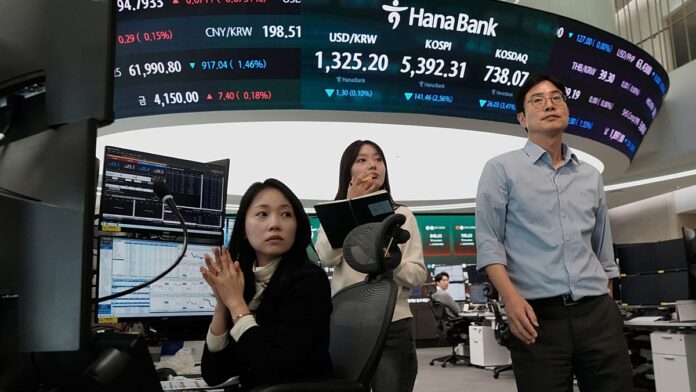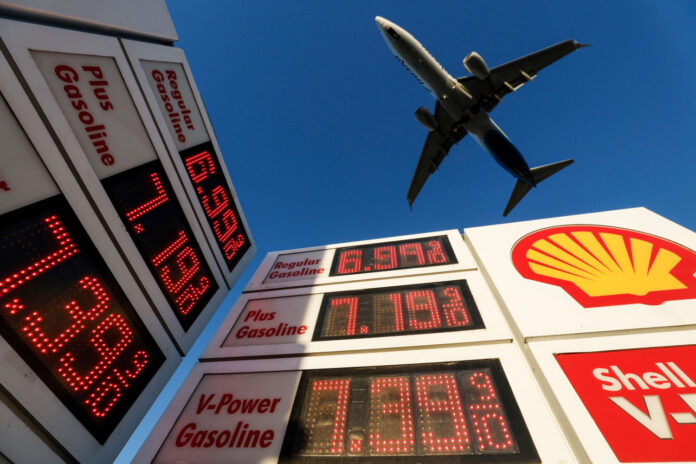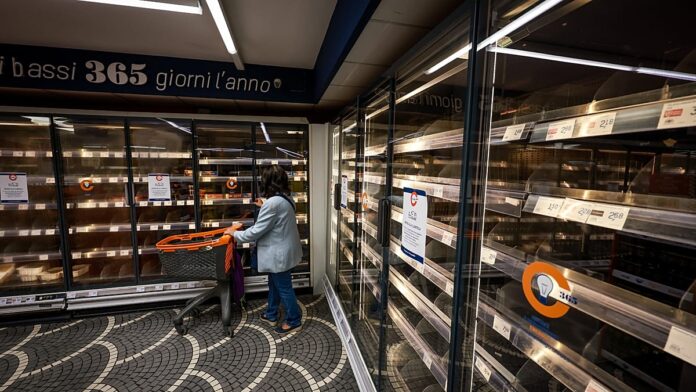

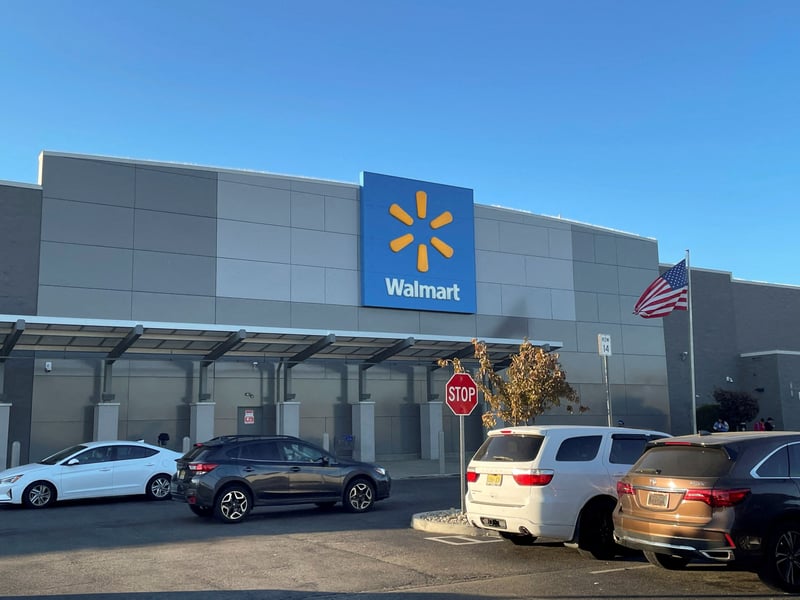
NEW YORK — Somewhere in America last quarter, a shopper stood in a Walmart aisle and put something back. Enough of them did it that the retailer’s chief financial officer, John David Rainey, went looking for a reason and found one at the pump. When fuel gets above $4 a gallon, Rainey told Al Jazeera, there is probably a psychological effect, and shoppers start making trade-offs. Walmart’s US same-store sales grew 2.6 per cent, its slowest quarter in six years, and the stock fell 9.6 per cent in a single session.
Two days later, the Dow Jones Industrial Average rose 517.80 points.
The index finished Friday at 53,277.01, up 0.98 per cent, and the distance between those two facts is the most useful thing an investor can understand about this market. The Dow did not climb because the American economy got better last week. It climbed because a handful of very expensive shares moved, inside an index that has never cared how large a company is, only what one of its shares costs.
Dow Jones Today: The Index Is Up and the Nasdaq Is Not
Monday’s session is making the argument better than Friday’s did. At 10:41am in New York the Dow was at 53,432.43, up 0.29 per cent, while the Nasdaq 100 was down 0.97 per cent at 29,024.90 and the S&P 500 was off 0.21 per cent. That is a spread of more than 1.2 percentage points between the blue-chip index and the megacap technology index inside a single morning, in the same direction as last week and for the same reason.
| Index | Monday, 10:41am | Session | Friday close | Last week | 2026 to date |
|---|---|---|---|---|---|
| Dow Jones Industrial Average | 53,432.43 | +0.29% | 53,277.01 | -455.40 (-0.8%) | +5,213.72 (+10.8%) |
| S&P 500 | 7,658.41 | -0.21% | 7,674.37 | -111.39 (-1.4%) | +828.87 (+12.1%) |
| Nasdaq composite | 26,036.19 | -0.55% | 26,180.45 | -548.71 (-2.1%) | +2,938.46 (+12.6%) |
| Nasdaq 100 | 29,024.90 | -0.97% | 29,308.86 | -2.4% | — |
| Russell 2000 | 3,003.96 | -0.46% | 3,017.87 | -50.54 (-1.6%) | +535.96 (+21.6%) |
| Monday figures are live intraday quotes taken at 10:41am New York time, not settlements, and will move before the close. Friday columns are settled closes. The Dow’s 52-week high, set earlier this month, is 54,744.33, which leaves it 2.4 per cent below the record as of this reading. | |||||
Three scheduled events will set the index’s direction into September. Nvidia, a Dow member since 2024, reports second-quarter results on Wednesday after the close. The Federal Reserve’s Jackson Hole symposium opens Thursday. July’s personal consumption expenditures price index, the Fed’s preferred inflation gauge, lands Friday. Ahead of all three, the money is coming out of the crowded trades first: memory and storage names are the worst performers on the Nasdaq this morning, with SanDisk down more than 9 per cent and Micron off nearly 7.
One Bank Delivered 44 Per Cent of Friday’s Rally
Goldman Sachs did most of the work. The bank rose 3.73 per cent on Friday, and because one Goldman share costs $1,039.28, more than any other Dow member, that percentage became $37.33 of index price. The Dow is price-weighted, so a dollar of share price is worth the same to the index whether it belongs to a $700 billion company or a $70 billion one.
By Eastern Herald’s calculation, using the divisor of 0.1627 implied by the 30 component closes and Friday’s index level, Goldman alone was worth roughly 229 Dow points, about 44 per cent of the day’s gain. Four stocks out of thirty produced 72 per cent of the move.
| Company | Share price | Friday change | Est. Dow points | Share of the +517.80 |
|---|---|---|---|---|
| Goldman Sachs (GS) | $1,039.28 | +3.73% | +229 | 44.3% |
| Caterpillar (CAT) | $827.90 | +1.53% | +77 | 14.9% |
| Amgen (AMGN) | $439.33 | +1.29% | +34 | 6.6% |
| Visa (V) | $371.04 | +1.45% | +33 | 6.3% |
| UnitedHealth (UNH) | $390.11 | +1.37% | +32 | 6.2% |
| Honeywell (HON) | $215.90 | -1.11% | -15 | drag |
| Nvidia (NVDA) | $214.72 | -0.98% | -13 | drag |
| Apple (AAPL) | $309.35 | -0.63% | -12 | drag |
| Point contributions are Eastern Herald estimates derived from the 30 component closes and an implied divisor of 0.1627, not exchange-published attributions. The full component set sums to 511.5 points against the official 517.80; the residual reflects rounding in the implied divisor rather than a missing name. Treat the individual figures as close estimates. | ||||
Widen the frame to the week and the picture inverts. The Dow lost 455.40 points, or 0.8 per cent. What flatters it is the comparison: the Nasdaq composite shed 2.1 per cent over the same five sessions. The Dow’s relative resilience is the whole story of August, and it is not a compliment. Money is not buying the Dow. It is selling duration, and the Dow happens to be where the least duration lives.
The Bond Market Is Setting the Price
The 30-year Treasury yield touched 5.27 per cent last week, its highest since 2007, and the 10-year sat at 4.73 per cent against 4.2 per cent at the start of the year. Behind those numbers is a national debt that has passed $40 trillion for the first time, with interest costs on track to overtake Medicare as the single largest line in the federal budget. Al Jazeera’s accounting of who actually holds that paper is worth reading alongside the yield chart, because the answer is increasingly domestic buyers who want to be paid more for the privilege.
Both yields came in on Monday, the 10-year to 4.70 per cent and the 30-year to 5.24 per cent. That is not relief so much as the other half of the same trade: money leaving technology has to go somewhere, and this morning it went into Treasuries and gold at once.
Bessent tried to force that outcome last week and could not. On Wednesday the Treasury more than doubled the ceiling on its long-bond buybacks, from $2 billion to at least $4 billion, an unusual intervention from a department that normally leaves the long end alone. It worked for about a day. Yields erased the entire decline by Thursday, and Eastern Herald reported that gold pushed to $4,600 as the bond market rejected the Treasury’s fix. Gold was at $4,730.40 an ounce on Monday morning, up another 1.1 per cent, which is not the behaviour of a market that believes the problem is solved.
Warsh Arrives at Jackson Hole on Friday
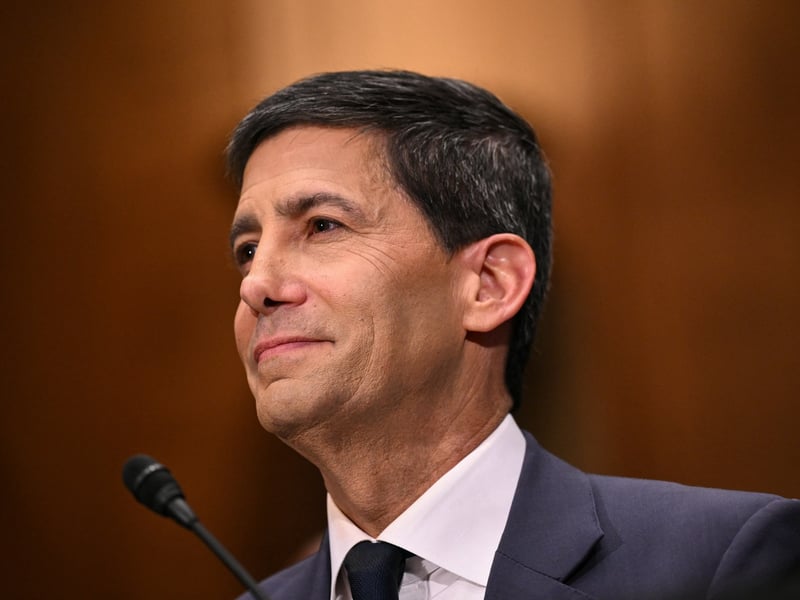
The Fed chair, sworn in only in May, arrives having already cut the central bank’s policy statement from 341 words to 132 and abandoned forward guidance altogether. Consumer inflation is running at 3.4 per cent. Traders are no longer certain the next move is a cut. The Kansas City Fed has set this year’s symposium for August 27 to 29 under the theme of financial innovation and payments, which is not what the bond market wants to hear about.
Tariffs Reach the Dow’s Industrial Core
Talks with Ottawa broke down on Friday night, and 50 per cent duties on roughly $20 billion of Canadian goods, including dairy, alcohol, cement and hockey equipment, took effect immediately after midnight, as Eastern Herald detailed when Carney confirmed the talks had failed. The prime minister, who said Canada would match the tariffs dollar for dollar and would not let any nation determine its future, has set retaliation for September 8 on steel, dairy, appliances, farm equipment, pulp and paper and electronics. NPR reported that Carney blamed last-minute American changes to the terms, which he called unfair and uneconomic.
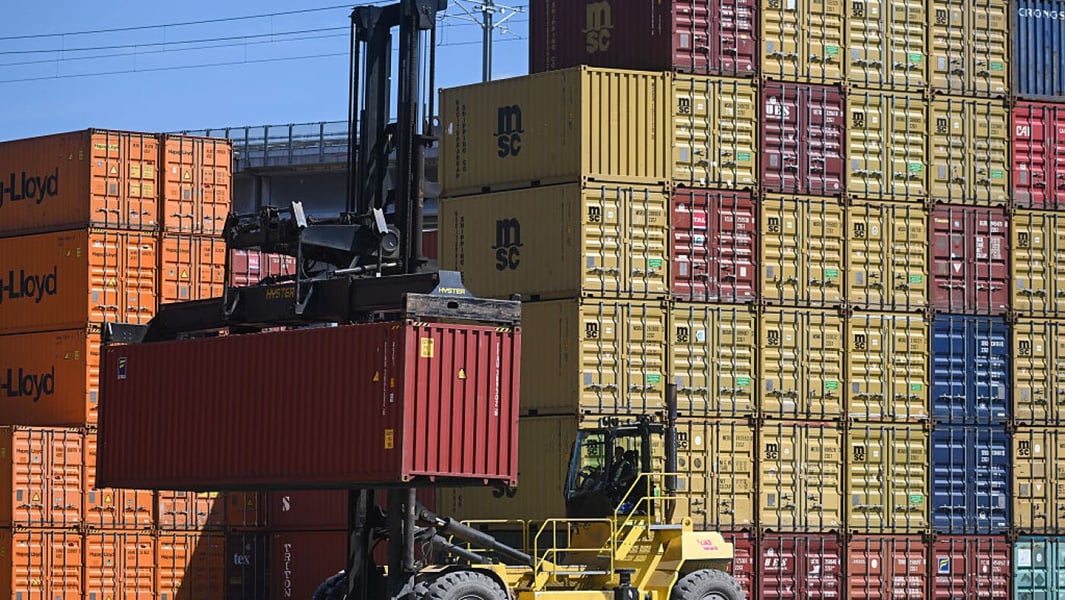
For the Dow the arithmetic is direct. Caterpillar, Boeing, 3M and Honeywell all sell into supply chains that cross that border, and all four underperformed last week. The index’s industrial core is the part of the American market most exposed to a tariff regime that now changes by press conference.
Iran Sanctions, Oil and the American Consumer
Washington’s other front is Iran. Bessent, who has described the six-month war as entering its endgame, is expected to unveil secondary sanctions aimed at the countries and firms that buy, finance and ship Iranian oil, layered on top of an existing naval blockade.
Crude fell anyway, and kept falling once New York opened. West Texas Intermediate was down 2.4 per cent at $85.01 and Brent off 1.9 per cent at $92.58 by late morning, with traders pointing to roughly 40 tankers moving through the Strait of Hormuz on Friday as evidence the barrels are still flowing. Tehran, for its part, has warned other governments against joining the campaign. Eastern Herald’s crude board for Monday tracks the benchmarks through the session.
That is the supply side. The demand side is the Walmart aisle, and it is the part of this story with no scheduled announcement attached to it. US retail sales fell 0.6 per cent in July, the largest drop since May 2025. Foot traffic into Walmart stores grew 1.5 per cent, down from 3 per cent.
What This Column Cannot Tell You Yet
Which of these forces the Dow is actually tracking is not knowable this morning. The equity volatility market says almost nothing is wrong: the VIX was near 15.9 at midday, a level associated with calm, while the 30-year Treasury trades at yields last seen before the financial crisis. One of those two markets is mispriced, and the gap has persisted long enough that the claim the bond market is wrong has become a position rather than an observation.
Nor can we say how much of Friday’s rally was a real rotation into cyclicals and how much was a single bank’s earnings-driven repricing amplified by an index construction rule written in 1896. The component arithmetic above narrows the question. It does not answer it. Nvidia on Wednesday and Warsh on Friday will not settle it either. They will only tell us which way the error runs.