NEW YORK — Micron has already sold next year. Not forecast it, not guided to it. The company has told investors it completed agreements on price and volume for its entire calendar 2026 high-bandwidth memory supply, its newest HBM4 parts included. The order book for the year is closed.
On Monday the market took 7.1 per cent off the stock anyway.
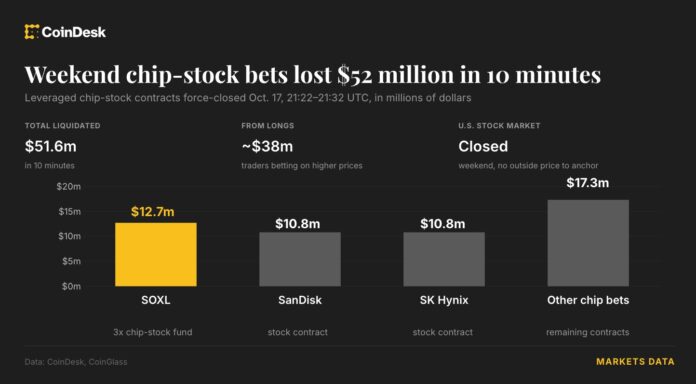
Micron traded at $897.77 shortly after 11:25am in New York, down from Friday’s $966.78 and second only to SanDisk, which fell harder still, among the day’s semiconductor casualties. The Philadelphia Semiconductor Index fell 3.54 per cent, which leaves the American chip benchmark 22.7 per cent below its 52-week high and in a bear market by the conventional definition. The Dow, meanwhile, was up 0.26 per cent, and our Nasdaq column for Monday found roughly half of the largest Nasdaq companies higher on the day.
So something is being repriced, and it is worth being precise about what. It is not the volume Micron will ship in 2026, because that is contracted. It is not the price it will receive, because that is agreed. What moved on Monday is the rate at which the market discounts those future dollars, and the willingness of investors to hold a crowded position into Nvidia’s results on Wednesday and Kevin Warsh’s Jackson Hole debut on Friday.
MU Stock Today: The Fall, and the Distance It Fell From
A 7 per cent day sounds like damage. Put it against the twelve-month range and it looks like something else.
| Instrument | Price | Session | Below 52-week high | Above 52-week low |
|---|---|---|---|---|
| Micron Technology (MU) | $897.77 | -7.14% | -28.5% | +686% |
| SanDisk (SNDK) | $1,459.99 | -8.53% | -38.0% | +3,073% |
| Intel (INTC) | $86.58 | -3.87% | -39.2% | +266% |
| Nvidia (NVDA) | $209.31 | -2.52% | -11.5% | +28% |
| PHLX Semiconductor Index (SOX) | 11,324.55 | -3.54% | -22.7% | +106% |
| Nasdaq 100 | 29,003.41 | -1.04% | -5.7% | +27% |
| Dow Jones Industrial Average | 53,414.16 | +0.26% | -2.4% | +19% |
| Live intraday quotes at 11:26am New York time, not settlements. Distance from the 52-week high and low is Eastern Herald’s calculation from the quoted price. One caveat on SanDisk: it was separated from Western Digital in 2025, so its trailing 52-week low sits in the earliest days of its independent listing and the percentage above it should not be read as an ordinary twelve-month return. | ||||
Micron is 28.5 per cent below its high and roughly seven times its 52-week low. Both facts are true at once, and any account of Monday that uses only one of them is selling a position rather than describing a market.

What Micron Has Actually Reported
The numbers behind that contracted order book are not a forecast. They are filed history, and they are difficult to overstate.
| Line item | Q3 FY2026 ($m) | Q3 FY2025 ($m) | Change |
|---|---|---|---|
| Revenue | 41,456 | 9,301 | +346% |
| Cost of goods sold | 6,400 | 5,793 | +10% |
| Gross margin | 35,056 | 3,508 | +899% |
| Gross margin as a share of revenue | 84.6% | 37.7% | +46.9 pts |
| Research and development | 1,316 | 965 | +36% |
| Operating income | 33,318 | 2,169 | +1,436% |
| Operating margin | 80.4% | 23.3% | +57.1 pts |
| Figures as reported. Percentages and margin ratios are Eastern Herald’s calculation from the reported amounts. Over the nine months to May 28, revenue was $78,959 million against $26,063 million and operating income $55,589 million against $6,116 million. Micron’s fiscal year ends in late August, so this is the third quarter of fiscal 2026, not a calendar quarter. | |||
Revenue more than four times what it was a year earlier, on a cost of goods sold that rose 10 per cent. That is the arithmetic of a shortage: the same wafers, sold for very much more. A gross margin of 84.6 per cent is not a semiconductor number at all, it is a software number, and Micron is posting it while running fabrication plants.
The figures come from the quarterly report Micron filed with the Securities and Exchange Commission. They describe the quarter that ended in May, before any of the 2026 contracts discussed above have shipped.
Why the Order Book Is Not the Variable
The memory industry is a three-company oligopoly. Micron, Samsung Electronics and SK Hynix together account for roughly 95 per cent of global DRAM production, and the AI buildout has pushed demand for high-bandwidth memory past what those three can supply. Micron’s own materials put HBM at a market of about $35 billion in 2025 growing towards $100 billion by 2028, a milestone it has pulled forward by two years against its previous outlook.
Capacity is the binding constraint and it does not respond quickly. Micron has guided capital spending above $25 billion for fiscal 2026 and signalled a meaningful step up in fiscal 2027, with construction-related spending alone rising by more than $10 billion year over year. Fabs commissioned now do not reach volume production until late 2027 or 2028. Nothing that happened on Monday changes a single wafer of that.
The practical consequence is showing up in Nvidia’s cost base rather than Micron’s. Fortune reported last week that Nvidia’s customers have been told server prices are rising more than 15 per cent on systems shipping early next year, and the reason given was memory cost. Nvidia did not comment on that reporting and the sources were unnamed, which is worth saying rather than glossing. If it is accurate, it is Micron’s pricing power turning up on somebody else’s invoice.
The Bear Case Has a Name, and It Is Chinese
The argument against all of this is supply from outside the oligopoly. ChangXin Memory Technologies, the Chinese DRAM maker, listed in Shanghai in July and its shares rose 466 per cent on the first day of trading, an outcome that says as much about Chinese retail appetite as about capacity. The relevant question is not the share price. It is whether CXMT can produce at a bit cost and a quality level that touches the HBM tier, and on the public record it cannot do so yet.
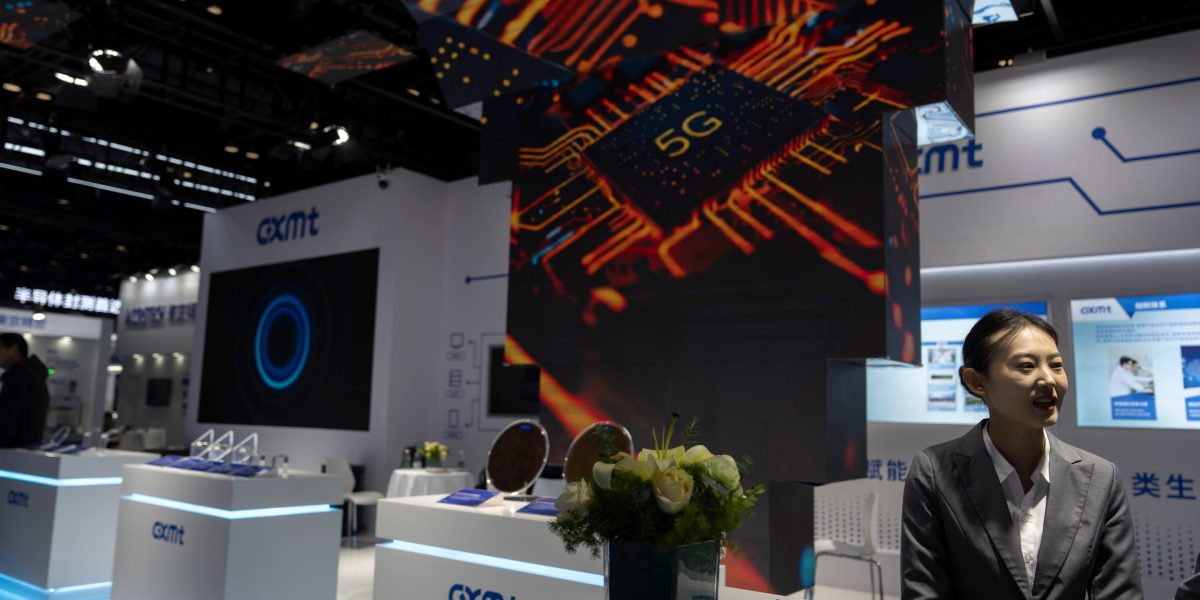
That is the honest state of the argument. Chinese supply is a real medium-term threat to commodity DRAM and a speculative one to high-bandwidth memory. Investors who sold Micron on Monday were not, on the evidence of the tape, distinguishing between those two.
A margin of 84.6 per cent is also its own argument for competition. Returns like that are what draw capital into an industry, and the reason they persist for now is that new fabrication capacity takes three to four years to build. The bear case is not that CXMT is competitive today. It is that a margin this wide is an invitation.
Eastern Herald has covered how violently this sector reprices when the balance shifts, including the day an SK Hynix miss triggered South Korea’s worst stock market day on record, and the wider pattern as AI infrastructure stocks came apart while Apple crossed $5 trillion.
What This Column Cannot Tell You Yet
We cannot tell you what Micron has agreed to charge. The company says price and volume are settled for calendar 2026; it has not published the price. Without it, nobody outside the contract can model 2026 gross margin with confidence, and anyone presenting a precise 2026 earnings figure is extrapolating from a number they do not have.
We also cannot separate Monday’s two possible sellers. A fund trimming a crowded semiconductor position before Wednesday night and a fund exiting the memory cycle outright produce the same red candle. The first is noise and reverses within a week. The second is the top. Nvidia’s gross margin on Wednesday will say more about which it was than anything Micron does between now and its own results.