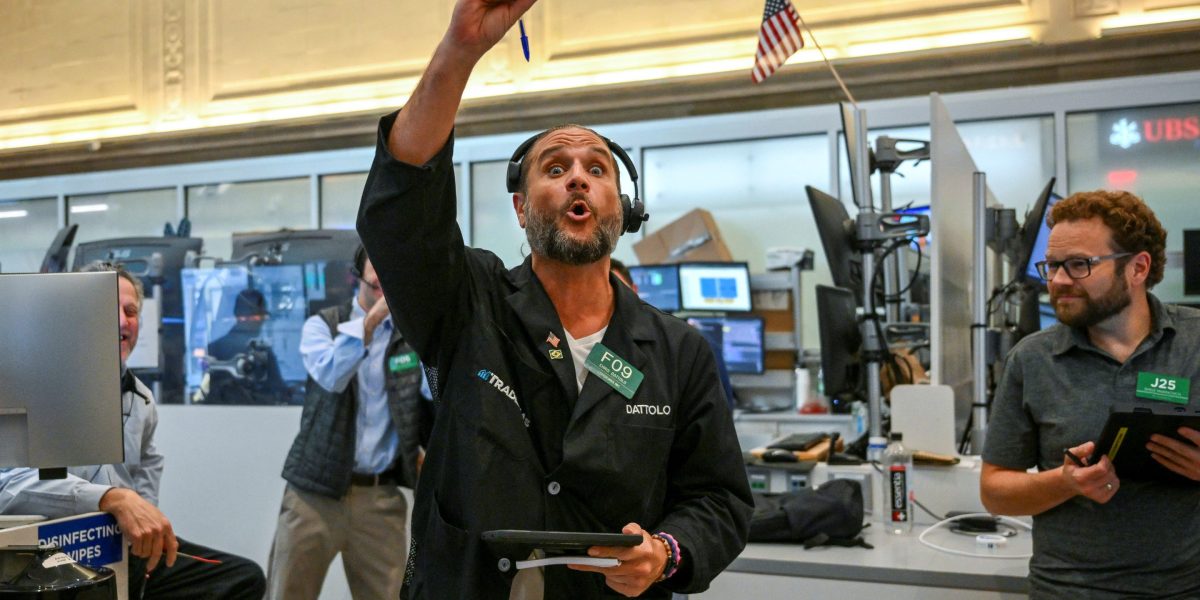

NEW YORK — Costco rose. So did Alphabet, Amazon, Booking Holdings, Mondelez and Microsoft. Of the thirty-two largest Nasdaq companies Eastern Herald checked shortly after 12:35pm in New York, fifteen were higher on the day and the middle stock in the sample was down just 0.13 per cent.
The Nasdaq 100 was down 0.64 per cent.
That gap is the entire session. An index falling five times as fast as its median constituent is not describing a market in retreat. It is describing a market where a small number of very large positions are being sold hard enough to drag everything else with them, and on Monday those positions were semiconductors and memory.
Nasdaq Today: The Indices, and What They Disagree About
| Index | Level | Session |
|---|---|---|
| Nasdaq composite | 26,092.29 | -0.34% |
| Nasdaq 100 | 29,122.03 | -0.64% |
| S&P 500 | 7,664.92 | -0.12% |
| Dow Jones Industrial Average | 53,414.36 | +0.26% |
| Russell 2000 | 3,002.24 | -0.52% |
| PHLX Semiconductor Index (SOX) | 11,438.92 | -2.57% |
| Live intraday quotes, not settlements. The composite holds roughly 3,000 listings and the Nasdaq 100 the largest non-financial hundred. The composite falling half as fast as the 100 means the damage sits in the biggest names, not the long tail. | ||
The composite fell 0.34 per cent, the Nasdaq 100 fell 0.64 per cent. Those two numbers are measuring the same market and disagreeing about it, and the disagreement is informative: the composite carries roughly three thousand companies, the 100 carries the largest non-financial names. When the narrower index falls faster, size is the problem.
The Breadth Check
Headline index moves hide this, so we counted. Across thirty-two of the largest Nasdaq constituents, fifteen were advancing and seventeen declining, with a median move of minus 0.13 per cent. That is close to an even session at the company level.
| Falling hardest | Session | Rising | Session |
|---|---|---|---|
| SanDisk (SNDK) | -5.39% | Costco (COST) | +2.28% |
| Micron Technology (MU) | -4.96% | Alphabet (GOOGL) | +1.84% |
| Advanced Micro Devices (AMD) | -2.76% | Booking Holdings (BKNG) | +1.74% |
| Lam Research (LRCX) | -2.63% | Amazon (AMZN) | +1.66% |
| Intel (INTC) | -2.60% | Mondelez (MDLZ) | +1.28% |
| Sample: AAPL, MSFT, NVDA, AMZN, META, GOOGL, TSLA, AVGO, COST, NFLX, AMD, PEP, ADBE, CSCO, INTC, QCOM, TXN, AMAT, MU, INTU, BKNG, ISRG, LRCX, PANW, ADP, SBUX, GILD, MDLZ, REGN, VRTX, PLTR, SNDK. Result: 15 advancing, 17 declining, median minus 0.13 per cent. This is a disclosed sample of large constituents, not the full Nasdaq 100 and not an exchange-published advance-decline line; treat it as an indication of where the weight sits rather than a market-wide breadth statistic. | |||
Every one of the five worst names in that sample is a chip or storage company. Four of the five best are not technology hardware at all. The Nasdaq did not have a bad day. Semiconductors had a bad day inside it.
Why the Selling Is Where It Is
The reason is calendar, not fundamentals. Nvidia reports second-quarter results after the close on Wednesday, the Federal Reserve Bank of Kansas City’s Jackson Hole economic symposium opens on Thursday, and July’s personal consumption expenditures price index, published by the Bureau of Economic Analysis, lands on Friday. Positions built on cheap money and AI capital expenditure are the most exposed to all three, and they are being trimmed first.
What makes Monday unusual is that the trimming is happening in names whose contracted revenue arguably improved this month, not deteriorated. Micron has already agreed price and volume on its entire 2026 high-bandwidth memory supply. SanDisk told investors eleven days ago to expect operating margins near 75 per cent from fiscal 2028, underpinned by contracts covering two-thirds of its bits. Neither of those claims was contradicted on Monday. Both stocks fell about 5 per cent.
Nvidia itself is down into a number it has already published, having guided to $91 billion of revenue for this quarter back in May. And Intel now trades below the $95 at which it sold $23 billion of new stock two weeks ago.
The Options Market Agrees the Risk Is Concentrated
The cleanest confirmation comes from volatility pricing. The Cboe Nasdaq 100 volatility index stood at 22.62 on Monday against 15.66 on the VIX, the equivalent gauge for the S&P 500. That is a ratio of 1.44, meaning options traders are paying a 44 per cent premium to insure technology exposure over broad-market exposure.
At the same time 15.66 on the VIX is a low number in absolute terms, a long way below its 52-week high. The market is not frightened. It is frightened about one sector and relaxed about everything else, which is a distinction the headline index level cannot express.
The Dow made the same point from the other side, rising 0.26 per cent while all of this happened. Our Dow column for Monday traces where that money went.
What This Column Cannot Tell You Yet
Our breadth count is a sample of thirty-two large constituents, chosen for size and disclosed above. It is not the full Nasdaq 100 and it is not an exchange advance-decline line covering all three thousand composite listings. A genuine market-wide breadth reading might be better or worse than what we found, and we would rather say that than imply a precision the method does not have.
The larger unknown is whether Monday’s split holds. A session where money rotates out of chips and into Costco and Alphabet can be the start of a healthy broadening, or it can be the first stage of a decline that reaches everything once Nvidia reports. The same tape supports both readings. Wednesday evening will start to separate them, and Friday morning in Wyoming will finish the job.