
LONDON — The morning before Ukraine’s Independence Day celebrations reached their peak in Kyiv, Moscow delivered its assessment of what was coming. Russia would identify and gather targeting intelligence on Ukrainian missile production facilities before any manufacturing line became operational, Kremlin spokesperson Dmitry Peskov announced — a threat aimed directly at what Britain’s prime minister was flying to Kyiv to offer.
On August 24, 2026, Prime Minister Andy Burnham made his first foreign trip as Britain’s leader to Kyiv, where he announced the most sensitive weapons technology transfer in the Ukraine conflict to date: Britain would authorise defence company MBDA to share classified technical data on the components it supplies for the SCALP cruise missile — known in British service as Storm Shadow — enabling Ukraine to produce the weapon domestically. By that point, Russia had already recalled its ambassador from London without naming a replacement.
The SCALP missile carries a warhead of approximately 450 kilograms and has a range exceeding 250 kilometres. It flies at low altitude along pre-programmed terrain-following routes to avoid radar detection, and operates in any weather, day or night, against hardened targets — command bunkers, logistics depots, naval facilities. Ukraine has deployed versions of the weapon supplied by Britain and France since 2023, using them against Russian chemical plants, oil refineries, and the Black Sea naval headquarters in Sevastopol. What Burnham offered was something different: the industrial knowledge to manufacture the missile rather than simply fire it.
Peskov characterised the announcement in a statement as “fuel on the fire” and accused Britain of attempting “to prevent any progress in the peace process.” The threat to gather targeting intelligence on production sites was explicit, though Russia did not identify specific facilities. Douglas Barrie of the International Institute for Strategic Studies assessed that establishing cruise missile production typically requires years rather than months, even under favourable conditions. Ukraine faces additional complications: component supply chains that cross multiple countries, software integration requirements, and US-origin technology that may require Washington’s separate sign-off.
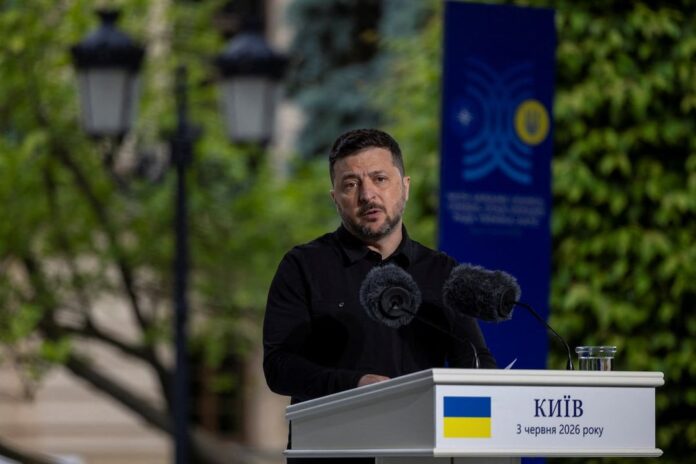
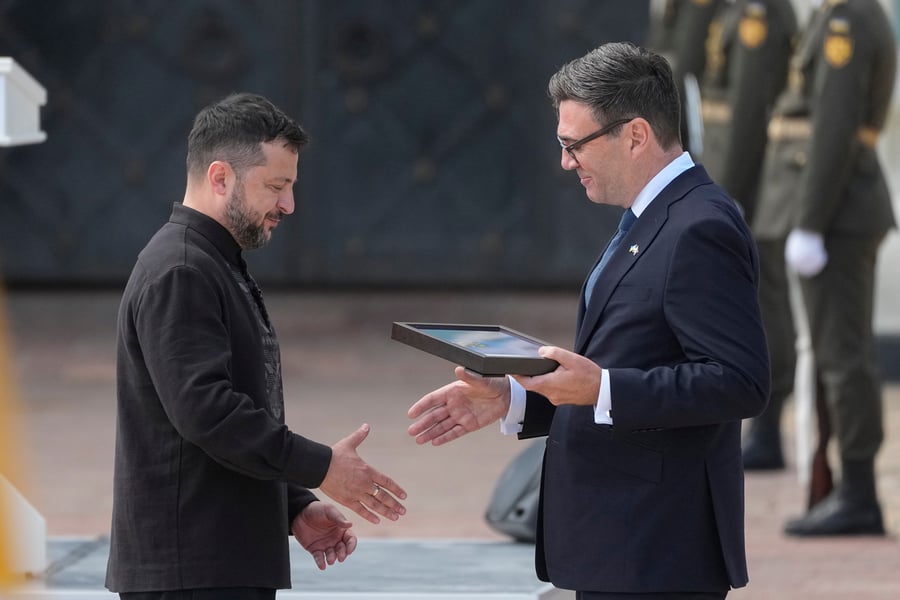
Burnham arrived in a Kyiv crowded with Western leaders. European Council President Antonio Costa, Nordic and Baltic heads of state, Moldova’s President Maia Sandu, and Luxembourg’s Prime Minister Luc Frieden had all converged on the Ukrainian capital for the country’s 35th Independence Day — the fourth the country has marked under Russia’s full-scale military operation. At a commemorative ceremony, Burnham shook hands with President Volodymyr Zelenskyy beneath Ukrainian flags. “Four and a half years of Russia’s full-scale invasion aimed at crushing independence we celebrate here,” Burnham said at the ceremony. “But you prove they failed.”
Alongside the missile announcement, Britain and Ukraine signed a new military partnership granting the UK access to Ukraine’s AI Avengers Labs battlefield dataset — the first foreign nation to receive that access. The AI system aggregates sensor data, drone feeds, and targeting information into a unified platform used by Ukrainian commanders. Britain’s access opens a channel of intelligence-sharing that runs in both directions: Ukraine gains missile production knowledge, Britain gains real-time performance data on weapons operating in conditions no NATO exercise can replicate.
The ambassador’s departure had come the day before. Andrei Kelin, who had served as Russia’s envoy in London since 2019, left without a named successor — a deliberate signal that Moscow was not preparing a routine rotation. The Kremlin described the decision as a response to Britain’s “path of confrontation” on Ukraine, a formulation that covered a range of British actions — long-range missile supply, drone technology transfers, intelligence sharing, and now the blueprint announcement — that Russia has consistently framed as direct participation in the conflict.
Diplomatic relations between Russia and Britain have operated at varying degrees of estrangement since the 2018 Salisbury nerve-agent attack, which killed a British national and prompted the expulsion of twenty-three Russian diplomats. Russia retains an embassy in London and the British ambassador in Moscow has not been recalled, so formal relations have not broken. But the absence of a named replacement for Kelin places the relationship closer to suspension than to the managed hostility that has persisted for eight years. In that context, the UK power plant cyberattack earlier this week — attributed to Iran-linked hackers — adds another layer of pressure to British infrastructure security at a moment when London’s adversarial relationships are multiplying.
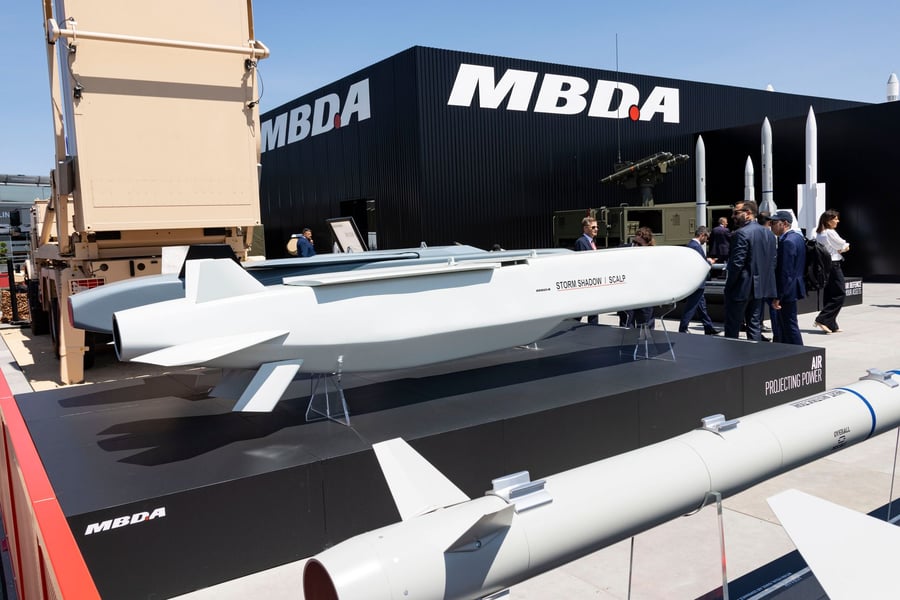
The practical question is whether Ukraine can produce Storm Shadow missiles in militarily relevant quantities before the conflict’s character changes. Keir Giles of Chatham House noted that Ukraine’s defence industry has proved more agile and motivated than Western European counterparts; its rapid adaptation of drone technology and its Neptune and Flamingo cruise missile programmes demonstrated an ability to absorb and iterate on weapons design faster than pre-war estimates suggested. The Ukraine war has already shown how Ukrainian industrial adaptation under fire can compress timelines that would take Western manufacturers years. Whether the same applies to a more complex precision weapon remains to be demonstrated.
Both governments are managing information in the gap between what has been announced and what exists. Britain has authorised a technology transfer; no production facility has been identified publicly. Russia has announced a targeting intent; no sites have been named. The threat and the capability are both, for now, prospective. What is already established is that the Kyiv Independence Day visit has moved something — the character of Britain’s commitment to Ukraine has changed, and the absence of an ambassador in London is the Kremlin’s receipt. What that exchange produces in military terms is a question neither side has answered, and one that may take years to resolve.