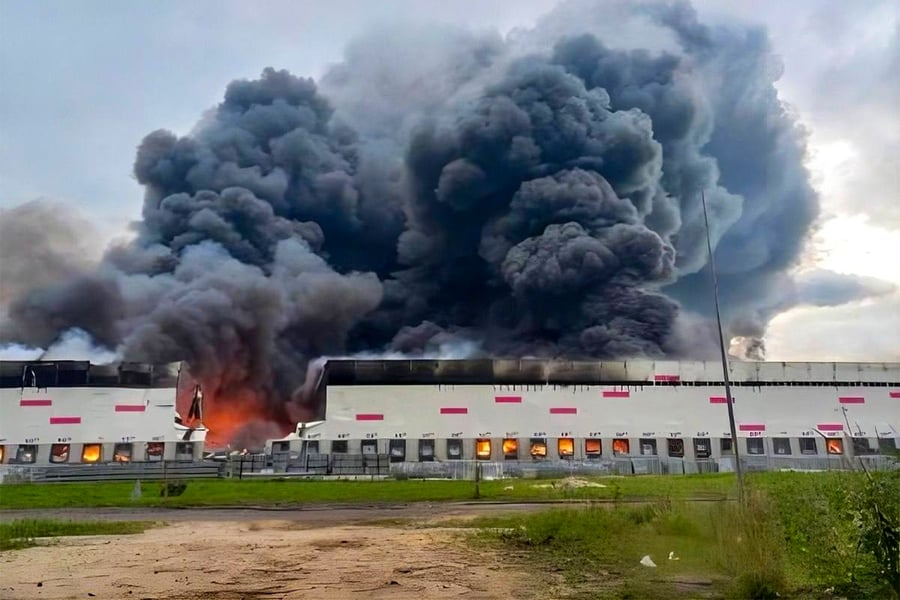

KYIV — The fire at the Ozon warehouse in Makhachkala was still burning when the Moscow Exchange opened on Monday morning. By noon, shares in Russia’s second-largest online retailer had fallen 28 percent, a loss that stripped hundreds of millions of dollars from the company’s market value in a single session. The strike in the Dagestan capital was one of five Ozon logistics facilities hit by Ukrainian drones across three nights, completing a campaign that Ukraine’s Defense Ministry framed as the opening of a new economic front.
“After Ukrainian units struck Wildberries’ 15 largest logistics hubs, now it’s Ozon’s turn,” Ukraine’s Defense Ministry said in a statement, calling the strikes “long-range sanctions” — a phrase that reframes drone warfare as economic coercion rather than military targeting.
The campaign hit roughly 233,000 square meters of warehouse space, about 6 percent of Ozon’s total logistics capacity, across facilities in Chapaevsk in the Samara region, Orenburg, and three southern hubs in Adygeysk, Nevinnomyssk, and Makhachkala. Russian emergency services confirmed at least three people killed in the strikes, with several outlets reporting children among the dead near the Adygeysk facility in Adygea republic.
The choice of targets reflects a deliberate shift in Ukraine’s drone strategy since the summer. Beginning on July 18, Ukrainian forces struck 15 of Wildberries’ largest fulfillment centres, destroying an estimated 40 percent of the company’s warehouse capacity and causing losses measured in hundreds of billions of rubles. Ozon, the listed rival that had been quietly absorbing displaced Wildberries business in the weeks since those strikes, has now found itself on the same target list.
That displacement was the point. When Wildberries fell behind on deliveries and closed distribution points, consumers and sellers migrated toward Ozon. Its shares, which had risen on the expectation of capturing that market share, gave back those gains and then some when it became clear Ukraine intended to follow the same playbook against its competitor. Meduza described Ozon as “the big winner from Wildberries’ ruin” — a status that lasted five weeks before the drones arrived.
The strikes on Russia’s logistics sector come as the Ukraine war’s economic dimension widens across multiple sectors. The Perm oil refinery, a major processing plant in the Ural region, halted operations last week after repeated attacks damaged key processing units. Repairs are expected to take up to two weeks, contributing to fuel shortages in several regions east of the Urals. Together with the retail logistics campaign, these strikes suggest a coordinated attempt to impose costs across civilian economic infrastructure rather than purely military targets.
Vladimir Putin’s government responded on Monday by signing a decree granting the Russian state authority to temporarily seize control of critical infrastructure deemed inadequately protected. The decree applies to facilities across fuel and energy, including nuclear installations, as well as industry, communications, transport, logistics, and utilities. Under its terms, the state may strip owners of physical and financial control if repairs are considered too slow or security measures insufficient.
The decree reveals a tension that Ukraine appears to have identified and is now exploiting: private operators of critical infrastructure, focused on profit margins, have in many cases invested less in hardening their facilities than Russian authorities regard as necessary for wartime conditions. The Ozon and Wildberries warehouses were civilian commercial assets. Before Monday’s decree, the government had limited tools to compel their owners to install protective measures or relocate inventory to less exposed sites.
On Ukraine’s Independence Day, August 24, the thirty-fifth, President Volodymyr Zelensky convened an expanded meeting of the Coalition of the Willing in Kyiv. UK Prime Minister Andy Burnham attended in person, alongside European Council President Antonio Costa; France and Germany joined remotely. The meeting’s central focus was air defence: Zelensky told the gathering that Ukraine received 675 air defence missiles across all of 2023, 364 across all of 2025, and is on pace to receive only 264 across 2026, even as Russian missile salvos have intensified.

“For 2026, as currently projected, it is 264,” Zelensky said, seeking “a package of at least 300 for the upcoming winter.” Norway announced 85 billion kroner, approximately 9.1 billion dollars, in aid for 2027, part of a Nordic-Baltic declaration issued the previous day. Patriot interceptor stockpiles available to Ukraine have fallen by half since 2023 even as the volume of incoming Russian strikes has grown.
Finnish President Alexander Stubb, speaking before the Kyiv meeting, said Ukraine’s strikes on Russian logistics infrastructure could accelerate pressure on Moscow toward eventual negotiations. Stubb did not predict a timeline but said the cumulative economic damage, across energy, retail logistics, and oil refining, was reaching a scale that political leaders in Moscow could no longer treat as a temporary inconvenience.
The Russian government has not indicated whether it will offer tax deferrals to Ozon as it did for Wildberries after the July strikes. For the tens of thousands of small businesses that depend on Ozon’s warehousing and delivery network, the uncertainty extends to whether orders placed before the attacks will reach customers in affected regions, or whether inventory stored in damaged facilities can be recovered.
What remains unclear is whether Ukraine’s drone campaign against Russian retail logistics is producing the economic dislocation Kyiv intends, or whether Russian consumers and businesses are adapting faster than the attacks can compound. That question may not have an answer until winter, when heating costs, slower deliveries, and constrained fuel supplies converge into a single pressure point. Zelensky says Ukraine needs 300 missiles to survive that season. It is also the season Moscow’s logistics operators are trying to repair before the cold arrives, and the season Ukraine shows no sign of allowing them to finish.