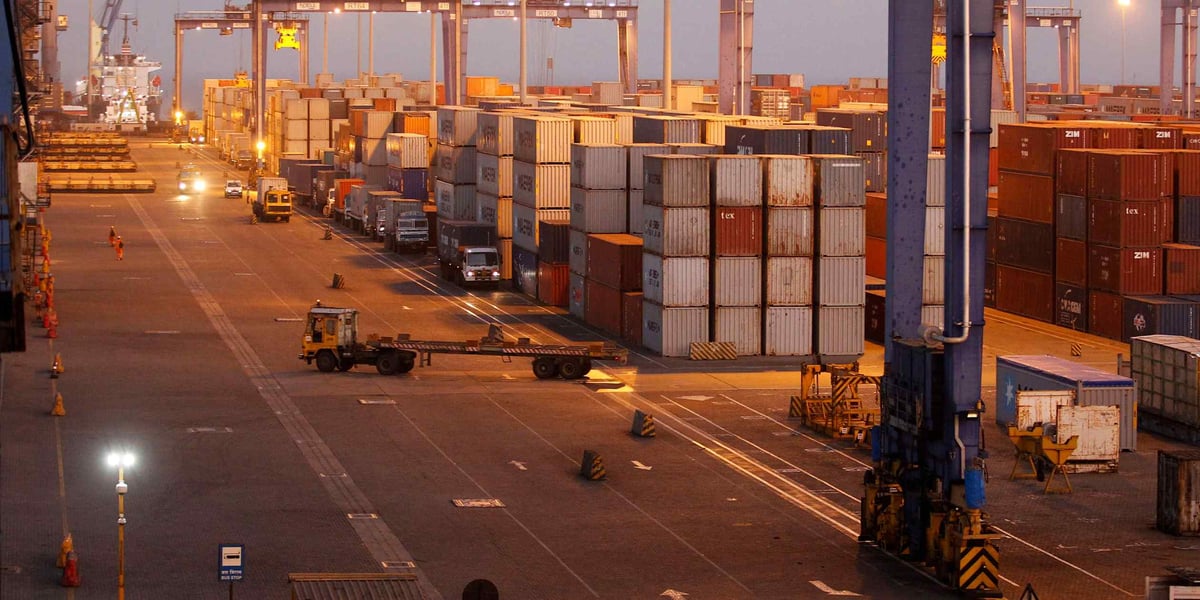

MUMBAI — The cargo counter at Mundra Port ticked past 500 million metric tonnes on an annualised basis in the April-June quarter of FY27, and Adani Ports & SEZ did not celebrate quietly. The milestone arrived as the company reported Q1 FY27 revenue of approximately Rs 7,200 crore, up 22% year-on-year, with EBITDA margins holding near 70% — the structural advantage of owning port infrastructure that cannot be replicated overnight.
India’s logistics sector has been among the clearest beneficiaries of the PM GatiShakti National Master Plan, which aims to integrate roads, rail, ports, and multimodal hubs into a single planning framework. Roughly Rs 11 lakh crore has been committed across the sector through FY30. What Q1 FY27 results reveal is that the benefits of that commitment are flowing unevenly — to port operators with first-mover scale advantage, and away from government-affiliated intermediaries struggling to hold market share.
| Company | Q1 FY27 Revenue (Rs Cr) | YoY Growth | EBITDA Margin | Key Metric | |||||
|---|---|---|---|---|---|---|---|---|---|
| Adani Ports & SEZ | ~7,200 | +22% | ~70% | 500 MMT throughput | |||||
| JSW Infrastructure | ~1,050 | +31% | ~60% | Cargo volume +28% | |||||
| Container Corp (Concor) | ~2,250 | +6% | ~25% | Volume growth muted | |||||
| Gateway Distriparks | ~580 | +14% | ~35% | Rail TEUs +19% | |||||
| Source: BSE/NSE filings, company Q1 FY27 earnings reports. | |||||||||
Container Corporation of India — Concor — is the number that demands explanation. Revenue grew just 6% to approximately Rs 2,250 crore, an underwhelming result for a company that holds a statutory advantage as the primary operator on Indian Railways’ dedicated freight corridors. EBITDA margins around 25% are structurally below what port operators are earning on comparable throughput. The problem is not demand; India’s container trade volumes are expanding. The problem is Concor’s cost structure: land lease charges to Indian Railways, haulage rates that are periodically revised upward, and the operational burden of managing 61 inland container depots of wildly varying efficiency.
The structural threat to Concor is Adani Logistics, the rail freight arm of Adani Ports that has been acquiring private freight terminal licences systematically since FY24. Unlike Concor, Adani Logistics does not pay haulage rates to the railway ministry on the same terms — it operates on commercial contracts negotiated at the dedicated freight corridor level. In Q1 FY27, Adani Logistics moved approximately 85,000 TEUs by rail, up from near-zero two years ago. That volume does not yet threaten Concor’s approximately 900,000 TEUs per quarter. But the trajectory is what analysts are watching, not the current share.
JSW Infrastructure had the sector’s strongest Q1, posting revenue of approximately Rs 1,050 crore — up 31% year-on-year. The company commissioned two new terminals in Odisha and Tamil Nadu in the previous financial year and the capacity is now fully ramped. JSW Infrastructure’s model differs from Adani Ports in one critical respect: it handles bulk cargo (coal, iron ore, fertilisers) rather than containers, which means its growth is tied to India’s industrial cycle rather than consumer trade. With steel and power sector demand sustained in Q1 FY27, JSW’s cargo volumes rose 28%.

Gateway Distriparks, the smallest of the listed names at roughly Rs 580 crore of quarterly revenue, delivered a 14% top-line increase with EBITDA margins around 35%. The company’s rail freight volumes grew 19% in TEU terms — faster than the market — on the back of its Western Dedicated Freight Corridor positioning. Gateway operates a lean model: it does not own ports, it owns the inland connection between ports and hinterland warehousing. In a quarter when the DFC’s western corridor ran at sustained utilisation above 80%, that positioning paid off.
The bigger picture is an infrastructure buildout that is running ahead of operator readiness in some stretches. India’s major ports collectively handled approximately 820 MMT in Q1 FY27 on an annualised basis, up roughly 9% year-on-year. Non-major ports — including Mundra — now handle more than half of India’s total port cargo by volume, a reversal from five years ago when government-owned major ports still dominated. That reversal is structural, not cyclical: private ports invest faster, turnaround vessels faster, and offer integrated logistics packages that government ports cannot.
For equity investors, the logistics sector in FY27 presents an unusually clean relative-value story. Adani Ports and JSW Infrastructure are compounding at high rates with durable infrastructure moats. Concor is cheap on a relative basis — it trades at a discount to private port operators — but its path to margin expansion is not yet clear. The government has been considering privatising Concor for several years; that process has moved slowly, and in Q1 FY27 there was no new development on that front. Until privatisation or a meaningful tariff restructuring occurs, Concor’s margin gap to its private-sector peers is likely to persist.