
MUMBAI — For the first time in a decade, Asian Paints entered a quarter genuinely uncertain about its own market share. Birla Opus, Grasim Industries’ Rs 10,000-crore paints bet, captured roughly 5-6% of India’s decorative paints market in its debut year — forcing the sector leader to spend more, discount more, and defend turf it had long taken for granted.
The Q1 FY27 results across India’s paints sector make that pressure legible in the numbers. Asian Paints posted revenue of approximately Rs 8,900 crore, up 8% year-on-year — healthy growth in isolation, but its profit after tax contracted about 5% to around Rs 1,050 crore as advertising and dealer incentive costs climbed. EBITDA margin slipped to roughly 18.5%, compared to above 20% two years ago. The company did not lose volume. It lost pricing power.
Berger Paints, by contrast, had a better quarter. Revenue came in near Rs 3,100 crore, up 11%, with PAT of approximately Rs 280 crore and EBITDA margins around 15.8%. Without the weight of defending a 50%-plus market share, Berger absorbed input cost relief from lower crude oil derivatives — primarily titanium dioxide and vinyl acetate monomer — more directly into earnings rather than spending it on competitive defence.
| Company | Q1 FY27 Revenue (Rs Cr) | YoY Growth | PAT (Rs Cr) | EBITDA Margin | |||||
|---|---|---|---|---|---|---|---|---|---|
| Asian Paints | ~8,900 | +8% | ~1,050 | ~18.5% | |||||
| Berger Paints | ~3,100 | +11% | ~280 | ~15.8% | |||||
| Kansai Nerolac | ~2,050 | +7% | ~145 | ~13.2% | |||||
| Indigo Paints | ~450 | +18% | ~42 | ~16.5% | |||||
| Birla Opus (Grasim) | ~1,100 | New entrant | — | Investment phase | |||||
| Source: BSE/NSE filings, company Q1 FY27 earnings reports. | |||||||||
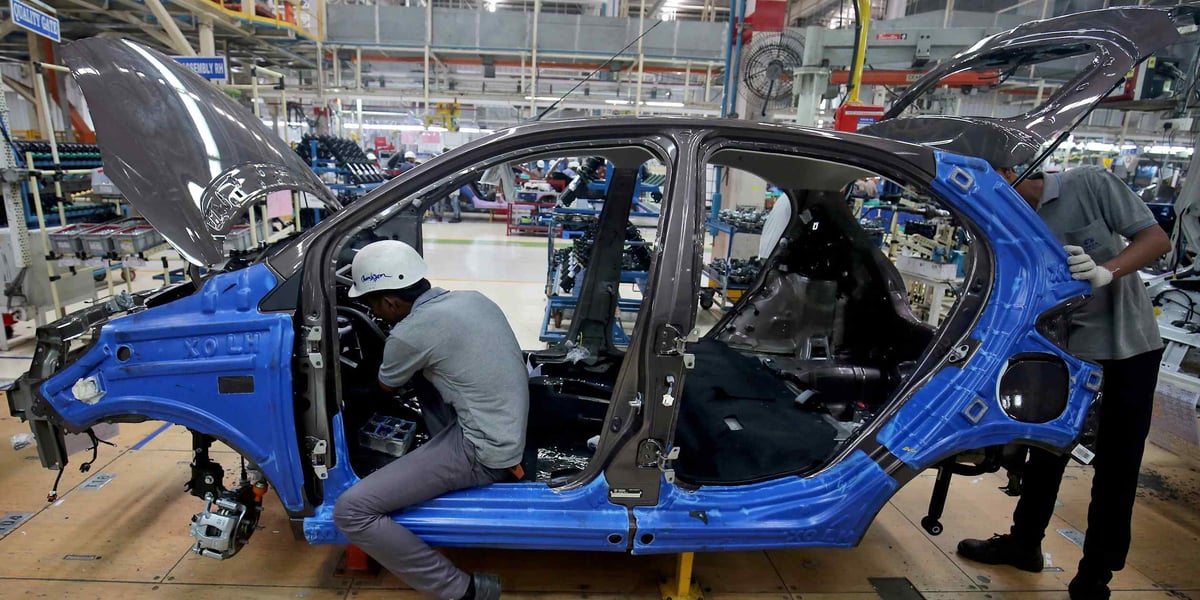
The Kansai Nerolac result is the one that does not fit cleanly into the competitive-disruption narrative. Revenue grew 7% to approximately Rs 2,050 crore, but PAT came in near Rs 145 crore — subdued relative to peers. The drag is structural: Kansai Nerolac carries a heavier industrial and automotive paints mix than its decorative-focused rivals. With passenger vehicle production running at a pace that fell short of earlier FY27 forecasts, the automotive segment did not provide the volume lift Kansai needed to offset lower decorative realisations.
Indigo Paints, the smallest of the listed peers, delivered the sector’s strongest revenue growth at 18%, reaching roughly Rs 450 crore. The Puducherry-based company has built a differentiated product portfolio in textured and speciality coatings and faces no obligation to defend legacy pricing across 50,000 dealer outlets. Its 16.5% EBITDA margin shows that, at its scale and with its positioning, the new competitive environment has not yet arrived at its doorstep.
Birla Opus is where the story actually begins and ends. Grasim Industries committed Rs 10,000 crore to enter the paints business — a capex outlay with no precedent in the Indian consumer goods sector for a greenfield entry into an existing, well-defended market. In Q1 FY27, Birla Opus reported revenue of approximately Rs 1,100 crore, on a trajectory the company says will reach Rs 10,000 crore annually by FY30. It is not profitable yet; it is not trying to be. The business is in dealer acquisition mode, trading price for shelf space.
The mechanism by which Birla Opus has applied pressure on Asian Paints is worth understanding precisely. It is not a price war in the crude sense. Birla Opus has matched Asian Paints on price in most product categories while offering dealers a higher margin — a distribution incentive strategy designed to prise open a network that Asian Paints spent 30 years building. Asian Paints responded with its own dealer loyalty programmes, which meant discretionary cash going out the door regardless of what happened to volumes.
On raw material costs, the sector caught a partial break in Q1 FY27. Crude oil prices retreated from their FY26 highs, pulling down the cost of petrochemical derivatives that collectively account for roughly 55-60% of paint formulation costs. Titanium dioxide, the white pigment that drives opacity in decorative paints, also eased in price on the back of softer Chinese export demand. These tailwinds provided margin relief of perhaps 80-120 basis points for most players. Asian Paints would have seen more of that flow to earnings in a normal quarter — instead it was absorbed into competitive spending.
The question that analysts are sitting with as FY27 progresses is not whether Birla Opus will succeed. At Rs 10,000 crore of committed capital, the Aditya Birla Group has too much on the line to walk away. The question is what Asian Paints looks like on the other side of this disruption. At 50% market share, the company is too large to cede ground without visible damage to its P&L. At 40% share, it would still be the dominant player but a structurally different business — one that competes rather than dictates.
The sector’s overall revenue pool is expanding. India’s housing market remains active, with new launches in the affordable and mid-segment categories sustaining demand for interior and exterior paints. The waterproofing and wood coatings categories are growing faster than decorative paints. Infrastructure spending — roads, bridges, industrial estates — supports industrial coatings demand. The pie is bigger than it was in FY24. What has changed is how it is being divided.
For investors, the paints sector in FY27 presents a straightforward split: established players absorbing disruption costs versus challengers reaping the benefit of competitive catalysts. What is not yet clear is where Birla Opus’s share gain stabilises — and until it does, Asian Paints’ margin trajectory will remain the sector’s central uncertainty.