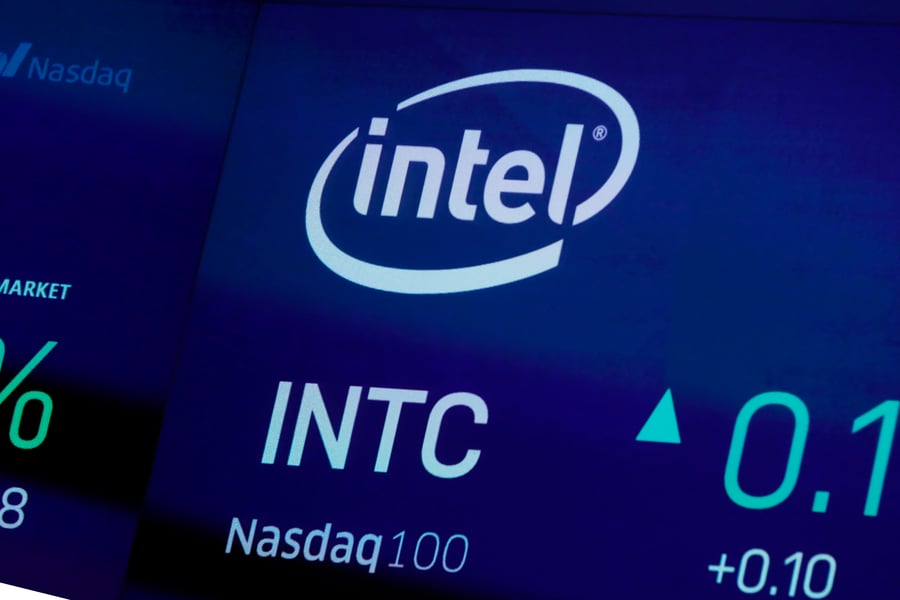

NEW YORK — Intel’s quarter does not improve with more scrutiny. The stock fell 49 cents to $22.84 on Tuesday — a 2.1% decline that made it the weakest component of the Dow Jones Industrial Average — as the investment community spent the day digesting an analyst note from Bernstein that updated foundry loss projections through 2027. The conclusions were not encouraging.
| INTC Key Metrics — August 26, 2026 | |
|---|---|
| Price | $22.84 |
| Change | -$0.49 (-2.1%) |
| Q2 Intel Foundry Operating Loss | $2.8 billion |
| Q2 Client Computing Revenue | $7.4 billion (-8% YoY) |
| Q2 Data Center & AI Revenue | $3.1 billion (-2% YoY) |
| 52-Week Range | $17.68 – $31.45 |
| CHIPS Act Commitment | $8.5 billion |
| 18A Volume Production Target | H1 2027 |
The Intel Foundry Services division, the unit Intel restructured as a standalone business earlier this year to attract external customers, posted an operating loss of $2.8 billion in the second quarter of 2026. That figure was disclosed in Intel’s July earnings report and has been circulating in analyst models since, but Bernstein’s updated note put it in a context the market found uncomfortable: at the current loss rate, Intel Foundry will consume more than $10 billion in operating losses through the end of 2027 before reaching the scale necessary to approach profitability.
CEO Lip-Bu Tan, who took over from Pat Gelsinger in late 2024 after the board concluded that Gelsinger’s IDM 2.0 strategy was not producing results fast enough, has maintained that Intel Foundry is a strategic necessity rather than an optional business line. His argument: the United States cannot afford a future in which advanced semiconductor manufacturing is entirely controlled by TSMC and Samsung. The federal government, which has committed $8.5 billion to Intel under the CHIPS and Science Act, appears to agree at the policy level. Whether the business model closes is a separate question.
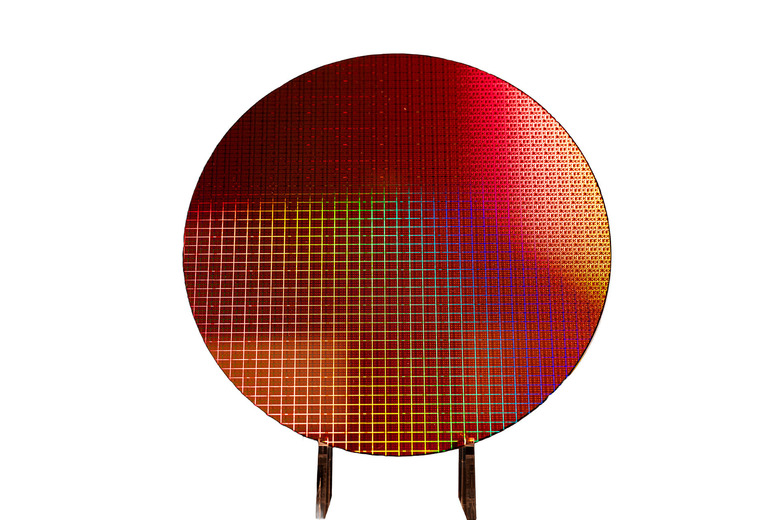
The foundry’s technical capabilities are at the center of the debate. Intel’s 18A process node, which uses the company’s proprietary PowerVia backside power delivery technology, is scheduled to enter volume production in the first half of 2027. Independent wafer quality assessments commissioned by potential customers — including one by a major unnamed hyperscaler, according to The Information — have reportedly shown results that are competitive with TSMC’s N2 node on some performance metrics. That is a meaningfully different position than Intel Foundry was in eighteen months ago, when 18A was widely described in the industry as behind schedule and below yield targets.
The progress on 18A has not been enough to halt Intel’s share losses in the processor markets where it still earns most of its revenue. AMD’s EPYC server processors now hold approximately 34% of x86 server unit share, according to Mercury Research estimates, a position AMD has built primarily at Intel’s expense. In the laptop CPU market, AMD’s Ryzen AI 300 series and Qualcomm’s Snapdragon X Elite have both taken share from Intel in the premium segment. Intel’s Lunar Lake and Arrow Lake processors, released in late 2025, received mixed technical reviews — positive on power efficiency, weaker than expected on AI workload performance.
AMD’s competitive positioning against Intel in server and PC markets remains the most direct pressure on Intel’s product division, which still generates the bulk of the company’s revenue. Client computing group revenue was $7.4 billion in Q2 2026, down 8% year-over-year. Data center and AI revenue was $3.1 billion, down 2% and flat against expectations that had already been revised lower twice.
The restructuring that Tan announced in August 2025 — which included laying off 15% of Intel’s workforce, or approximately 15,000 employees — is producing measurable cost reductions. Operating expenses in Q2 2026 were $8.9 billion, down from $10.5 billion in the same period of 2025. The cost base is shrinking faster than revenue, which has helped gross margin stabilize at around 38% after falling below 34% in the worst quarters of 2025. Intel has guided for gross margin above 40% in the second half of 2026 if product mix improves.
At $22.84, Intel trades at approximately 28 times fiscal year 2027 earnings consensus — a multiple that looks elevated relative to the company’s recent earnings history, and that assumes a meaningful recovery in both the PC and data center segments. The stock’s 52-week range runs from $17.68 to $31.45. The lower end was touched in the weeks immediately following last year’s restructuring announcement; the upper end reflected the brief optimism that 18A technical progress generated in early 2026.
The CHIPS Act funding provides a floor of sorts — the $8.5 billion commitment is disbursed on milestone schedules, and Intel has an incentive to hit those milestones that goes beyond shareholder returns. Whether that floor translates into stock price support is a different question. Intel’s foundry losses are structural until 18A volume production creates the throughput necessary to spread fixed costs. Nothing in Tuesday’s selloff changes that timeline. The question the market is debating is whether the timeline is eighteen months or thirty-six.