
NEW YORK — Tesla shares were on course for their fifth losing session of August by midday Wednesday, falling 1.79% to $343.98 as a market transfixed by Nvidia’s after-hours earnings report had little appetite for risk broadly. But the bearish tape masked a corporate story at Tesla that is moving, by most measures, faster than at any point in the past two years.
| TSLA Key Metrics — August 26, 2026 | |
|---|---|
| Price | $343.98 |
| Change | -$6.26 (-1.79%) |
| Market Cap | ~$1.38 trillion |
| Forward P/E | >300x |
| Nevada Robotaxi Permit | Approved (August 2026) |
| Semi Factory Opening | September 2026 (Nevada) |
| FSD Version | v13 (staged U.S. rollout, Q2 2026) |
| Wedbush Market Cap Target | $3 trillion |
The proximate cause of Wednesday’s slide is not Tesla-specific. The Personal Consumption Expenditures price index rose 3.7% year-over-year in July, according to data released Wednesday morning — sticky enough to push back Federal Reserve rate-cut expectations into 2027 for some investors. Companies with elevated valuations, Tesla’s price-to-earnings ratio sits north of 300, absorb that re-pricing asymmetrically. Every basis point added to the long end of the yield curve compresses the present value of Tesla’s long-dated autonomous-driving revenue streams, which remain theoretical in scale even as they advance in practice.
The practical advances, though, are real. Nevada regulators approved Tesla’s application to operate paid robotaxi service in the state earlier this month, a permitting milestone that sent the stock up 5.14% on a single day — to $362.86, a closing level that now sits about 5% above Wednesday’s price. The approval means Tesla joins Waymo and a handful of smaller operators with a legal commercial framework for charging passengers in a U.S. state, a meaningful step beyond the internal testing and free-ride phases that characterized the program through most of 2025.
The robotaxi revenue timeline has been the central variable in every Tesla valuation model for two years. Dan Ives at Wedbush has staked a $3 trillion market capitalization target on a scenario in which Cybercab deployments scale through 2027 and 2028 at a pace consistent with Musk’s most aggressive public projections. That thesis requires Nevada to be followed quickly by California, Texas, and at least one international market. The permitting record so far has been slower than Musk predicted; it has also been faster than critics expected.
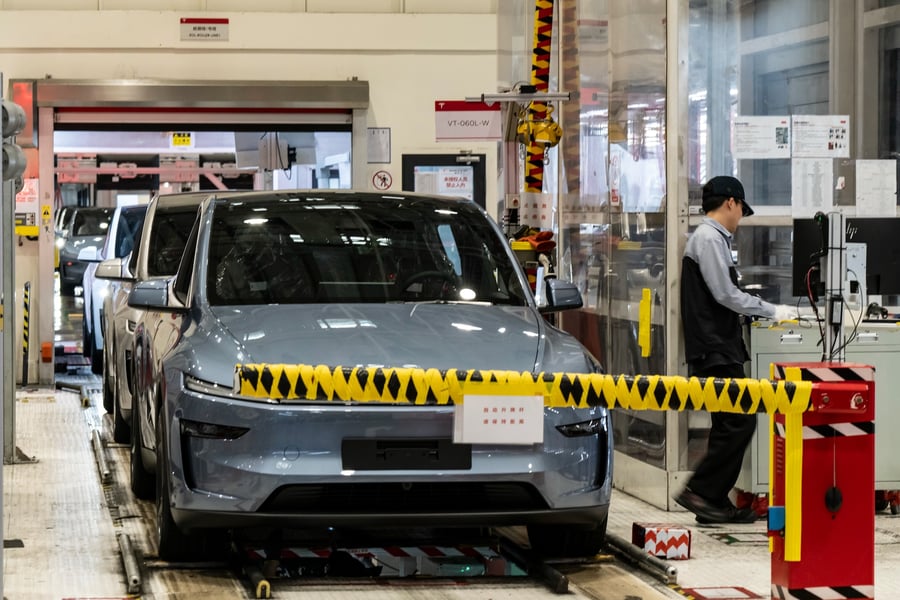
The Nevada permit coincided with reports that Tesla is preparing to open a Semi truck manufacturing facility in the state next month. The Semi — Elon Musk’s long-delayed electric freight vehicle — has been in limited production since late 2022, but a dedicated Nevada factory would represent the first purpose-built facility for the product line. Semi deliveries have been modest to date, but the addressable market for electric long-haul freight is large enough that even modest penetration would generate meaningful revenue contribution by 2028.
Full Self-Driving software revenue is the other variable that remains unresolved on both the technical and regulatory dimensions. FSD Version 13, released in staged U.S. rollout through the second quarter, has received generally positive reception from testers, who report improved performance on unprotected left turns and in construction zones — historically problematic edge cases for camera-only autonomy systems. Whether the performance improvement is sufficient to satisfy state DMV certification requirements, which vary significantly in their standards for unsupervised operation, is not yet known.
For context on how the broader technology and markets landscape is shaping Wednesday’s session, investors tracking the NASDAQ today will find Tesla’s move roughly consistent with the composite’s modest decline on Nvidia earnings anticipation and inflation data.
Tesla carries a market capitalization of approximately $1.38 trillion at Wednesday’s price, implying a forward price-to-earnings ratio above 300 on consensus 2026 estimates. That multiple requires Tesla to execute on multiple high-probability growth pillars simultaneously: energy storage, FSD, robotaxi, and Optimus. The valuation is demanding even by the standards of the most optimistic scenario models, a fact that the stock’s 18.1% year-to-date decline through the August low acknowledged without fully resolving.
The rebound from those lows — driven by the Nevada permit, the Semi factory announcement, and improving FSD reception — is what gives the current price range its tension. Bears see a company trading at a speculative premium on unmonetized optionality; bulls see a company at the threshold of converting that optionality into revenue, with the Nevada permit as the first concrete evidence that the conversion is beginning.
Nobody disputes that the vehicle manufacturing business alone does not justify the stock’s valuation. What remains genuinely open is whether the timeline for the services businesses — FSD, robotaxi, Optimus, energy — is a matter of quarters or years. Wednesday’s price says the market hasn’t decided.