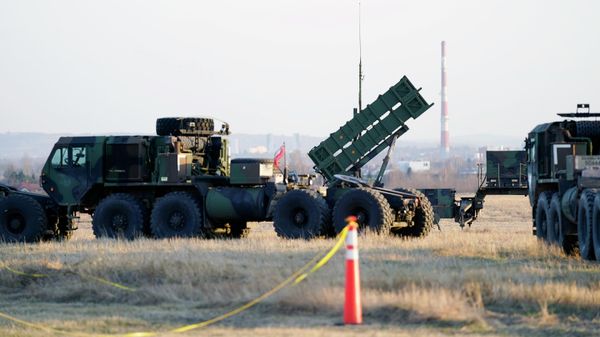

WASHINGTON – The calculus behind the phrase “beyond critical” is not one a defense department volunteers readily. But as of Wednesday, that was the assessment circulating in NATO planning circles about the state of US Patriot missile interceptor stocks in Europe, a consequence of the missile transfers that have flowed steadily out of European pre-positioning toward the Iranian theater since Trump ordered direct military engagement earlier this year.
The disclosure, first reported by The Associated Press citing current and former defense officials, described US stocks of Patriot Advanced Capability-3 interceptors in Europe as having dropped to a level that defense planners categorize as below minimum operational readiness. The Pentagon, in a statement Wednesday evening, disputed the characterization, saying that US forces in Europe retain “significant capability to defend NATO allies.” The statement declined to detail current inventory levels.
The gap between those two positions: “beyond critical” from officials who spoke to the AP versus “significant capability” from the Pentagon press office, is precisely the kind of institutional dispute that tends to resolve, eventually, in the direction of the warning.
The Iranian theater has consumed Patriot interceptors at a pace that few public assessments anticipated. Iran’s ballistic missile arsenal, the largest in the Middle East, has been used extensively since US forces entered the conflict, requiring sustained intercept operations that burn through stockpiles designed for deterrence and periodic use, not sustained combat. Patriot systems in the Middle East intercepting Iranian ballistic missiles during extended engagements require replacement batteries at a scale that the US industrial base (currently producing around 500 PAC-3 interceptors per year at Lockheed Martin’s Troy, Alabama, facility) was not configured to maintain simultaneously with European readiness posture.
Europe’s air defense architecture has relied heavily on American Patriot systems as the backbone of theater missile defense since the end of the Cold War. Germany, the Netherlands, Poland, and Romania all operate Patriot systems under bilateral agreements with the United States. What European defense ministers have not been fully apprised of, according to the officials who spoke to the AP, is that the American supply of interceptors to replenish those systems has thinned to a point where the capability gap is measurable.

The Pentagon’s refutation notwithstanding, the timing of the disclosure is politically uncomfortable. NATO defense ministers meet in Brussels next month, and the European alliance has spent three years telling its members that American commitment to collective defense is unconditional. The Patriot interceptor count, whatever its actual level, is one data point that tests that claim.
The strategic tension is not new. Every US decision to use military force outside the NATO theater draws on readiness that is globally fungible. Munitions directed at Iranian targets are munitions not available to backstop the Baltic flank. Carrier strike groups in the Persian Gulf are carrier strike groups not in the North Atlantic. The Trump administration has managed this tension by arguing that defeating Iran is itself a contribution to global stability, a position that European capitals accept with varying degrees of conviction.
What the “beyond critical” assessment adds, if accurate, is a specific and visible number to a trade-off that was previously abstract. European allies contributing to NATO’s eastern flank from Poland to Estonia have been absorbing the logic of American rearmament commitment for four years. They now face the possibility that a portion of the interceptor inventory they expected to draw on in an emergency is repositioned several thousand miles away.
Lockheed Martin’s production ramp at Troy is real: the company has expanded the PAC-3 line and moved to two-shift operations, but production expansions operate on timelines measured in quarters, not weeks. The interceptors missing from European stocks cannot be replaced before NATO’s September ministerial.
The US’s Iran engagement shows no immediate sign of winding down. Pentagon planners have publicly stated that the campaign’s objectives include permanently disabling Iran’s ballistic missile production infrastructure, a goal that is neither close nor clearly defined. Until it is achieved or abandoned, the transfer of Patriot resources out of the European theater will continue.
For the moment, the gap is a problem in a planning document. Whether it becomes a problem on a runway or in a Baltic city depends on choices that Russian and Iranian decision-makers have not yet made, and that is the part of the equation that no stockpile audit can resolve.