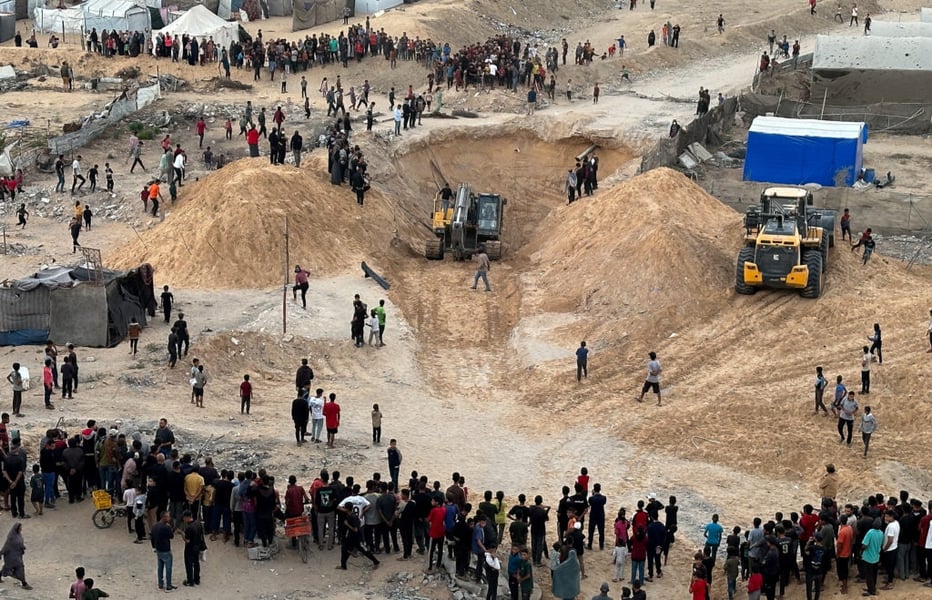

GAZA – Israeli forces said Thursday they had destroyed a section of an underground route near Gaza’s Yellow Line after an operation that brought troops into central Gaza beyond the military separation line and restricted Palestinian movement during a ceasefire now more than a year old.
The military described the route as Hamas infrastructure posing an immediate threat to its troops. Those claims about the tunnel’s ownership, operational use and intended targets have not been independently verified for this article. The announcement came as humanitarian organisations warned that continued attacks, restrictions and displacement were undermining the relief promised under the October 2025 truce.
For civilians near Bureij and Nuseirat, the operation also meant warnings to stay away and a closure affecting Salah a-Din Road, Gaza’s main north-south highway. Israeli authorities said Thursday that the activity had ended and the road had reopened. The completion of the raid did not resolve the wider restrictions on movement or the humanitarian emergency across the enclave.
The Israel Defense Forces said troops had acted with intelligence from the Israel Security Agency, also known as Shin Bet. The military said the underground infrastructure crossed into the Israeli-controlled side of the Yellow Line and connected to Hamas activity centres in central Gaza, according to the published account of its announcement in The Times of Israel.
The army said it identified attempts to restore the route and characterised that work as a ceasefire violation. It said the demolition removed an immediate threat. Neither the intelligence underlying that assessment nor the full extent of the underground system was independently established in the material reviewed. Destroying one section should not be read as confirmation that an entire network was eliminated.
The military had publicly announced the operation on Wednesday, saying it was targeting a tunnel west of the Yellow Line and had warned civilians about the area and a road closure. Thursday’s completion announcement followed that earlier statement. The Yellow Line separates areas under Israeli military control from the remainder of Gaza; it is not Gaza’s international border.
The immediate account did not establish the number of civilians displaced by this particular operation or provide an independently verified assessment of damage to surrounding civilian property. Those remain reporting gaps. The military’s description of an urgent security threat is its justification for the operation, not an independent determination that every aspect of the raid complied with the ceasefire.
A separate humanitarian assessment released Thursday placed the operation within a much broader failure to deliver civilian protection. Five organisations, the Danish Refugee Council, Norwegian Refugee Council, Oxfam, Refugees International and Save the Children, gave the internationally backed Gaza peace plan four points out of a possible 26. Their joint assessment evaluated implementation against the plan’s objectives, including humanitarian access, reconstruction and freedom of movement. It was an advocacy assessment, not a judicial ruling.
The organisations reported at least 1,650 Palestinians killed and 5,975 wounded between the October 2025 ceasefire declaration and mid-November 2026. These are cumulative figures cited in their assessment, not casualties attributed to the tunnel operation. They said humanitarian access received a score of zero and warned that shortages were causing preventable suffering despite the formal truce.
The UN Office for the Coordination of Humanitarian Affairs documented how those conditions were affecting daily survival before this week’s raid. In its November 13 situation report, covering November 3 to 9 unless otherwise specified, OCHA said airstrikes, shooting and shelling continued to hit populated areas, including places sheltering displaced people. Heavy rain had compounded the damage, disrupting health services and leaving families exposed to contaminated standing water.
OCHA cited an early-October monitoring survey in which 85 percent of assessed households experienced moderate to severe water insecurity. Two-thirds reported access to less than six litres of drinking water per person per day. Those survey results describe the households assessed and should not be confused with a fresh census taken during Thursday’s operation.
The medical shortages were similarly concrete. OCHA reported that about 42 percent of medicines were at zero-stock levels in October, citing Gaza’s Ministry of Health. Shortages of engine oil, batteries, tyres and spare parts also affected transport for health workers and the generators supporting medical services. The UN report said Israeli authorities heavily restricted entry of many of those maintenance items.
These are extensions of the water, sewage and child-protection risks previously documented in Gaza, rather than consequences that can all be assigned to this week’s raid. OCHA said stormwater mixing with sewage exposed residents to contamination while pumps and other equipment remained insufficient. Israeli restrictions and funding shortfalls both constrained the response.
The aid organisations called for humanitarian access, civilian protection and implementation of the ceasefire commitments. Israeli forces, meanwhile, continued to frame operations around the Yellow Line as necessary to counter Hamas. For this particular demolition, the publicly reviewed record still leaves the tunnel’s precise extent, the underlying intelligence and the full civilian impact unverified.