
NEW YORK — The week that was supposed to belong to Nvidia ended with Amazon absorbing a lesson it already knew: in 2026, every AI infrastructure story eventually circles back to the Federal Reserve.
AMZN shares fell roughly 2.8% on Friday to close near $228, pulling back alongside the broader Nasdaq as Federal Reserve Chair Kevin Warsh used his Jackson Hole address to signal that the central bank’s appetite for rate cuts remains constrained by persistent services inflation, as CBS News reported on Warsh’s address. Warsh stopped short of ruling out a September move, but his tone — measured, cautious, deliberately unhurried — was enough to push rate-sensitive technology stocks into the red across the board. Amazon, with a market capitalization that now approaches $2.5 trillion, has enough weight in the Nasdaq 100 that its reversal amplified the index’s own decline.
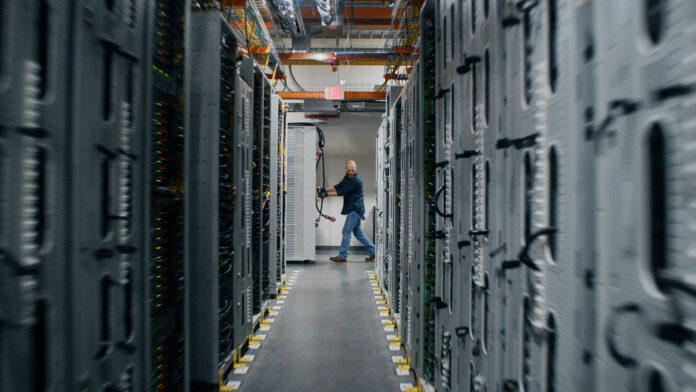
The irony is that the news driving the most attention to Amazon this week had nothing to do with interest rates. Amazon Web Services announced that it had committed to purchasing two million Nvidia GPUs — the company’s most powerful AI accelerators — to power the next generation of inference workloads across its global cloud infrastructure. The contract, disclosed alongside Nvidia’s fiscal second-quarter earnings report, represented one of the largest single GPU procurement announcements in the industry’s history and validated, in concrete terms, what AWS had been signaling in earnings calls for four consecutive quarters: that the cloud is not in the business of waiting for AI demand to materialize.
AWS has been here before. When the first wave of generative AI deployments began in 2023, Amazon was slower than Microsoft’s Azure — which had already embedded OpenAI’s models into its infrastructure — to stake out an obvious position. That lag became a talking point in analyst notes and a recurring question on earnings calls. Andy Jassy, Amazon’s chief executive, spent the better part of 2024 and 2025 repositioning the narrative: AWS was not behind, he argued, it was being deliberate about the infrastructure layer, choosing to build at a scale that smaller moves would not support. The two-million-GPU order is the most legible version of that argument yet.
| Security | Close | Change | % Change |
|---|---|---|---|
| Amazon (AMZN) | ~$228 | ▼ | -2.8% |
| NASDAQ 100 (NDX) | 19,840 | ▼ | -2.3% |
| S&P 500 | 5,580 | ▼ | -1.9% |
The Nvidia relationship matters beyond the GPU count. Nvidia’s Vera CPU, which the company unveiled alongside its Blackwell Ultra GPU architecture, is being deployed by AWS for AI inference at a scale that no public cloud had previously announced. Inference — the process of running a trained AI model to generate a response — is increasingly where cloud economics are made. Training a large model is expensive and infrequent; serving it to millions of users is continuous and, at AWS’s scale, the difference between a margin that expands and one that compresses.
Analysts at Morgan Stanley estimated in a note published Thursday that AWS’s AI-related revenue run rate could reach $40 billion by the end of fiscal 2027, driven in part by the kind of GPU capacity commitments announced this week. AWS reported $32.1 billion in revenue for the second quarter ended June 30, up 22% year over year — respectable growth for an operation of that scale, but one that the GPU contract suggests is being deliberately positioned to accelerate.
For ordinary investors parsing the week’s moves, the Friday selloff complicates what had been a straightforward story. Nvidia’s quarter was extraordinary — $96.22 billion in revenue, up 106% year over year — and AWS’s GPU commitment was the single largest validation of that demand story among hyperscalers. Amazon’s stock fell anyway, because the market on Friday was not trading on infrastructure commitments. It was trading on what Warsh said at a symposium in Wyoming about the path of overnight borrowing costs.
That tension — between the structural AI investment cycle and the monetary policy cycle — is not going away. Amazon’s capital expenditure guidance for fiscal 2026 has been running ahead of initial estimates all year, driven almost entirely by AWS data center expansion. Higher rates raise the cost of financing that expansion, compress the multiple on future earnings, and create headwinds for a stock that the market has repeatedly repriced on the assumption that the AI capital cycle will last longer than prior technology cycles. Warsh’s remarks did not change the underlying trajectory, as Fortune’s analysis of his Jackson Hole address noted. They changed the discount rate applied to it, and that is enough to move a $2.5 trillion company 2.8% in a single session.
The week’s full picture is more coherent than Friday’s close suggests. AWS locked in a GPU supply chain that competitors will struggle to replicate quickly. The S&P 500 closed at 7,711, down on the session but not in territory that signals a broader reassessment of earnings expectations. And Amazon’s own business — fulfillment, Prime, advertising, AWS — continues to operate at a scale and margin profile that investors a decade ago would not have thought possible.
What Friday did not resolve: whether the pace of hyperscaler capital spending is sustainable if Warsh’s rate timeline extends further into 2027 than the bond market currently prices. Amazon has not given guidance that accounts for a prolonged higher-rate environment. None of the hyperscalers have. That uncertainty is not new, but it is a more live question on the morning after Jackson Hole than it was the morning before.
For now, AWS has two million Nvidia GPUs on order and a market that spent Friday worrying about the cost of capital. Those two facts will compete for primacy in every AMZN analyst note for the next several weeks.