
LONDON — While American tech investors processed a Federal Reserve chair who would not give them the rate cuts they wanted, the FTSE 100 did something quietly exceptional on Friday: it went up.
The index closed at 10,817.72, a gain of 0.23% from Thursday’s close, after trading a range of 10,792.44 to 10,844.99 through the session. It is not a large move by any measure. But context matters: European peers were under more pressure on the day, and the FTSE 100’s resilience comes from a structural reason that is worth understanding rather than treating as coincidence.
The immediate backdrop is Kevin Warsh’s address at the Jackson Hole Economic Symposium in Wyoming, where the Federal Reserve chair gave a mildly hawkish speech that declined to signal any rate cut before year’s end, NBC News reported. In a US context, that put pressure on rate-sensitive growth stocks and pushed the Nasdaq 100 down 0.5%. In a London context, the channel of transmission is different. The FTSE 100 is not a technology index. Its largest constituents are energy companies, banks, pharmaceutical manufacturers, mining groups, and consumer staples businesses. Their valuations are less sensitive to American interest rate expectations than their counterparts in New York, which is precisely why Friday’s performance diverged.
The energy sector was among Friday’s contributors. Oil prices held near $82 a barrel through the week, a level that supports the earnings of Shell and BP, both of which carry substantial weight in the FTSE 100. Shell, the index’s largest energy component, has benefited from production volumes that held up better than some analysts had forecast in the most recent quarterly results, and the stable crude price floor provided a platform for modest sector-level gains on Friday. BP, which has been managing its own mix of upstream and transition-energy investments, moved in sympathy.
HSBC Holdings provided support from the financial sector. The bank’s exposure to Asian growth markets rather than domestic UK consumer lending gives it a slightly different earnings profile from the UK-focused lenders, and that profile has been rewarded in a week when Asian economic data came in ahead of expectations. AstraZeneca, which has become one of the FTSE 100’s heaviest index weights following a run of successful oncology approvals, was broadly flat on the day, which at its current valuation translates into a meaningful contribution to index stability simply by not selling off.

Unilever, the consumer goods group that generates revenue across more than 190 countries, moved modestly higher. The company has been in the middle of a portfolio restructuring that has been well received by institutional shareholders, and its recent earnings trajectory has improved the stock’s standing with investors who had been cautious about it through 2025. Rio Tinto, by contrast, was more sensitive to signals from China and spent most of Friday’s session close to flat as copper and iron ore prices traded sideways.
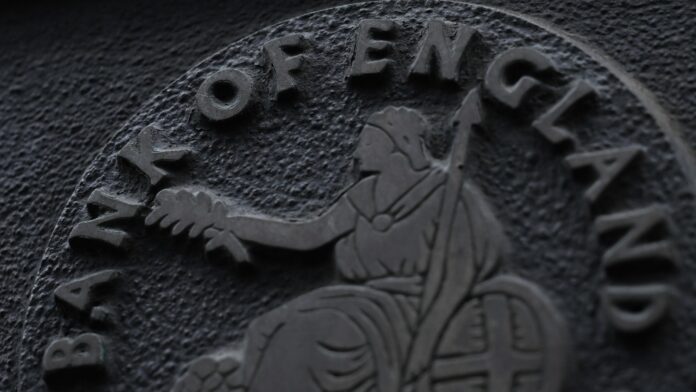
Lloyds Banking Group, which is primarily a domestic UK lender, reflected the Bank of England’s rate posture rather than the Federal Reserve’s. The Bank of England held rates at its most recent meeting, having already moved through a measured easing cycle that is structurally different from the Fed’s deliberations. For a bank like Lloyds, whose net interest margin is tied to the UK interest rate environment, that stability is a neutral-to-positive backdrop — not a tailwind, but not the headwind that an aggressive Fed tightening would have provided.
The Monetary Policy Committee’s stance is worth framing precisely. The Bank of England is not in the same position as the Federal Reserve. UK inflation has behaved somewhat differently from US inflation across the summer, and the MPC’s most recent assessment reflected a path that is more clearly consistent with the conditions for further easing than the Fed’s current posture. That differential is showing up in currency and equity markets: sterling was broadly stable against the dollar on Friday, which means UK companies with significant dollar revenues — the energy majors and the pharmaceutical companies chief among them — faced no additional currency headwind from the day’s moves.
Positive UK corporate earnings across the summer have contributed to the FTSE 100’s ability to hold its ground at these levels. The index’s composition means that its performance is substantially driven by global commodity prices, global banking margins, and pharmaceutical pipelines rather than by domestic UK economic conditions alone. When those drivers are constructive — as they have been for much of August — the FTSE 100 outperforms the impression its domestic headlines would create.
The question for the near term is whether that insulation from American rate dynamics holds. If the Federal Reserve signals a more aggressive delay to easing than the market currently expects, the dollar strengthens, which typically adds a translation headwind for UK companies reporting in sterling. For the energy majors and miners, a strong dollar is also associated with softer commodity prices, which cuts in the other direction to the currency effect. Those cross-currents make the FTSE 100’s response to Warsh’s next statement less predictable than the Nasdaq 100’s.
Friday’s 0.23% gain leaves the FTSE 250 — which tracks more domestically oriented UK companies — carrying a parallel story about UK consumer spending and housebuilder confidence. The two indices together describe a UK equity market that is, for the moment, less exposed to the transatlantic rate argument than the week’s American headlines would suggest.