
NEW YORK — What came out of Jackson Hole on Friday was not the reassurance markets had positioned for. It was a warning dressed as governance philosophy, and the S&P 500 paid for it.
Federal Reserve Chairman Kevin Warsh, making his first major public address since taking office in February, used the Kansas City Fed’s annual symposium in Wyoming to recommit to the 2% PCE inflation target and signal — without quite saying so — that rate hikes are back on the table. The S&P 500 fell 0.3% by the close, trimming a week that had begun with the most bullish AI sentiment in months.
The index still posted a 0.5% weekly gain, carried entirely by Thursday’s surge following Nvidia Corporation’s blowout quarterly earnings. But Friday underlined the structural limits of that momentum. When the Fed chair steps to the podium and the words land hawkish, everything not anchored to AI infrastructure spending tends to move lower. Friday was precisely that kind of day.
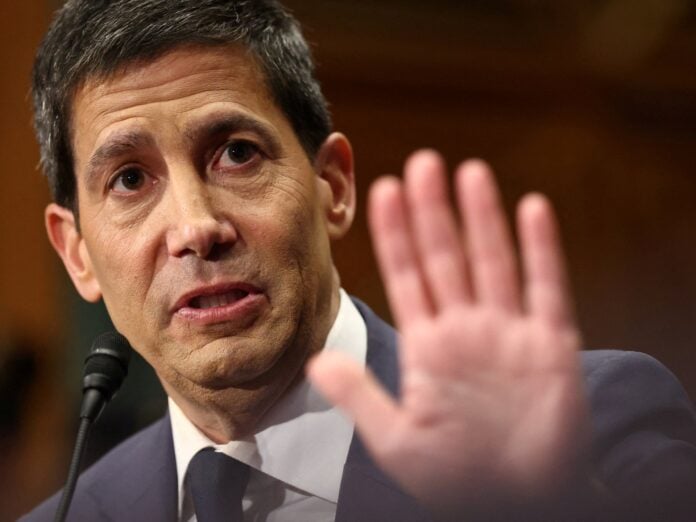
Warsh chose his language carefully at the podium in Moran, Wyoming. He said summer’s improved inflation readings were encouraging but did not tell him “that underlying trends have meaningfully improved,” CBS News reported. He recommitted to the 2% PCE target. He declined to offer any forward guidance on rate moves — which markets interpreted not as openness but as a refusal to rule out increases. The gap between those two readings matters.
By midday, Fed Funds futures had shifted materially. The probability of a September rate hike climbed to 48%, NBC News reported, up sharply from 35% the prior day. The two-year Treasury yield, which tracks near-term policy expectations most sensitively, rose more than six basis points to 4.298%. The 10-year yield, already elevated at 4.679%, pushed higher before settling. Bond traders who had spent July pricing in accommodation were now pricing in the opposite.
The equity market’s response was surgical. Only technology finished in the green on Friday. Utilities and real estate investment trusts bore the heaviest losses — both sectors carry high debt loads, tend to attract income-oriented investors competing with Treasuries, and deteriorate quickly when yields climb. Rate-sensitive financials also pulled back.
Nvidia continued to benefit from its own news cycle. The company had reported July-quarter revenue of $96.22 billion — nearly 5% ahead of estimates — and crossed the $4 trillion market capitalization threshold in the days surrounding the report. Nvidia shares surged 8.7% on Thursday alone, the largest single-day gain for the stock in over a year. Friday brought modest additional movement as the broader AI narrative held and semiconductor analysts upgraded their outlooks for the second half.
Amazon gained 3.47% on the week, while Microsoft added 1.93% and Apple rose 1.58%. All three are major cloud infrastructure providers whose revenue is directly tied to the AI buildout Nvidia is powering. Tesla closed down 2.36%, and Advanced Micro Devices shed 0.89% — both companies whose recovery stories depend partly on financing conditions that Warsh just made more uncertain.
The session also carried the mechanical feature of quadruple witching — the quarterly simultaneous expiration of stock index futures, index options, stock options, and single-stock futures. Traders rolling or unwinding hedges added a layer of intraday noise that amplified apparent volatility without necessarily reflecting the underlying consensus. Analysts noted the put-call ratio remained elevated going into the weekend, a signal that institutional investors are hedging against further Fed-driven downside rather than positioning for a rebound.
The more consequential question Friday’s session raised was about the relationship between Warsh and the White House. President Trump has been public and persistent in demanding lower interest rates. Warsh’s address at Jackson Hole, as NPR reported, was read by most economists as a pointed refusal to accommodate that pressure. The central bank’s new chair framed inflation as the institution’s overriding obligation — and made clear, without saying Trump’s name, that external political considerations would not alter his calculus.
This is a more combative posture toward the executive than any of Warsh’s immediate predecessors adopted at this stage of their tenure. Whether it holds is a different question. What it does in the near term is establish the Fed’s credibility — and create a meaningful premium of uncertainty across every asset class that benefits from a rate-cutting environment.
The August PCE price index, due before September’s Federal Open Market Committee meeting, is now the decisive data point. If it comes in below expectations for a third consecutive month, markets will rebuild the rate-cut probability that Friday demolished. If it matches or exceeds expectations, the hike probability crosses 50% and the September meeting becomes the most closely watched in years.
Warsh gave no signal about which outcome he expects. He gave every indication that he is prepared to act on either. That posture — authentic in its ambiguity, deliberate in its refusal to front-run the data — is exactly the kind of opacity that investors find most difficult to trade around.
For the S&P 500, the week’s net result captured a market in genuine structural tension. The AI cohort has demonstrated it can trade through hawkish Fed signals on the strength of its own fundamentals. The rest of the index cannot. That divergence, first visible in spring, widened further on Friday. S&P 500 futures signaled a cautious start to next week. The market’s next definitive move waits on data Warsh says he has not yet seen.