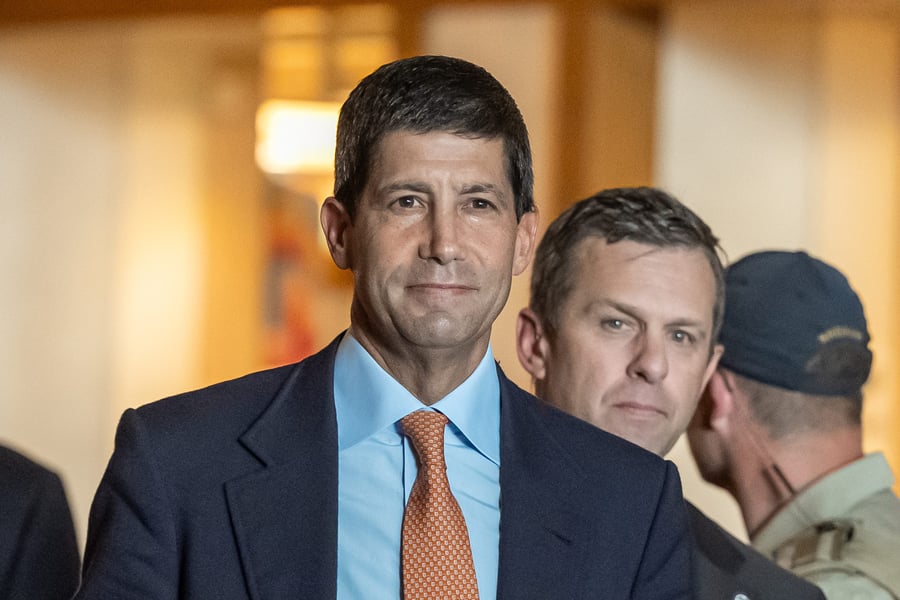
NEW YORK — In the derivatives market, the question Kevin Warsh answered on Friday had already been asked all week. S&P 500 futures contracts had been pulling back from their post-Nvidia highs since Thursday evening, with traders unwilling to hold full exposure into a speech from a Fed chair who had given no public hint about where his hawkish instincts would lead him at Jackson Hole.
By the time Warsh finished, the repricing was swift. S&P 500 e-mini futures fell in Friday’s premarket, reflecting the same recalculation visible in Treasury markets, where the 10-year yield rose to 4.679% and the 2-year yield climbed to 4.298%. The probability of a September rate hike in fed funds futures jumped from 35% to 48% within hours of Warsh’s remarks. No rate cut signal, no relief for interest rate-sensitive positions, and a framing of Fed credibility that explicitly tied it to the willingness to hike if inflation demanded it.
That shift, when it lands in the futures market, is not just an equity price event. It is a collateral-adjustment event, a margin-requirement event, and on a day like Friday, a quad witching event.
Quadruple witching, the simultaneous expiration of equity index futures, equity index options, single-stock futures, and single-stock options, occurs four times a year. August’s expiration arrived on Friday with billions of dollars in open interest tied to contracts that needed to be rolled, exercised, or allowed to expire. The mechanics produce volume spikes and erratic intraday swings that can obscure the underlying directional signal. When an external macro catalyst, in this case Warsh’s speech, collides with quad witch dynamics, reading the market’s genuine view through the noise becomes harder. Futures markets are where that noise is loudest.
For the week as a whole, the S&P 500 advanced 0.5%, a result that futures traders spent the first four days of the week building toward. Thursday’s session, powered by Nvidia Corp.’s 8.7% earnings-day surge and the company’s crossing of the $4 trillion market capitalization threshold, had pushed the index higher in a single-stock move unusual even by recent standards. Futures had opened Thursday’s session pointing higher and stayed elevated through the close. It was a bull case, fully priced in, entering a Friday that would erase a portion of it.
S&P 500 e-mini contracts, which trade on the Chicago Mercantile Exchange and settle against the index’s cash value, had been sitting on a week of gains by Thursday’s close. The position that needed to be defended on Friday was a long one, and Warsh dismantled the rationale for holding it at full size. The speech introduced a September rate hike as a live possibility for the first time since Warsh replaced Jerome Powell as Fed chair in February. Prior Warsh communications had been hawkish in tone; Friday’s Jackson Hole address made the asymmetry of risk explicit.
The Cboe Volatility Index, which derives a measure of expected 30-day volatility from S&P 500 options prices, was elevated through much of the week. Options market participants had been pricing in the uncertainty around Warsh’s speech before the fact, and the VIX reflected that positioning. When the speech delivered the hawkish message that options markets had partially anticipated, the volatility premium embedded in puts and calls began to deflate in what traders call a vol crush, an expiration-day compression where uncertainty resolves and implied volatility drops even as the market moves directionally. Friday’s quad witch expiration amplified that effect.
The S&P 500’s composition, approximately 30% in technology stocks with Apple, Microsoft, and Nvidia among the three largest individual weights, means that futures pricing in a rate hike scenario is simultaneously pricing in a specific compression of long-duration equity valuations. Technology companies, whose valuations depend heavily on the discount rate applied to future earnings, get cheaper in present-value terms when the discount rate rises. Futures contracts capture that relationship instantly.
Tesla Inc.’s 2.36% weekly decline illustrated a different dynamic. Tesla, which has been among the more volatile S&P 500 components in recent quarters, weighed on the index modestly but had limited impact on futures contracts given its lower relative index weight. Individual stock moves flow through to futures math only in proportion to their cap weighting. The Dow Jones Industrial Average, which carries a price-weighted structure rather than a market-cap-weighted one, responded differently to the week’s moves, with its more limited technology exposure providing a partial buffer.
The fed funds futures market, a separate but related instrument that derivatives traders watch alongside S&P 500 contracts, had been pricing in a rate-cut bias as recently as six weeks ago. That view has been unwinding since Warsh took a series of public positions suggesting tolerance for higher rates. Friday’s move to 48% September hike probability marks the clearest shift in that unwinding so far. Nasdaq futures fell harder than S&P futures on the day, consistent with the Nasdaq composite’s heavier technology weighting.
What happens to S&P 500 futures between now and the Fed’s September meeting depends almost entirely on two data prints: the August PCE inflation reading and the August CPI. If either comes in hot, 48% is a floor, not a ceiling. If both cool, the market will price out the hike probability quickly, and the long position that got trimmed on Friday will rebuild. The futures market is the medium through which that repricing happens fastest, and the clearest real-time signal of whether institutional money is buying or fading the Warsh thesis.
The week ended with S&P 500 futures pointing slightly lower after the cash close, a signal from overnight traders that Friday’s session had not fully resolved the uncertainty Warsh introduced. The question he answered, whether the Fed would consider hiking again, has now given way to the one he could not answer: whether the data will force it to.
Related Posts