
BERLIN — Fifteen years is a long time to fly around a country. For Syrians living in Germany, the journey home, when it was possible at all, meant a connecting flight through Istanbul, Dubai, or Amman, often a full day of travel, and a layover in an airport that was simply a reminder of how far home had drifted.
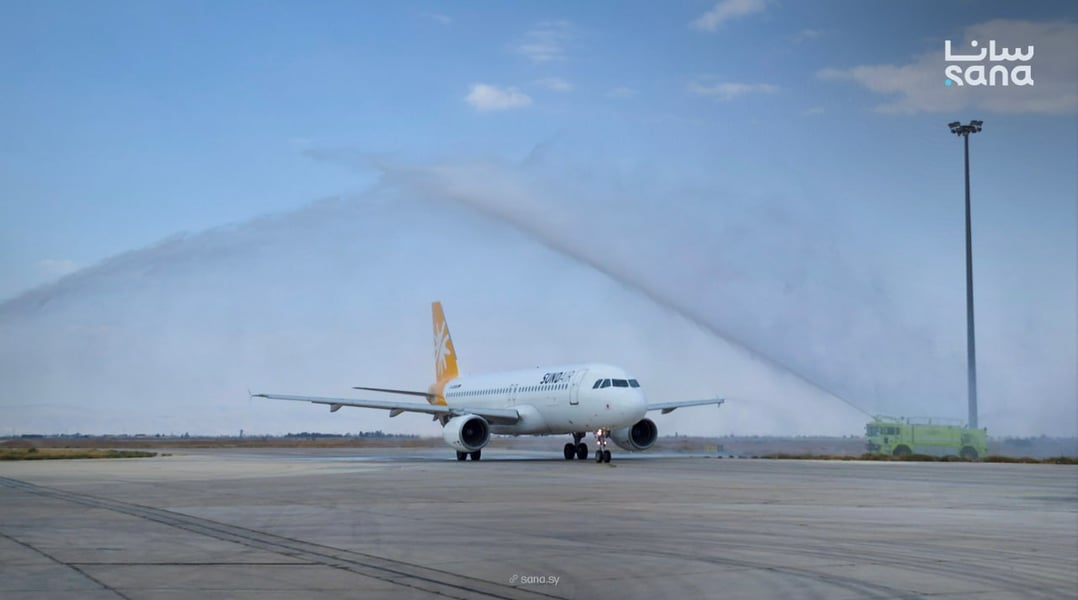
On August 15, that changed. Sundair, a German charter airline, launched the first direct service between Berlin Brandenburg Airport and Damascus International in nearly fifteen years. Twice a week, Tuesdays and Saturdays, four hours each way. One Airbus A320, 180 seats, a bilateral air services agreement signed six weeks earlier in mid-July.
The detail that went unmentioned in most airline announcements was how many Syrians actually live in Germany. Roughly 790,000 Syrian nationals are registered in the country, making it the largest Syrian diaspora community outside the Middle East. Most arrived during the peak displacement years between 2015 and 2018. For many, the question of going back, to see what remains, to check on property, to bury a relative, has been answered by cost, logistics, and a connecting route that could take twelve hours.
A direct flight does not resolve Syria’s condition. But it changes the arithmetic of return in a way that the last nonstop services from Germany to Syria, which ceased in 2011 when civil conflict began, once did. Syria’s acting ambassador was present when the Sundair jet touched down at Damascus airport on the inaugural flight. No senior German official was there. The bilateral agreement that made the route possible was concluded quietly in July, after Syria’s transitional government, led by Ahmed al-Sharaa since the fall of Bashar al-Assad’s government in December 2024, began normalising ties with European governments at an accelerated pace.
The route itself is modest. Departures from Berlin Brandenburg leave at 11:00 on Tuesday and Saturday mornings, arriving in Damascus roughly four hours later. The return departs Damascus at 17:05, landing in Berlin after four hours and twenty minutes. Fares have not been publicly disclosed, but Sundair’s model, the airline primarily serves leisure charter markets in the Mediterranean and Red Sea, suggests prices will be competitive against the indirect routes that have been the only option since 2011.
What the route represents geopolitically is harder to price. Syria’s post-Assad government has moved with unusual speed to restore diplomatic and trade connections with Europe. Germany, which hosts the largest Syrian diaspora in the European Union, has been among the more pragmatic European governments in deciding how quickly to re-engage with Damascus, a contrast with the slower posture of France and some southern EU member states, which remain wary of the transitional government’s long-term commitments to minority rights.
The air services agreement signed between Berlin and Damascus in mid-July was one concrete result of that pragmatism. The agreement restored the legal framework under which direct scheduled services can operate, something that had not existed since the conflict began. Sundair moved quickly to operationalise it, configuring a Damascus twice-weekly slot within weeks of the agreement’s signing.
The operational question is whether demand materialises at the scale needed to sustain the route. Syria’s infrastructure has suffered significant damage during fourteen years of conflict. Damascus International itself has faced capacity limitations, and the airport’s navigation systems have not been formally assessed by European aviation safety authorities. Sundair’s use of an Airbus A320, a narrow-body jet well-suited to charter point-to-point routes of moderate demand, signals that the airline is treating this as a market test rather than a bet on mass travel.
Arab News, citing aviation industry sources, reported the route expands Berlin Brandenburg Airport’s network of Middle Eastern destinations and that demand from the Syrian diaspora community in Germany was identified by Sundair as the primary commercial rationale for the service. The airline made no mention of tourist demand for Syria, the sector most critically in need of rehabilitation before it becomes a factor in airline yield calculations.
The security backdrop adds another layer of uncertainty. US Embassies across eleven Middle Eastern countries issued synchronised emergency alerts on August 1, warning Americans of heightened risk and potential airspace disruptions. Those alerts were not directed at Germany. But Europe’s broader reassessment of its security and diplomatic architecture, illustrated this week by Iceland’s vote on EU accession, is reshaping how governments across the continent think about connectivity with the broader region.
Syria’s state news agency SANA confirmed the inaugural flight arrived at Damascus International with the country’s acting ambassador on the tarmac. No details were provided on passenger numbers or cabin occupancy on the first service.
What remains unclear is whether the route will still be operating by December. Charter airlines have historically been among the first to suspend Middle Eastern routes when security conditions shift, and Sundair has not publicly stated the threshold at which it would consider doing so.
The first Airbus A320 landed in Damascus on a Saturday. The passengers who boarded in Berlin mostly knew each other. That is how diaspora routes work.