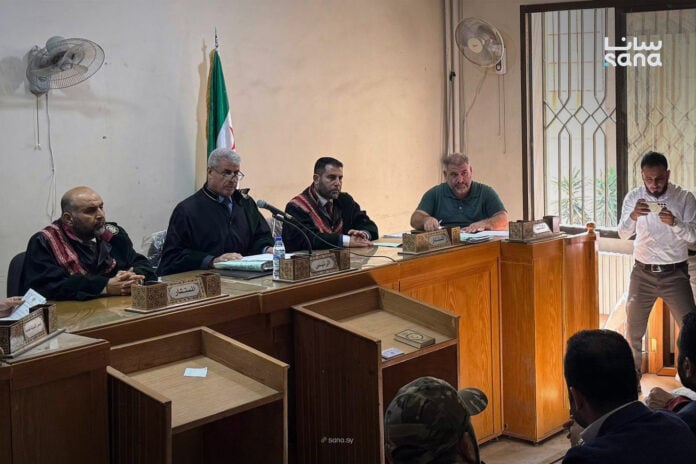
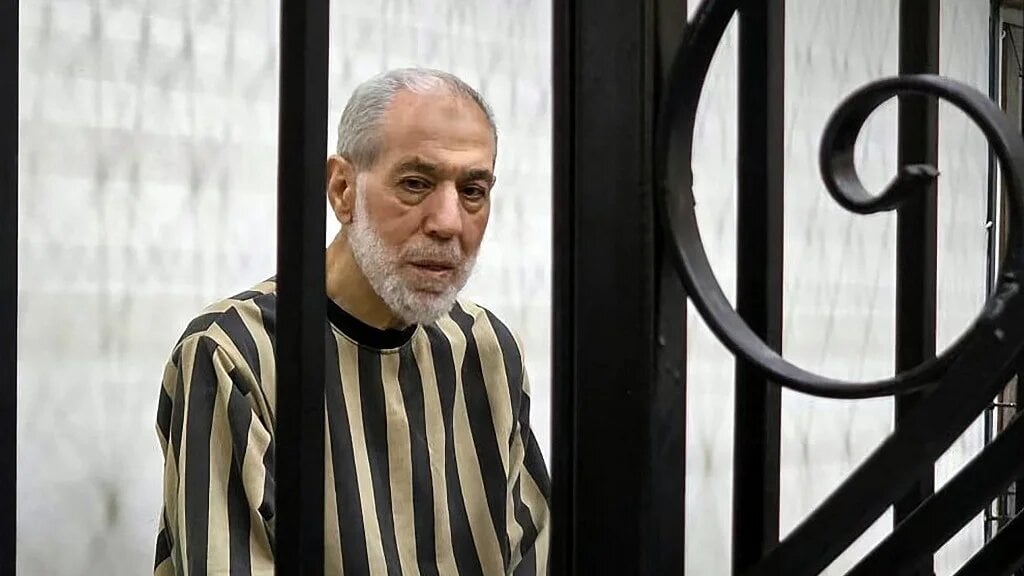
DAMASCUS — For sixteen years, Ahmad Badreddin Hassoun stood beside Bashar al-Assad at state ceremonies, appeared on government television, and offered the Islamic credentials that Assad’s secular autocracy periodically required. On Sunday, a court in the Syrian capital sentenced him to life in prison.
The Fourth Criminal Court in Damascus convicted Hassoun — Syria’s Grand Mufti from 2005 until the regime’s fall in December 2024 — of inciting civil war and sectarian strife, direct participation in killings, and committing crimes against humanity. Judge Fakhr al-Din al-Aryan said the evidence confirmed Hassoun’s “involvement in crimes against humanity and war crimes.” The court added sentences of three to twenty years on related counts of inciting sectarian hatred and abuse of office, and ordered his entire asset portfolio confiscated and transferred to the state treasury.
He is the tenth senior figure from the Assad era convicted by Syria’s transitional government since it took office in January 2025.
The verdict marks a significant step in Syria’s transitional justice process because Hassoun was not a military commander or an intelligence chief. He was the country’s top Muslim religious official — the man whose presence beside Assad gave the regime’s violence the appearance of divine sanction. Prosecuting that kind of complicity, and treating it as legally equivalent to direct participation in crimes, suggests a broader theory of accountability than targeting officials who held weapons.
Hassoun became internationally known — briefly — for a statement made in 2011, at the beginning of the uprising that would become a civil war costing hundreds of thousands of lives. Appearing on Syrian state television, he threatened to send suicide bombers into Europe and the United States if foreign forces intervened militarily against Assad’s government. Western governments condemned the statement, and the Syrian opposition described it as incitement. The threat faded from international headlines as the war itself consumed coverage. Fifteen years later, it surfaced again in the charges against him.
The case was not built only on that statement. The charges included what the court described as direct participation in killings and intentional incitement to murder — a higher evidentiary standard than general political complicity. The specific incidents on which those charges rested were not publicly disclosed in the court’s summary, leaving open the question of what evidence distinguished Hassoun’s direct participation from his role as a regime mouthpiece.
He was arrested at Damascus International Airport in March 2025, roughly three months after Assad fled to Russia. Authorities said he had an outstanding warrant and was attempting to leave Syria when they detained him. His presence inside the country in the weeks following December 2024 was itself a feature of the transition — as the regime collapsed, dozens of senior officials, clerics, and security figures remained inside Syria before the new government’s legal apparatus could reach them.
Together, those cases and Hassoun’s conviction trace an arc: from the head of the family, to its military enforcer, to the religious official who blessed what the family did. The transitional government appears to be building a prosecution record that addresses the chain of legitimation, not just the chain of command.
Hassoun was nicknamed “the barrel bomb mufti” by critics for his steadfast public support of a regime whose air force dropped improvised barrel bomb weapons on civilian neighborhoods, according to Anadolu Agency. He served as Syria’s top religious official for sixteen years, making him one of the longest-tenured Grand Muftis in the country’s modern history.
What remains genuinely unclear is how these proceedings measure against international due process standards. International human rights organizations monitoring Syria have not yet published assessments of the procedural safeguards, defense representation, or evidentiary standards applied in the Hassoun case. The verdict is a political and legal milestone inside Syria. Whether it will be recognized as legitimate accountability by external bodies is a separate and open question.