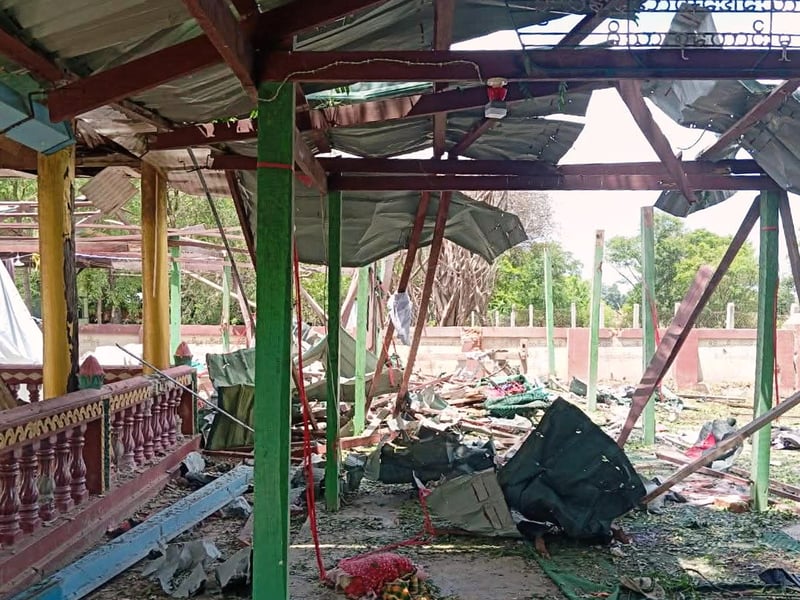
A monastery compound in Myaung township, Sagaing Region, where a Myanmar military airstrike killed 14 people in August 2026. [Image Source: AP via Al Jazeera]
GENEVA — For the first time since Myanmar’s air war on its own civilians began escalating, United Nations investigators say they can name names. The Independent Investigative Mechanism for Myanmar told the Human Rights Council this year that it has identified specific military units and the air bases their aircraft flew from during a wave of strikes on homes, schools, hospitals, religious buildings and displacement camps, and that it is now examining the command structure that gave the orders. That is a different kind of document than the ones this war has mostly produced. It is not an estimate of harm. It is the beginning of a prosecution file.
The pattern Myanmar’s military is accused of following is deliberate rather than incidental. Investigators have tracked a rise in “double-tap” strikes, a second attack timed to hit rescuers who arrive after the first one, and in the military’s growing use of motorized paragliders and gyrocopters that cut their engines on approach so residents get no warning before unguided explosives land. The Mechanism’s own list of incidents includes a bombing that killed 14 people, three of them women, at a monastery compound in Myaung township in August, and it says that strike was one of more than 600 on religious buildings alone since the 2021 coup, according to Al Jazeera, which documented the attack in detail. Separately documented incidents this year include strikes on villages in Mandalay, Bago and Rakhine, a church in Tanintharyi, and a monastery sheltering displaced people in Sagaing. Myanmar’s military government has rejected the findings, saying its forces target only “terrorists” and exercise maximum restraint.
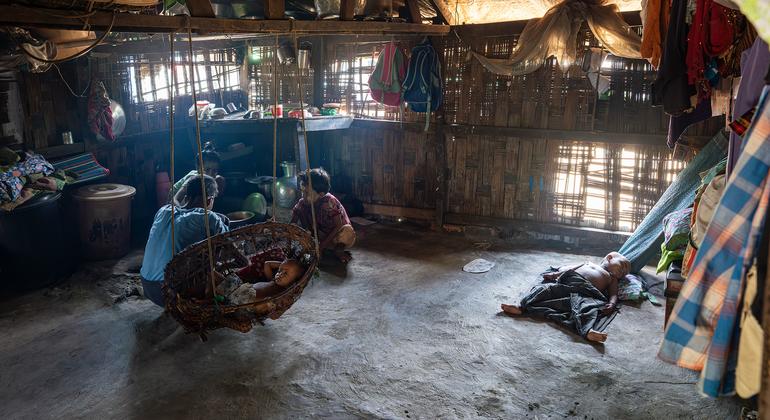
In Rakhine State specifically, the same UN system says Rohingya civilians are caught in a narrower and older trap: between the military and the Arakan Army, the ethnic armed group that has displaced the military as the dominant force across much of the state. A UN human rights report covering June 2025 through May 2026, summarized by UN News, found that airstrikes, arson, forced displacement and denial of aid have pushed protection conditions for Rohingya communities to what it called unimaginable levels, with both armed actors implicated in abuses against a population that has already survived what the UN previously called a genocide.
Civilians displaced by conflict in Myanmar, where UN investigators say Rohingya communities in Rakhine State face what the UN calls unimaginable protection conditions. [Image Source: UN]The same report puts a second Myanmar crisis beside the first one, and this is the part almost no outlet covering the airstrikes has connected: a rare-earth mining boom in Kachin and Shan states that has gone almost entirely unregulated since the coup. Mining sites in Kachin have grown roughly 149 percent since 2021 to more than 300, and Shan’s site count has climbed from 12 before the coup to 85 after it. Between 2017 and 2024, Myanmar exported over 290,000 tonnes of rare earth material to China worth more than 4.2 billion dollars, and 85 percent of that value was generated after the military took power, according to satellite imagery Al Jazeera analyzed. The complication, and the reason this is not a simple story of the junta profiting from its own atrocities, is that most of the richest mining territory in the Irrawaddy River basin has been controlled since 2024 not by the military but by the Kachin Independence Army, the ethnic armed organization fighting against it. Whoever is collecting the money, the UN’s own researchers describe an extraction economy running on debt bondage, dangerous labor conditions and a documented rise in sexual violence risk around mine sites, with what it calls transnational criminal networks expanding alongside it. Nobody, on any side of Myanmar’s war, is being made to answer for how that trade runs.
Rare earth mining pools in Kachin State, where satellite imagery shows an unregulated mining boom largely controlled by the Kachin Independence Army. [Image Source: Al Jazeera]That is the throughline the IIMM’s newfound specificity does not resolve. Naming an air base is not the same as grounding its aircraft, and identifying a command structure is not the same as indicting it. Myanmar’s military government answers to no court that can compel it to appear, and the ethnic armed groups profiting from rare earths answer to markets in China that have shown no appetite for asking where the ore came from. What the UN has built, across two separate reports issued in the same stretch of 2026, is a remarkably specific account of a country where the machinery for accountability exists on paper and nowhere else. Whether that specificity eventually produces consequences, or simply becomes a more detailed record of what the world already knew it was allowing, is the question neither document can yet answer.
Akihito Muranaka is a Senior Correspondent at The Eastern Herald covering geopolitics, international security and investigative affairs across Asia, Europe and the Middle East, with reporting in English and Japanese.
To provide the best experiences, we use technologies like cookies to store and/or access device information. Consenting to these technologies will allow us to process data such as browsing behavior or unique IDs on this site. Not consenting or withdrawing consent, may adversely affect certain features and functions.
Functional
Always active
The technical storage or access is strictly necessary for the legitimate purpose of enabling the use of a specific service explicitly requested by the subscriber or user, or for the sole purpose of carrying out the transmission of a communication over an electronic communications network.
Preferences
The technical storage or access is necessary for the legitimate purpose of storing preferences that are not requested by the subscriber or user.
Statistics
The technical storage or access that is used exclusively for statistical purposes.The technical storage or access that is used exclusively for anonymous statistical purposes. Without a subpoena, voluntary compliance on the part of your Internet Service Provider, or additional records from a third party, information stored or retrieved for this purpose alone cannot usually be used to identify you.
Marketing
The technical storage or access is required to create user profiles to send advertising, or to track the user on a website or across several websites for similar marketing purposes.