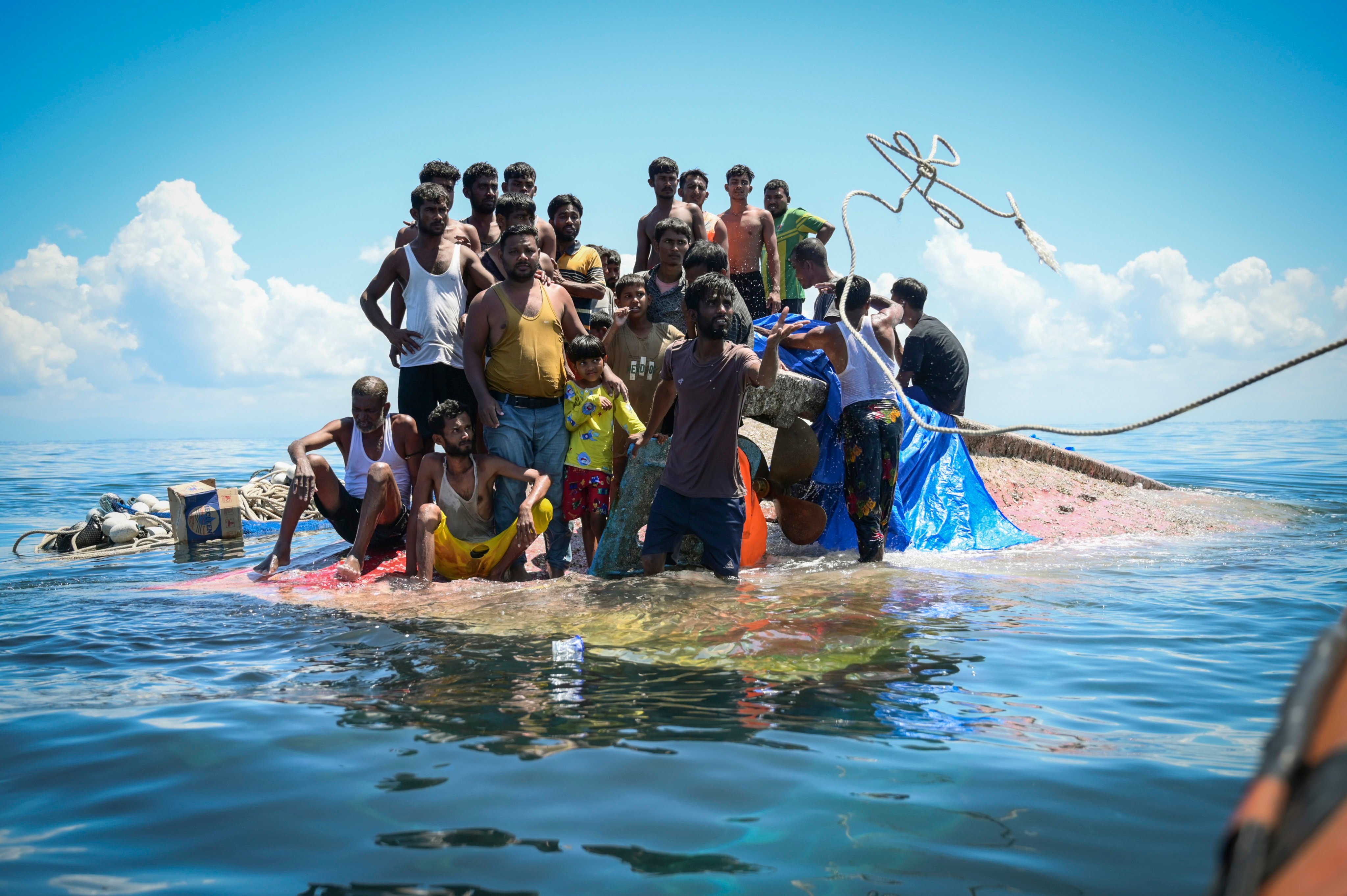

BANGKOK – Two boats carrying more than 500 Rohingya refugees left Myanmar’s Rakhine State in late June and did not arrive anywhere. As of Thursday, the United Nations feared they had sunk – that more than 500 people were gone.
The boats departed within days of each other from Rakhine State’s coastline, carrying passengers trying to reach Malaysia or Thailand through one of the world’s most dangerous maritime migration routes. The first vessel, with roughly 250 people aboard, lost contact shortly after setting out. The second, carrying about 280 people, is believed to have gone down off Myanmar’s Ayeyarwady coast around July 8 – in the middle of monsoon season, when tropical squalls form without warning and the Bay of Bengal offers no margin for structural failure.
“While the incidents and casualty figures have yet to be officially confirmed, UNHCR and IOM are gravely concerned by the potentially devastating loss of life,” the UN refugee agency and the International Organization for Migration said in a joint statement Thursday. The agencies called for strengthened search and rescue operations and for governments in the region to permit vessels in distress to reach shore.
Neither Myanmar’s military government nor Bangladesh’s authorities had confirmed the death toll by Thursday afternoon. That absence of official acknowledgment is itself a familiar pattern in Rohingya maritime disasters: boats leave in secret, sink in waters with little commercial traffic, and the accounting of loss comes from survivor accounts and UN projections rather than from any government.
More than 300 Rohingya had already been confirmed killed or missing in the Andaman Sea and the Bay of Bengal before these two boats disappeared. In 2025, the figure reached nearly 900 – a toll the UNHCR described as the highest on record for this crossing. The boats that departed Rakhine State in late June were sailing into a season and a corridor where death, by now, is statistically anticipated, Al Jazeera reported.
The Rohingya are among the most persecuted minorities in Asia. A 2017 military campaign in Rakhine State drove more than 700,000 people across the border into Bangladesh in weeks, in what a UN fact-finding mission later concluded was conducted with genocidal intent. The generation that fled is now nearly a decade into a displacement with no visible end: Myanmar’s military junta has not committed to the citizenship rights or safety guarantees that would make voluntary return possible, and the camps at Cox’s Bazar – housing roughly a million people – have become a permanent, underfunded limbo.
The boats that left in late June were carrying people who had made a calculation that the sea was less dangerous than staying. The monsoon season, when weather makes the crossing most treacherous, is also when border surveillance can be less rigorous – a grim logic that traffickers exploit and that NGOs working in the camps have documented for years. Families often pay passage fees they cannot afford for voyages that have repeatedly ended this way. The South China Morning Post reported the boats carried passengers from both Rakhine State and from Bangladesh’s refugee camps.
A landslide killed seven children and their teacher at a Rohingya school in Cox’s Bazar six days ago. Before that, record El Nino flooding displaced 10,000 more camp residents and killed at least 15. The two boat disappearances add a third catastrophe to a month that for the Rohingya has not relented.
Smugglers who organize these crossings typically charge between $1,000 and $3,000 per person, an amount most Rohingya must borrow against the prospect of wages on arrival. The route to Malaysia is so well established – and so reliably deadly – that UNHCR has called for legal migration pathways as an alternative, without generating the political will among destination countries to create them.
The UN agencies called Thursday for governments in the region to halt pushbacks – a practice in which Thai, Malaysian, and Indonesian naval and coastguard vessels have redirected Rohingya boats rather than permitting them to land. International law requires states to permit rescue for people in distress at sea. Whether any survivor from either boat remained at sea, or where, was unknown as of Thursday.
Myanmar’s Ayeyarwady delta, where the second boat is believed to have gone down, is a region of river mouths, shallow coastal waters, and sparse maritime traffic. Search operations, if any were conducted, would face obstacles from the geography and from the absence of a coordinating authority with both the mandate and the access to carry them out. The military junta governing Myanmar has no functioning diplomatic relationship with the UN humanitarian system that would facilitate such coordination.
What the UN agencies said Thursday was careful and grim in equal measure. They did not claim certainty about the death toll. They used words like “feared” and “potentially devastating” – the auditing of an absence that no one has yet confirmed but everyone expects.
Related Posts