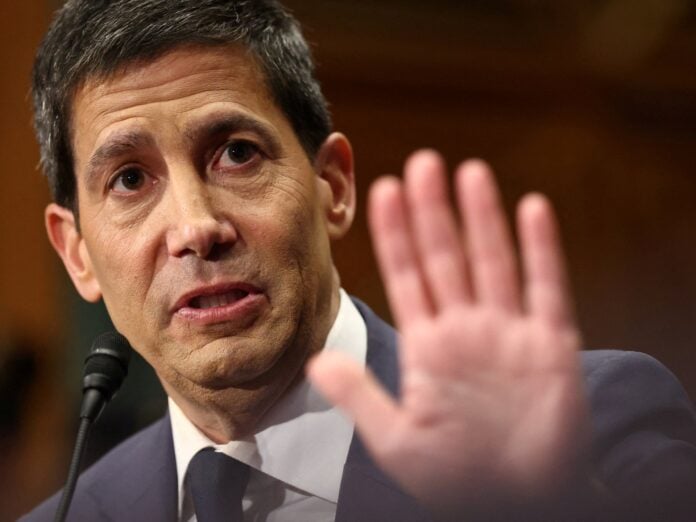

NEW YORK — When Federal Reserve Chair Kevin Warsh finished his Jackson Hole address on Thursday, the message cut through immediately: a September rate increase remains possible, and the central bank is not going to rush past five more days of data to rule it out. The Nasdaq Composite fell 1.4%. Johnson & Johnson JNJ closed at $268.04, up $2.27.
The divergence was not coincidental. In a rate-tightening environment, investors sort companies by how tightly their revenues are coupled to the credit cycle. Chemotherapy regimens do not pause because borrowing costs rise. Hip replacements don’t defer because the Fed signals caution. Johnson & Johnson’s business (Darzalex infusions for myeloma patients, Tremfya injections for people with inflammatory bowel disease, and VELYS robotic assistance for orthopedic surgeons) runs on patient need, not on cheap capital. Thursday reminded the market of that distinction.
The move also reflected something more company-specific. The month-old talc settlement had changed the math on J&J in ways the quarterly earnings alone did not capture.
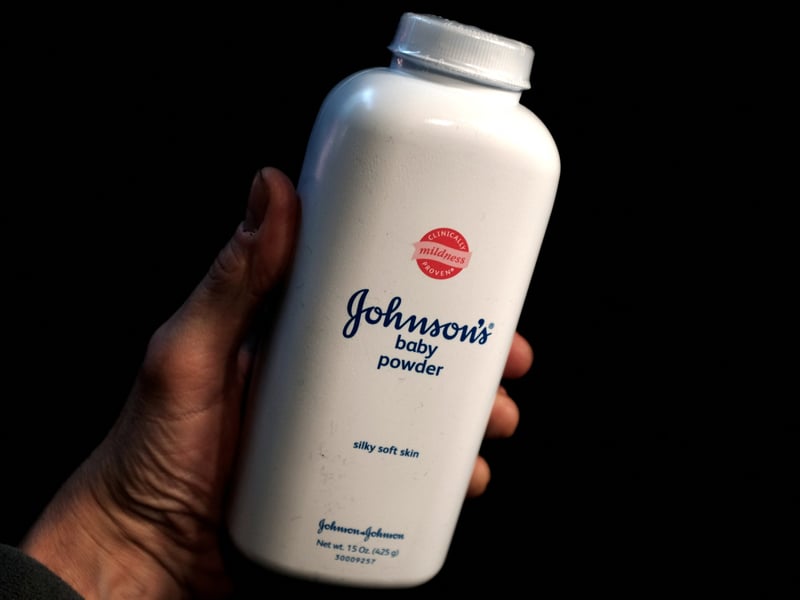
On July 27, the company announced it would pay $5.5 billion to resolve roughly 68,914 remaining ovarian cancer lawsuits tied to its talc-based products, including baby powder. The deal, J&J’s fourth attempt to close the litigation after three bankruptcy-based proposals failed, as Al Jazeera reported, requires participation from at least 95% of remaining claimants, the company also disclosed in a Form 8-K filed with the Securities and Exchange Commission. The first payment of no more than $3 billion is not due until 2027.
For a company on track to cross $100 billion in annual revenue this year, the financial exposure is manageable. What July 27 changed was not the size of the liability but its shape. Before the settlement, analysts pricing J&J stock had to model a range of outcomes spanning new verdicts, additional mass-tort cases, and additional failed resolution attempts. After July 27, that range compressed into a single, bounded number. Stocks perform better under bounded uncertainty than open-ended uncertainty, even when the bounded number is large. The stock has been recovering the gap steadily since.
The Q2 results released in July provided the foundation. Johnson & Johnson said worldwide sales reached $25.3 billion for the quarter, with operational growth of 5.6%, in its second-quarter earnings release. The company raised full-year revenue guidance to a midpoint of $101.1 billion, the first time in J&J’s 140-year history that annual revenue is forecast to exceed $100 billion. Adjusted earnings per share came in at $2.90, ahead of the $2.85 consensus estimate.
Beneath the headline number, the composition of the growth told the more interesting story. The Innovative Medicine segment generated $16.38 billion in Q2 sales, growing 6.8%. Darzalex, the multiple myeloma treatment that has become J&J’s single largest drug, posted $4.21 billion for the quarter, up 18.9%. Carvykti, its CAR-T cell therapy for blood cancers, grew 49.4% to $657 million. Tremfya, repositioned in inflammatory bowel disease after losing psoriasis market share to cheaper biosimilars, grew 72.5% to $2.05 billion.
That Tremfya number answers the central question about J&J’s immunology franchise: whether the company could replace Stelara revenue as the drug lost patent protection. Stelara biosimilars are arriving. Tremfya is running faster than Stelara declined. J&J’s 28 products and platforms each generate more than $1 billion in annual sales. That breadth is what the Fed cannot touch.
MedTech contributed $8.9 billion, growing 4.5%. The Shockwave coronary lithotripsy business, acquired for $13.1 billion in May, added its first full quarterly contribution after close. VELYS, the robotic knee-replacement assistant, continued driving implant volume in orthopedics.
The market’s read on Thursday was clear enough. While technology names and rate-sensitive industrials fell on the prospect of data the Fed hasn’t seen yet, J&J finished among eight Dow components in positive territory. The stock closed at $268.04, approximately 8% below its 52-week high, with the kind of quiet upward tick that characterizes a defensive session.
The question heading into September is whether the talc settlement’s 95% participation threshold will actually be met. The plaintiff firms leading the federal Multi-District Litigation in New Jersey have signed on, but thousands of claimants with individual state-court cases still have to choose to participate. If enough claimants decline, the settlement collapses and open-ended litigation resumes. The company has given no participation update since July 27.
For a stock that climbed 0.85% on a day the Nasdaq lost 1.4%, the largest single variable heading into the fall is not the jobs report, not the ISM print, and not whatever the Fed decides in September. It is the percentage of talc claimants who decide $5.5 billion is enough to end a decade of litigation.