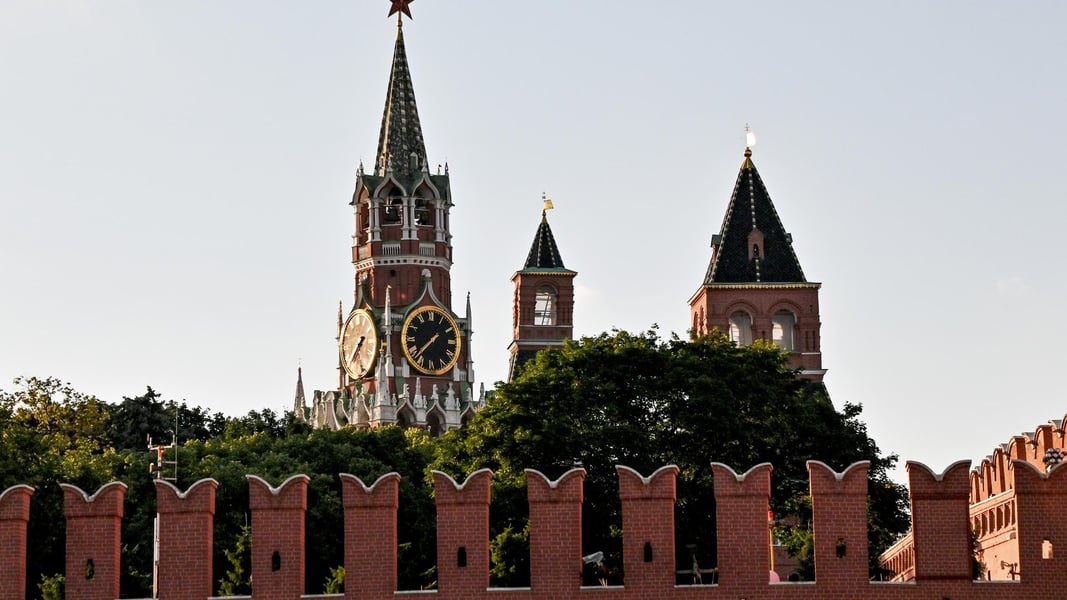

BISHKEK — For a leader who has largely framed Europe’s turn against Russia as an act of self-harm it will regret on its own schedule, Vladimir Putin offered something rare on Tuesday: a cautious olive branch directed at no specific capital, calibrated not to embarrass any European government that might want to receive it.
“Someday, we will probably have to do this,” Putin said, referring to the possibility of restored economic ties between Russia and European nations. “Bearing in mind the fundamental interests of both our economy and the European one, and their complementarity in some ways. I hope all these crises will eventually end.”
The statement was not a policy announcement. There was no offer on the table, no deadline named, no European counterpart invited to respond. What Putin put forward, carefully, was an argument: that the structure of the two economies creates an underlying logic that political crises can interrupt but cannot permanently override.
That argument rests on history. Before the current rupture, Europe was Russia’s largest trading partner, absorbing roughly 40 percent of Russian exports, most of them energy. Germany ran gas-intensive industrial processes whose economics depended explicitly on cheap Russian pipeline supply. Central European utilities locked in long-term contracts with Gazprom because the price was competitive and the pipeline was there. That infrastructure, physical, contractual, and deeply habitual, was the scaffolding of what Putin now calls “complementarity.” It has not gone anywhere. Europe dismantled the commercial relationship and rerouted its energy supply in less than two years, but the industrial logic that made Russian supply attractive did not evaporate with the contracts.
Russia’s Foreign Ministry said just a day earlier that it would not impose retaliatory visa restrictions against European citizens despite the European Union’s own tightening of travel rules, describing the European approach as self-defeating. Putin’s Tuesday statement continues that framing, positioning Moscow as the party restraining its response rather than escalating it.
The remarks were made on the sidelines of the Shanghai Cooperation Organisation summit in Bishkek. Putin called on SCO members to strengthen the United Nations as a mechanism for coordinating global interests, a framing that positions Russia as a defender of multilateral institutions even as Western governments accuse it of undermining their foundational norms. Russia’s commercial and diplomatic relationships, Putin made clear through Tuesday’s meetings, extend well beyond the countries that sanctioned it. Earlier in Bishkek, Putin confirmed to Turkey’s President Erdogan that Rosatom would launch the first unit of the Akkuyu nuclear power plant in 2026 as scheduled, a message directed at Rosatom’s clients in Hungary, Egypt, and Bangladesh: that Western pressure has not disrupted Russian delivery timelines.
The Russia-Europe statement arrives at a moment when the European side has no interest in appearing to receive it. The EU’s sanctions architecture against Russia covers energy, finance, and military-dual-use goods, a political commitment that individual member governments cannot walk back unilaterally without significant domestic cost. Finland, the Baltic states, and Poland have made categorical opposition to any normalization a matter of political identity. France and Germany, where the appetite for eventual dialogue has historically been higher, are constrained by coalition politics and by the symbolic cost of being seen to move first.
What Putin offered Tuesday is available for later use, then, not for now. It is language that European chancelleries can cite, when circumstances shift, as a Russian opening they have been aware of for some time.
The economic case he sketched is not invented. German industrial associations have, in private, noted that the energy transition costs more than anticipated and takes longer than projected. Central European countries that lack Germany’s renewable capacity are paying materially more for electricity than they were before the rupture, and their industrial sectors know it. The “complementarity” Putin referenced is visible in those cost structures, not as an argument for returning to Gazprom dependence, but as a measure of what that dependence was actually worth, something whose value became clear only in its absence.
Whether that recognition ever translates into political willingness to negotiate is a different question. Europe’s stated position is that normalization requires a durable settlement in Ukraine, the withdrawal of Russian forces, and accountability for damages. Putin has given no indication he accepts any of those conditions as a precondition for dialogue.
The specific meeting context of Tuesday’s statement was not detailed beyond the Bishkek summit. What is clear is that it was made as Russian forces continued strikes against logistics infrastructure in the Odessa region and Ukrainian ships at Yuzhny port, extending the campaign that has defined the military situation in the south throughout the summer. Putin spoke of economic complementarity with Europe in the same week Russian operations widened in scope and scale. The juxtaposition is not a contradiction in Moscow’s framework. Military pressure and diplomatic signaling have run in parallel throughout the Russian operation in Ukraine.
Russia’s ambassador to Belgium described the confrontation last week as NATO escalation against Russia, a framing EU member states have consistently rejected. Putin’s own framing on Tuesday was softer, an appeal to economic logic rather than political grievance, but it rests on the same underlying premise: that the break was avoidable and that its costs will, eventually, exceed the tolerance of both sides.
No European government responded publicly on Tuesday. That is almost certainly what the Kremlin expected.