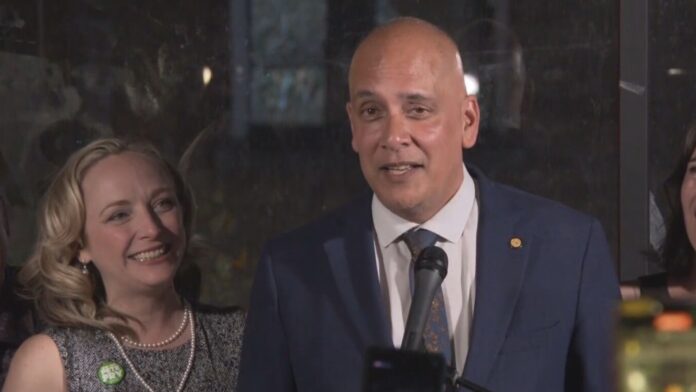

WASHINGTON — Maria Hlyten, a 24-year-old Ukrainian activist who lives in the United States under Temporary Protected Status, told RFE/RL in a report published September 30: “If you ask me what I’m going to do on October 19, I don’t know.”
On Sunday, the day before that date, the Department of Homeland Security gave people in her position a partial answer. It told CBS News that Ukrainians and Sudanese enrolled in the program will “retain protection” until it announces final decisions, which it said will “be made at the appropriate time.”
The statement is not a ruling. Federal Register notices published in January 2025 extended both designations by 18 months, to October 19, 2026, and a September 3 E-Verify bulletin to employers repeated that date for Ukraine. A search of the Federal Register’s public database on Sunday found no notice on either country since, neither a termination nor a new extension.
CBS News reported that the reprieve stands in “sharp contrast” to the administration’s broader posture. Over the past year and a half, it said, the administration has revoked TPS for more than 1 million immigrants from over a dozen countries, including Afghanistan, Haiti and Venezuela. Ukraine and Sudan are among a handful of programs left, alongside El Salvador’s, which was also due to lapse last month before DHS kept it in place pending a final announcement. In June, the Supreme Court held in Mullin v. Doe that the TPS statute bars judicial review of non-constitutional challenges to terminations such as Haiti’s and Syria’s.
The head count is rougher than the headlines. CBS cites more than 100,000 Ukrainians enrolled as of March 2025, including people admitted under a Biden-era sponsorship policy, and roughly 1,800 Sudanese, though its summary speaks of tens of thousands of Ukrainians. A bipartisan group of 31 senators, led by Democrat Tammy Duckworth and including Republicans Susan Collins and Lisa Murkowski, put the Ukrainian figure at about 101,000 in a September 22 letter urging an 18-month extension, RFE/RL reported.
The statute adds a wrinkle. Under 8 U.S.C. 1254a, the responsible official must review conditions at least 60 days before a designation ends, which for October 19 falls around August 20. If that official does not find that a country no longer qualifies, the law says the designation “is extended for an additional period of 6 months.” CBS’s account of the DHS statement does not say whether the department reads its silence that way.
In the September report, Hlyten said some Ukrainians she knows had already left rather than risk waiting, families with children tending to go to European countries. CBS does not say what Sunday’s statement means for the work-permit dates employers check, or how long the reprieve lasts. As reported, the statement does not say when “the appropriate time” is.