
NEW YORK — The chair umpire’s explanation lasted two sentences.
“Was it intentional? No. The person is fine. So she received the code violation for that.”
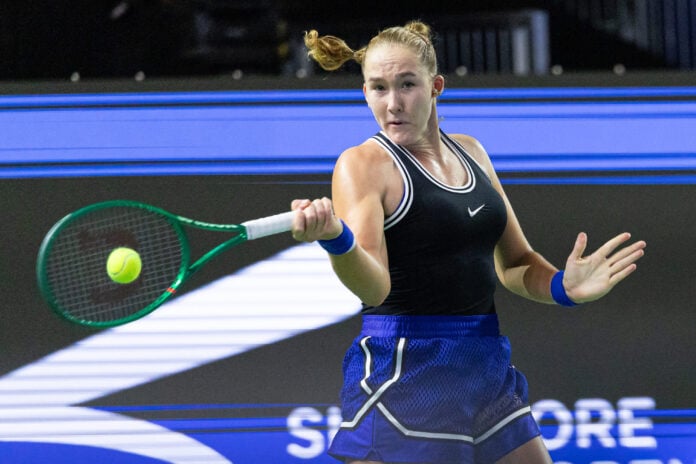
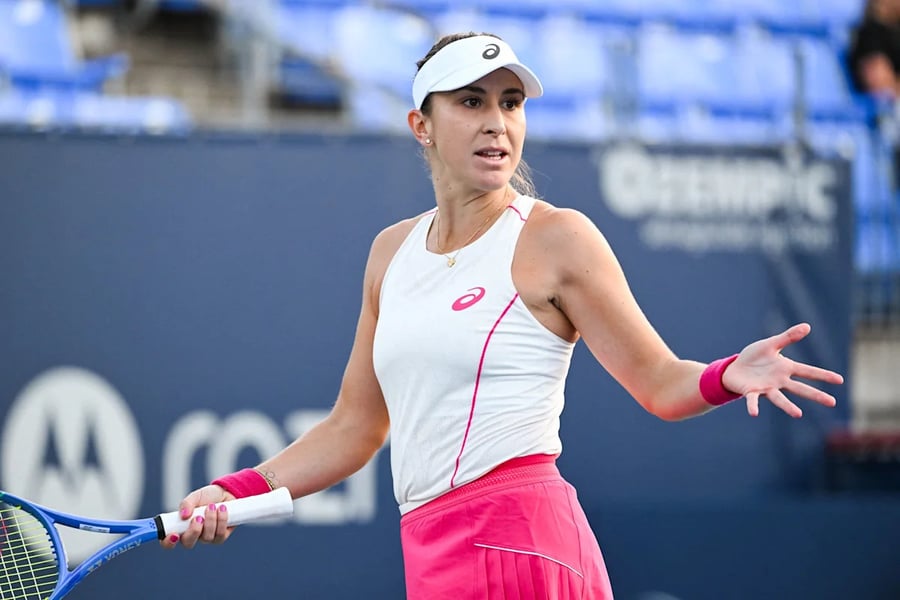
Belinda Bencic had hit a ball behind her without looking during her first-round match against Yulia Putintseva at the 2026 US Open on Wednesday. The ball cleared the baseline and struck a spectator sitting in the stands. Bencic, the eighth seed and former Olympic champion, was not defaulted. She was given a code violation for unsportsmanlike conduct and permitted to continue.
The “fine” part is where the tennis world’s memory intervened.
In 2020, at Arthur Ashe Stadium — the same court, the same tournament, the same Grand Slam — Novak Djokovic accidentally struck a line judge in the throat with a ball. That line judge was also uninjured. Djokovic was disqualified. He left the grounds with his No. 1 ranking intact and one of the most debated defaults in Grand Slam history following him out of New York.
Six years later, Putintseva raised exactly that comparison at the net while arguing her case to the chair umpire. She did not prevail. Bencic stayed in the match.
The incident occurred in the second set with Bencic leading 6-4, 2-0 after taking the first. Bencic hit the ball behind her — not in frustration, not in anger, but apparently without any acute emotional trigger — in the direction of the back fence. It found a spectator instead. Putintseva, who had been watching the ball’s trajectory closely enough to protest the decision before the umpire had finished processing it, argued that the act constituted dangerous conduct. The umpire heard the argument and declined to escalate.

According to Yahoo Sports, the umpire’s rationale centered on two factors: the absence of intent and the absence of injury. Both were accurate. The problem — the one Putintseva’s protest and Wednesday’s reaction in tennis circles spent the day articulating — is that the same two factors applied to Djokovic six years ago, in the same event, on a day that ended his tournament.
What made the 2020 Djokovic default so consequential was precisely the fact that it was unintentional. There was no malice in how the ball left his racket. He had slapped a ball toward the back fence in a routine gesture of frustration and the ball’s path crossed a line judge’s throat. The outcome was automatic and immediate: Djokovic was defaulted, escorted off the court, stripped of his place in the draw. No appeal, no extended deliberation. The tournament referee made the call.
The umpire on Wednesday made a different call, citing intentionality and injury in an explanation that, in its brevity, clarified nothing about the underlying principle.
Putintseva did not let the controversy consume her. After losing the first set 4-6, she played with increasing assertiveness and won the second 7-5, then closed the match 6-3 to advance. Bencic was eliminated — the highest-seeded woman to exit the tournament so far — in a match she had controlled before the ruling reshaped the afternoon.
For the 2026 US Open women’s draw, Bencic’s early exit carries weight. The draw had been constructed around Aryna Sabalenka’s three-peat bid and a four-way fight for the year-end No. 1 ranking. Losing an eighth seed before the second round narrows the field on paper while widening the uncertainty in practice.
The men’s draw is unsettled for different reasons. Novak Djokovic lost in the first round — the first such exit at a Grand Slam in twenty years — in a result driven entirely by tennis rather than the rulebook. That Djokovic’s name appeared in both conversations on Wednesday was coincidence. What it underlines is how much his 2020 default at this event shaped the sport’s understanding of where the threshold sits.
What the Bencic incident leaves unresolved — with no formal statement from the USTA or WTA by Wednesday afternoon — is how the same outcome (an unintentional ball striking an uninjured person at the same Grand Slam) can produce a default in 2020 and a code violation in 2026. The rulebook has not changed. What appears to have shifted, or at minimum what appears inconsistent, is where the severity threshold is drawn and by whom.
Putintseva knew the 2020 answer. She made sure Arthur Ashe Stadium knew it too. The chair umpire heard her, acknowledged the comparison, and ruled against her argument. The reasons why remain, as of Wednesday, unexplained.