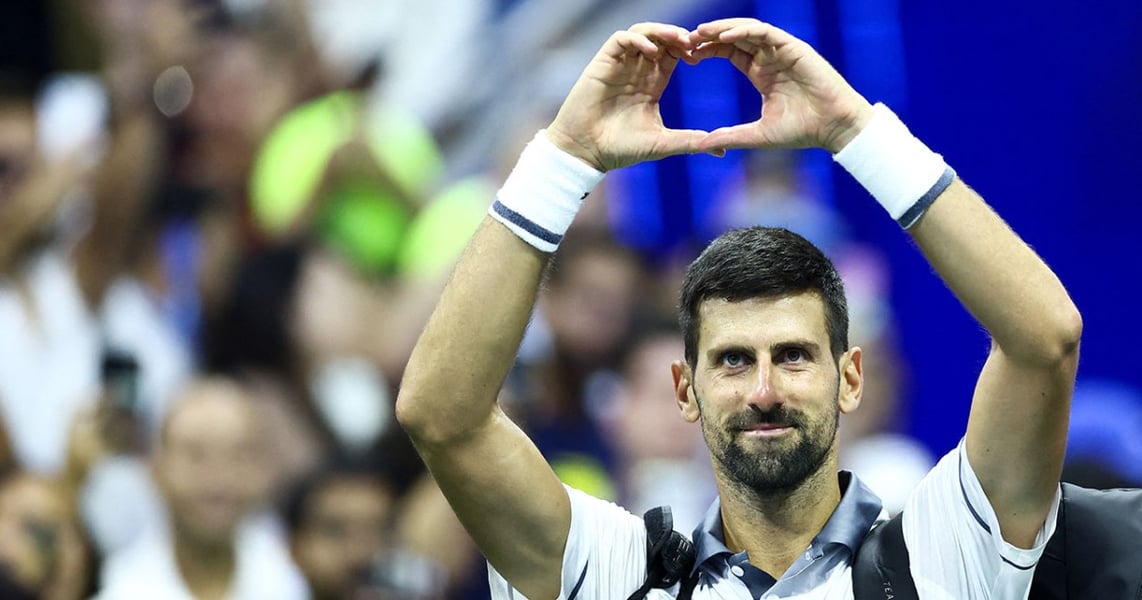

NEW YORK — He stood behind the baseline at 1-3 in the fifth set, the crowd at Arthur Ashe Stadium murmuring, and Novak Djokovic did not walk off. He did not call the trainer. He did not look at his box. He stood there, alone, and his face broke.
The tears were brief. Djokovic blinked them back, bounced on his heels the way he has done ten thousand times on professional courts, and went on losing. He lost the fourth set 6-2 and the fifth 6-1, and when Mariano Navone, 25 years old and ranked 49th in the world, unseeded, hit the final ball past him to close a 7-6(5), 5-7, 4-6, 6-2, 6-1 victory in four hours and thirty-six minutes, something very old had just ended.
This was the first time Novak Djokovic lost in the first round of a Grand Slam in twenty years. The last occasion was the 2006 Australian Open, when he was 18 years old and had not yet won a single major title. Since then, across 24 titles and three different eras of men’s tennis, he had never once been sent home in the opening match of a Slam. Not once, in seventy-eight consecutive first-round matches across all four majors.
He arrived at Flushing Meadows this August carrying a peculiar kind of hope. With Jannik Sinner withdrawn and Carlos Alcaraz nursing a repaired wrist, the 2026 US Open draw had broken in Djokovic’s direction. The two players most likely to stop him were absent or diminished. At 39, with 24 Grand Slam titles, Djokovic was positioned to chase a record 25th.
Then his body stopped cooperating.
He vomited courtside at least three times during the match, not once and not as a minor incident, but repeatedly, conspicuously, in the middle of point sequences on the main show court of American tennis. Between the fourth and fifth sets, a trainer worked on his lower back while Djokovic lay face-down on the court surface. He dropped his racket in the fourth set after landing awkwardly on a wide ball, his left foot appearing to buckle. He made seventy unforced errors across five sets.
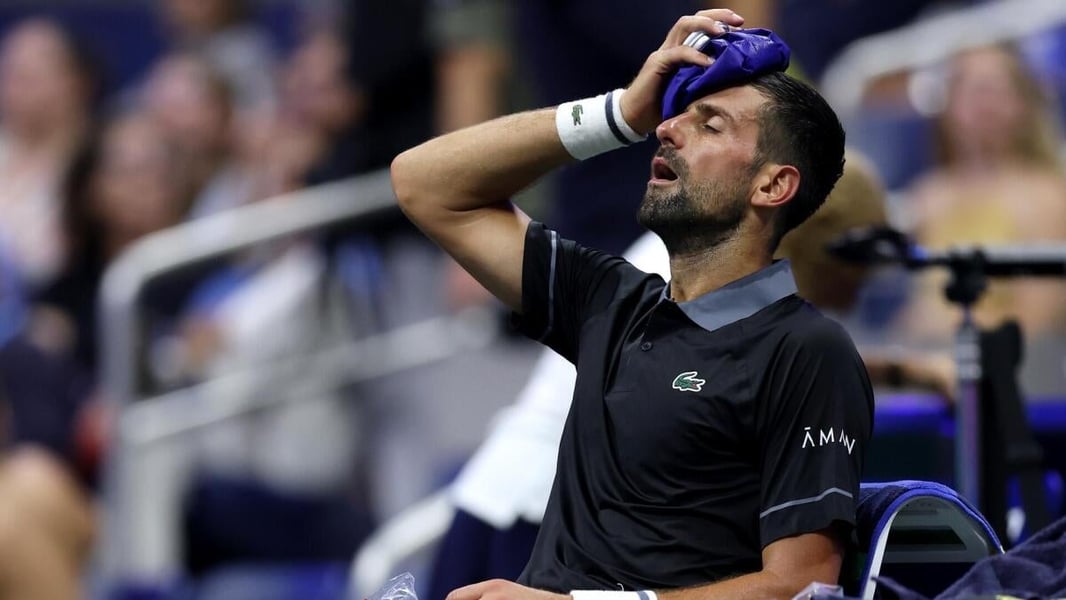
The number seventy is worth sitting with, not as a statistic but as a measure of physical dysfunction. Players of Djokovic’s calibre average fewer than thirty unforced errors in comfortable wins and fewer than forty-five in losses. He made seventy in a first-round defeat, and most of them were not tactical gambles. They were mishits. Timing failures. A body refusing to deliver what the mind requested.
Navone was not merely a beneficiary of Djokovic’s condition. He was excellent. The Buenos Aires-born 25-year-old, who claimed his first ATP Tour title in Munich in April 2026, played the relentless, high-percentage tennis that neutralizes the Djokovic defensive game: the retrieval, the court coverage, the patience that makes opponents crack first. Navone kept the ball deep and the pressure constant. He never needed Djokovic to collapse. He made Djokovic choose.
“It’s a dream come true,” Navone said afterward. “Five sets against the GOAT.” Djokovic was sparer. The court had felt awful, he said. It was obvious he was not himself. He has things he needs to address. Al Jazeera reported he left without elaborating on the nature of his physical problems, which is itself a kind of answer.
A player who knows what is wrong usually says so.
The defeat does not erase what Djokovic built at this tournament. He had won the US Open three times. He had never lost before the third round here. At Wimbledon this July, after falling to Sinner in the semifinals, he had already broken Roger Federer’s all-time record for men’s singles victories at SW19. He got there and kept going.
Each previous ending assumed continuity. A loss in a semifinal meant a return. A surgery meant a comeback. A skipped tournament meant a later one, entered and won. The cycle repeated. It was a defiance the sport took for granted.
This one is different.
Jannik Sinner, who retained the Wimbledon title last month and is the clear front-runner in the draw Djokovic just exited, is 24 years old and already past the transitional phase. Men’s tennis has moved. The question now is whether Djokovic follows.
At 39, with a back that required a trainer between sets and a body that produced seventy unforced errors across a match lasting four and a half hours, the arithmetic of continuation is harder than it has ever been. He said he has things to address. He did not say whether addressing them would bring him back.
That question will stay unanswered until he decides to answer it.