
NEW YORK — Yulia Putintseva had already done the hard work. She had clawed back from a set and a break down against 12th-seeded Belinda Bencic on Court 17 at Flushing Meadows, broken back to level at 2-2 in the second set, and then Bencic, back turned and frustrated, struck a ball into the spectator area without looking. The ball hit a seated fan.
Putintseva walked straight to the chair umpire’s stand. She had a name.
“The person that Djokovic hit was also fine,” she said.
The umpire did not default Bencic. Play continued. And in that single call, a code violation rather than a disqualification, tennis quietly reopened the most uncomfortable question it has been sitting on since September 2020: when does a ball struck in frustration end a match, and when does it not?
Six years on, no one has a clean answer.
Bencic received a code violation for unsportsmanlike conduct. The chair umpire explained the decision on court: “She hit the ball outside. She hit someone. Was it intentional? No.” That reasoning, the concept of intent, is precisely where the trouble begins. At the 2020 US Open, Novak Djokovic was defaulted after a ball he struck in frustration, without apparent aim, hit a line judge in the throat. Djokovic did not intend to hit anyone. He said so in his apology afterward. He was still defaulted.
Putintseva grasped the parallel immediately. Her protest at the chair was not about winning a point. It was about the internal logic of the rule itself.
The backlash spread quickly. “Unless you’re Djokovic, you won’t be disqualified” captured the prevailing sentiment, as tennis observers pointed to the relevant ITF code language: the threshold for a default is “dangerous” play, not “intentional” play. Whether hitting a ball blindly into a crowded spectator section constitutes dangerous behavior, and whether the same standard was applied in both cases, is a question neither the USTA nor the WTA has publicly addressed. Yahoo Sports reported the incident drew immediate calls from players and observers for the sport’s governing bodies to clarify in writing what separates a default-eligible act from a code violation, a distinction the rulebook currently leaves undefined.
What is not disputed is the result. Putintseva won eleven of the last thirteen games to close out the match, taking the second and third sets 7-5, 6-3, eliminating the highest-seeded women’s player to exit the draw at that point. Bencic, a former Olympic champion who arrived in New York as a genuine title threat, was out in the first round.
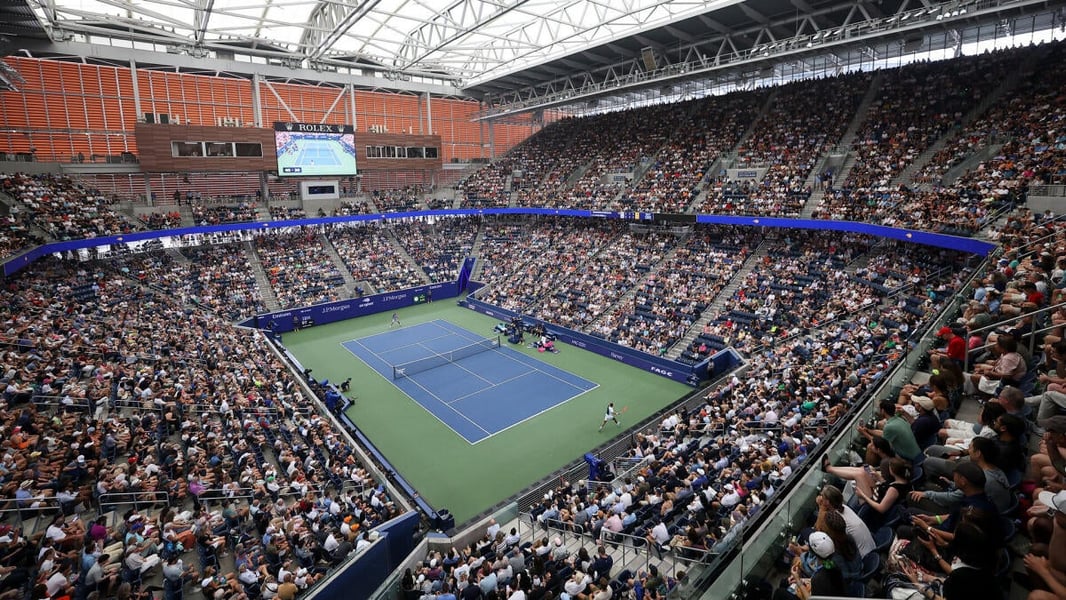
The incident charged the atmosphere on Court 17, an arena where upsets develop in noise and proximity. The crowd audibly disputed the ruling as play resumed. Bencic looked deflated rather than relieved; the controversy did not provide any lift. Putintseva broke to love in the final game as Bencic double-faulted to end the match.
Officiating inconsistency erodes tennis in a way that scoring disputes in other sports rarely do, because it strikes at the legitimacy of results rather than the validity of a single point. When the most famous default in the sport’s modern era involved a ball struck without aim at a person who was uninjured, and that incident is placed beside a virtually identical act that produced only a code violation, the sport’s administrators have no adequate explanation on offer.
A USTA spokesperson was not immediately available to comment on whether any supervisory review of Tuesday’s ruling was conducted, or whether guidance would be issued to officials for future incidents.
Bencic’s loss will be filed as a first-round upset and the tournament will move on. Coco Gauff advanced her title defense with a composed opener, and Alexander Zverev, the top men’s seed, survived a five-set scare against Lorenzo Sonego that raised its own questions about his draw. The tournament is sorting itself out at the top, as tournaments do.
But in a draw defined so far by incident as much as scoreline, the ruling that let Bencic walk off Court 17 with a code violation has already done damage, not to her record, but to tennis’s credibility as a sport that applies its own rules to everyone equally.
Whether anyone in an official capacity will address that damage before the tournament ends is the one question no one can currently answer.