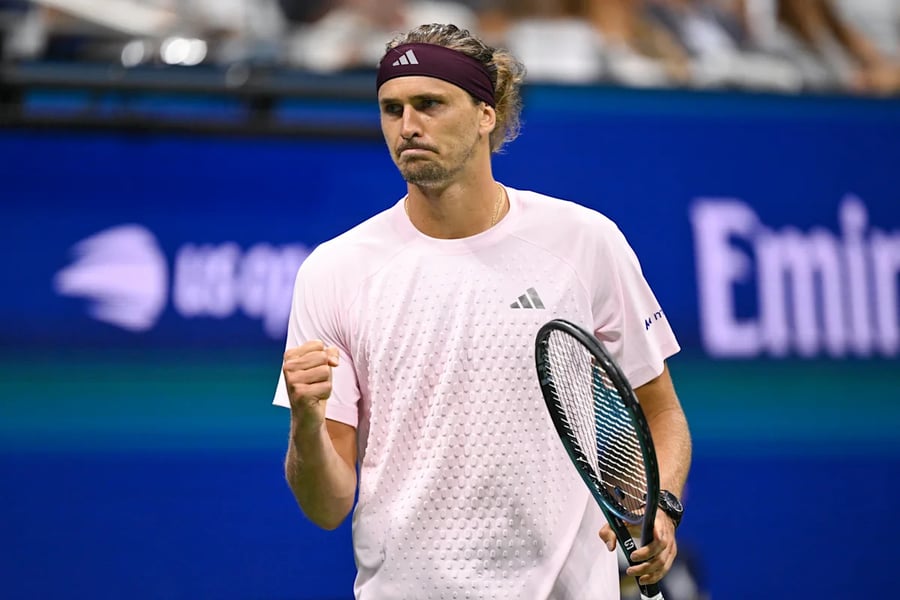

NEW YORK — In the fourth set, Lorenzo Sonego needed two points.
He was serving into the New York night, deep into what had already become a five-set confrontation that was supposed to be settled in straight sets or four, not at Arthur Ashe Stadium approaching 2 a.m. with the world’s top seed two points from elimination. Zverev held serve in that crucial game. Then he broke. Then he won the fifth, 6-4, and completed what the scoreboard recorded as a 6-4, 3-6, 6-7(9-7), 7-5, 6-4 result at 1:55 a.m.
Had Sonego converted, he would have helped write one of the stranger sentences in Open Era history: that Alexander Zverev became only the sixth No. 1 seed to lose a first-round Grand Slam match. The predecessors are a short list. John Newcombe at the 1971 US Open. Stefan Edberg at both the 1990 French Open and 1990 US Open. Lleyton Hewitt at 2003 Wimbledon. For more than two decades, no player sitting atop the rankings had managed to fall in the opening round of a major. Sonego was within two points of ending that record.
The Italian, ranked outside the top 80 and unseeded, did not come to Arthur Ashe to survive. His game plan was built around high-risk pace, taking the ball early, and forcing Zverev into the kind of prolonged physical exchange that would test whether the top seed had arrived in New York with form to match his ranking. The match confirmed that Sonego had read it correctly. What it does not confirm is where Zverev’s game actually stands.
The third set was the hinge. A tiebreak that went to 9-7 to Sonego placed the Italian up two sets to one in a contest that felt increasingly like it belonged to him. Through those stretches, Zverev was missing break point after break point, opportunities that, in the hands of a player operating at the level his résumé describes, should have closed the match earlier and cleaner.
The fourth set was where the night turned. Sonego had his moment, Zverev found the serve when it mattered, and the Italian’s tank, depleted by hours of high-risk tennis, ran down at the wrong moment. An early break in the fifth gave Zverev breathing room he used efficiently. He came off the court before 2 a.m.
The numbers underneath the result do not hide quietly. Zverev converted 5 of 22 break point opportunities. He hit 39 unforced errors to Sonego’s 43, a margin slim enough that the Italian’s slightly higher error count, rather than Zverev’s superior quality, was the real difference in discipline. As Yahoo Sports reported, the match finished in just under five hours, one of the longest first-round contests at Flushing in recent memory.
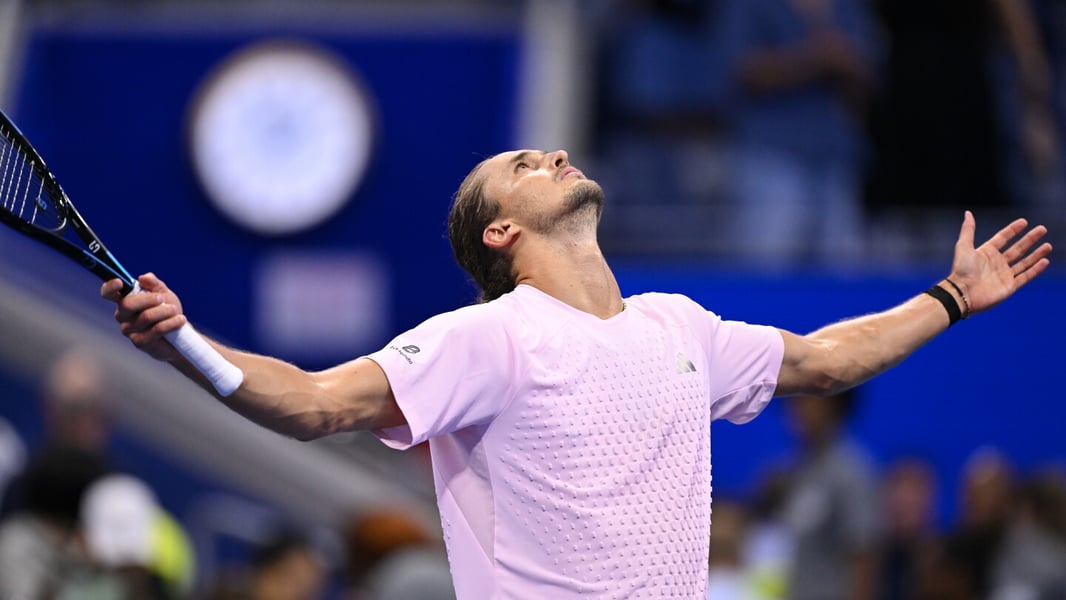
These numbers carry weight in context. Zverev arrived in New York having won Roland-Garros in June and then reached the Wimbledon final before losing to Jannik Sinner in straight sets. Through the clay swing, he had been among the two or three most dangerous players in the game. His Toronto and Cincinnati results in August were not consistent with that level. He lost early in both.
The question those results opened, whether Zverev is a clay-specific anomaly on hard courts this year or a genuine title contender at Flushing, did not get answered Tuesday night. It got more complicated. A five-set survival against a player ranked outside the top 80 is not the evidence a top seed presents when making the case that they belong among the tournament favorites.
The 2026 US Open men’s draw has no shortage of hazards. Sinner arrives as world No. 1, unbeaten for most of the year, having not dropped a set across the entire Wimbledon fortnight. Carlos Alcaraz returned from a wrist injury in time for Flushing. On the women’s side, Coco Gauff opened her title defense with a clinical performance against Sönmez that illustrated how a top seed handles first-round business when operating at full capacity.
Zverev’s Tuesday night offered a different template.
He advances to face Quentin Halys in the second round, a match his ranking and form should handle without needing five sets. The second round, though, will not answer the question that Tuesday raised. The match that clarifies whether Sonego’s night was a one-night irregularity or something structural will come deeper in the draw, against players who can sustain the kind of pressure Sonego applied for four hours and then add more.
He survived. But survival, at nearly five hours and 2 a.m., in the first round, against an unseeded qualifier, carries its own kind of question mark, one that will follow Alexander Zverev into whatever comes next at Flushing Meadows.