
FLUSHING MEADOWS, N.Y. — The first set was lost before most of the crowd had settled in.
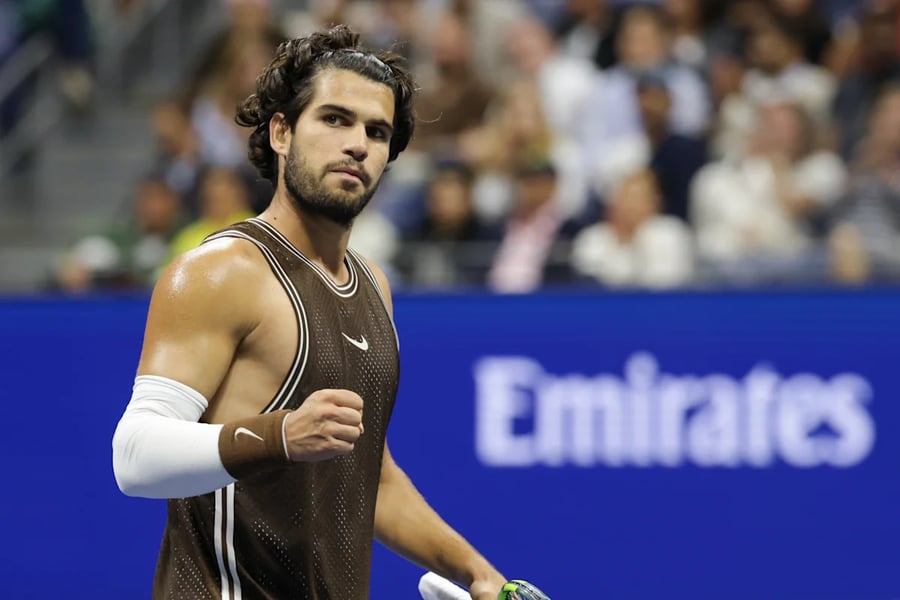
Carlos Alcaraz, returning to the US Open as its defending champion after four-and-a-half months away from the tour with a right wrist injury, gave Jaime Faria a set he had no business giving away. Faria, ranked 72nd in the world and seeded nowhere in this draw, broke Alcaraz serving at 4-4 in a game that stretched to 14 points before it ended. The world No. 3 lost the opening set 4-6 on Arthur Ashe Stadium, in the second round of a tournament he won twelve months ago.
What happened over the following two hours is why it qualifies as a story.
Alcaraz won the next three sets 6-0, 6-3, 6-2. He gave Faria five total games across those three sets. By the time Faria’s last shot landed in the net, two hours and forty minutes had elapsed and Alcaraz had converted seven of twelve break points and hit forty-three winners to his opponent’s twenty-seven.
What that first set raised was simple: whether Alcaraz’s wrist was genuinely right, whether four months off had created friction in a game that operates on fine timing. The rest of the match answered both. A player managing a wrist problem does not produce forty-three winners. He does not win a set 6-0. He does not flip from losing to dominant in the interval between shaking hands after the first set and walking to the baseline to serve the second.
“I realized that just playing four sets, it was really good for me to test everything physically,” Yahoo Sports reported Alcaraz saying. He said he was “feeling great” and saw “no reason to be afraid” about the wrist. A 4-6, 6-0, 6-3, 6-2 scoreline supports the claim.
Faria is a difficult early-round opponent in ways his ranking does not fully capture. He has spent most of his career on clay, where the slower surface rewards the kind of grinding baseline game he brought to Arthur Ashe on Wednesday. He reached the US Open main draw without a Grand Slam main-draw win at a hard-court major. By the end of the first set, he had taken one from the defending champion.
He built the first set by waiting for Alcaraz to provide openings rather than manufacturing them himself. Alcaraz provided them. The 14-point game that produced the break was one of attrition, the kind a returning player, whose feel for pace is still calibrating, was not yet equipped to win cleanly. He lost it.
He then played a second set that erased the question. Faria won seven of his twenty-one service points in the second. A 6-0 set in professional tennis is its own category of result: it means the loser won zero of twelve games contested, which requires a sequence of breaks, holds, and returns all trending in one direction simultaneously. Against a player ranked 72nd, Alcaraz produced that sequence in the set immediately after he lost one. The thing that made the first set possible, Faria’s patience and his willingness to grind from the baseline, stopped working in the second because Alcaraz stopped giving it room.
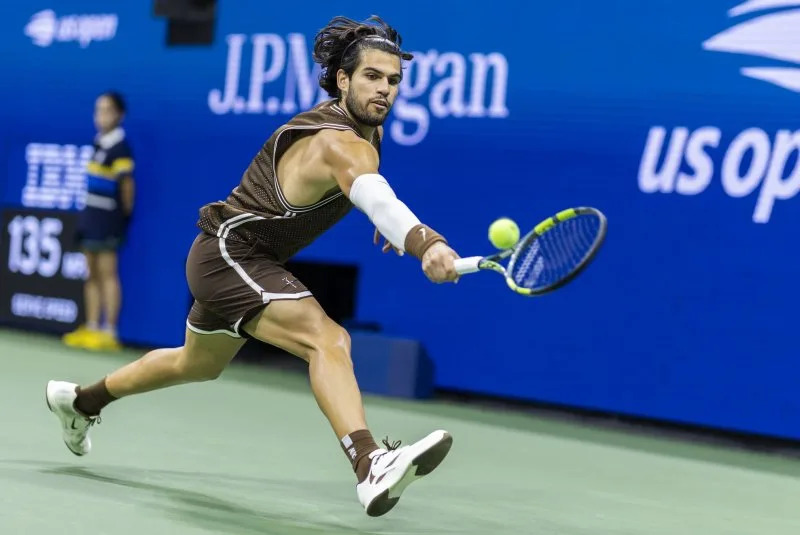
The defending champion had been absent since mid-April, when a right wrist injury removed him from the tour. He missed Roland Garros. He missed Wimbledon. He returned at Flushing Meadows earlier this week, winning his first-round match and telling reporters that his schedule for the remainder of the season would be abbreviated, that he planned to manage load rather than accumulate titles. As Eastern Herald reported after his first-round win, the central question was whether four months away had changed the mechanics that made him the defending champion here.
The first set against Faria reopened that question on Wednesday. The next three sets closed it.
His next opponent is Yibing Wu of China, ranked 113th, who reached the third round through the unseeded portion of the draw. A potential fourth-round match awaits against either Alexander Bublik or Tommy Paul, both of whom play at a level capable of producing the kind of unpredictable tennis that allowed Faria’s first set to develop the way it did.
Wednesday’s second rounds included other names pressing through what has become a competitive men’s draw. Alexander Zverev’s five-hour marathon over Lorenzo Sonego the day before had extended him considerably. Alcaraz, whose match lasted two hours and forty minutes, will arrive at the third round with considerably more in reserve.
Alcaraz committed just 29 unforced errors to Faria’s 38. The reversal in error count tracked almost precisely with the shift in scoreline: Faria made fewer mistakes in the first set; Alcaraz made fewer in every set after it.
What the second round settled for Alcaraz is provisional, as second rounds always are. He was tested early in a way his return match had not tested him. He found a way through that confirmed the wrist was not his problem. It was one match. The draw has four more rounds to offer.
The first set is history. The other three tell you what he is still capable of when he decides to start.