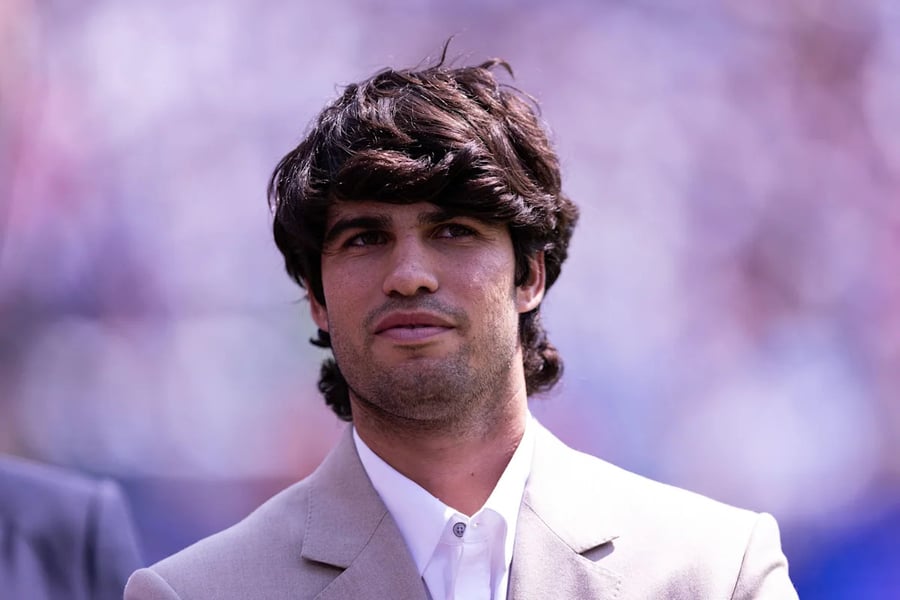

NEW YORK — He was four months gone, right wrist wrapped, first competitive match since April. He dropped the opening set. Then he won the next three and walked to his press conference to announce the future.
Carlos Alcaraz will see less of professional tennis in 2027. Not four months less; that was forced on him by a wrist injury sustained on a clay court in Barcelona. But one month, maybe two. Enough tournaments missed to make the year feel different from the ones before it.
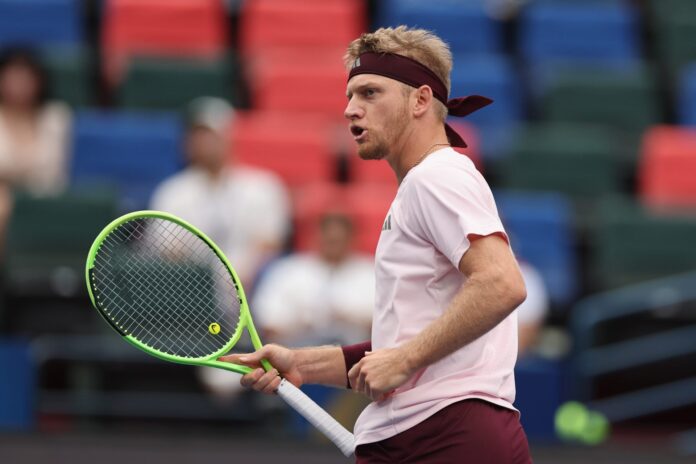
“In the future, I’m going to take some breaks, some long breaks,” Alcaraz said Wednesday after defeating Portugal’s Jaime Faria 4-6, 6-0, 6-3, 6-2 in two hours and forty minutes at Arthur Ashe Stadium. “Maybe not four months, but one month, two months, missing some tournaments, because it’s impossible to play them all.”
He is 23, nine-for-nine at Grand Slams in 2026, and the person who just told you he plans to be somewhere else more often.
Faria, ranked 72nd, was not the story. The score was not particularly close once the first set was behind them. Alcaraz dropped serve in the fourth and sixth games of the opening set and spent the first hour finding his timing, which four months removed from competitive tennis was exactly what it looked like. After that, he broke at will across the final three sets and closed out the match with the kind of controlled aggression that had been missing from the opening forty-five minutes.
His comeback opened Monday with a win over Roman Safiullin. He meets China’s Wu Yibing in the third round. The draw is manageable before it likely stops being manageable. For now, Alcaraz being at Flushing Meadows at all is still news.
The wrist injury came in April, at the Barcelona Open, during a first-round match against Austria’s Otto Virtanen. What followed was four and a half months of recovery that cost him the French Open, Wimbledon, and every tune-up in between. He was No. 3 in the PIF ATP Rankings going in, a seven-time Grand Slam champion who had already won the 2026 Australian Open in January. He came back at the US Open because the US Open was the next major on the calendar.
What the time away sharpened was not his forehand. It was his argument about the schedule that put him there.
“You can decide your calendar, but there are some Masters 1000s, some Grand Slams, and we’ve been out playing 40 weeks if we got to play every mandatory tournament that the ATP required us to play,” Alcaraz told reporters, as Yahoo Sports reported. “So it’s impossible, and we are seeing a lot of players getting injured, a lot of players getting tired. If they don’t do anything about it, we are going to see even more in the future.”
He is not the only player who has said this. The ATP calendar debate about how many mandatory events exist, what penalties apply to players who skip them, and whether an eleven-month season is structurally sustainable has been a recurring argument for at least a decade. What makes Wednesday different is that Alcaraz said it at 23, after four and a half months on the sideline, and at a press conference where he could have talked about anything else.
“I’m going to take some breaks and miss some tournaments in the future, for sure,” he said.
The specifics remain vague by design. Which tournaments, which months, whether that means skipping a smaller clay-court event or something with more ranking significance: those are all decisions for a season not yet planned. What Wednesday clarified is that the decision has been made in principle.
The 2026 US Open has arrived with stories built on biography and stakes beyond the seedings. The wheelchair quad draw, beginning September 8, has Guy Sasson and Niels Vink within reach of the first wheelchair doubles calendar Grand Slam in history. Earlier this week, seventeen-year-old Thea Frodin, the film double who stood in for a young Serena Williams in King Richard, filed eleven aces against No. 2 Rybakina in her first Grand Slam main draw appearance. Alcaraz’s return from four months out adds a chapter the main draw particularly needed.
Whether the ATP responds to what Alcaraz said Wednesday is a separate question from whether it matters. He is the third-ranked player in the world with seven Grand Slam titles. His presence in a draw raises both ticket prices and television ratings in measurable ways. When he says the mandatory-event structure is producing an injury crisis, the audience is not small.
His wrist held through two matches at Flushing Meadows. The third-round test against Wu Yibing, who ranks inside the top fifty, will be a harder day of tennis than either of the first two. After that, the draw opens toward the kind of opposition that has eliminated Alcaraz at this tournament before. He is playing well enough to be concerned about.
He also just said, clearly and voluntarily, that this is the kind of schedule that is no longer sustainable. Not at the pace he has been running it, not for anyone ranked where he is. The wrist that broke in April made the same argument. The difference now is that Alcaraz is the one making it.