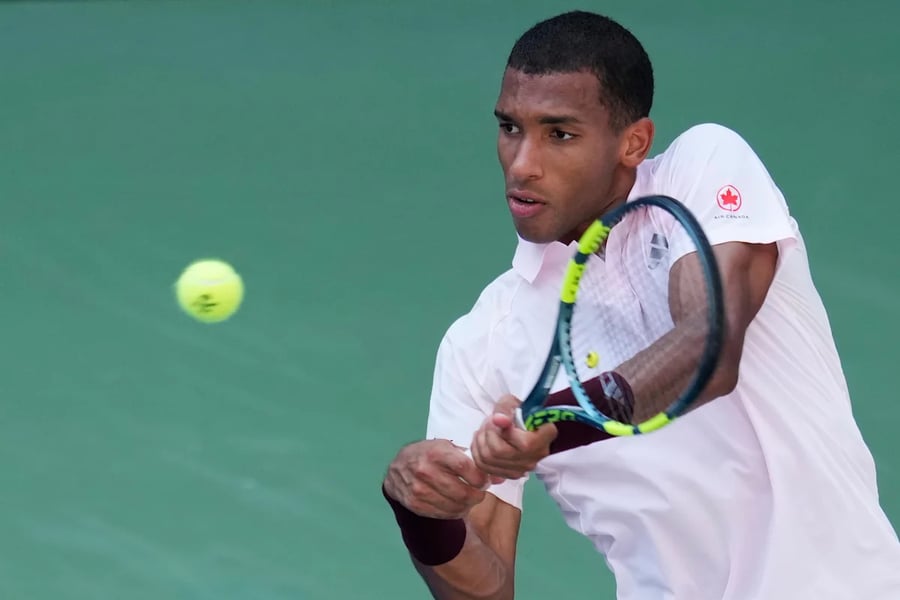

NEW YORK — The first set should have been enough to tell the story. Félix Auger-Aliassime came through a tiebreak against Karen Khachanov with the efficiency that had made him the third seed at this tournament, playing the kind of hardcourt tennis he has spent the last five years building toward. Then something happened that had nothing to do with tennis.
“I just couldn’t feel well and was dizzy and seeing spots,” Auger-Aliassime said after the match, one that ended with Khachanov winning 6-7, 6-3, 6-2, 6-2 inside Louis Armstrong Stadium. The Canadian’s description was clinical in its precision and offered nothing by way of explanation. Whatever seized him between Set 1 and Set 2 gave no advance notice. “There were no signs in the last couple of days,” he said, “and no signs this morning.”
The scoreline that followed that first set tells the rest of the story in numbers that have no good answer. Auger-Aliassime faced 20 break points across the four sets. He made 47 unforced errors to Khachanov’s 30. Those are not the numbers of a player who ran into someone sharper. They are the numbers of a player who ran into something inside himself.
Khachanov, seeded 50th but a former top-10 player who reached a Grand Slam semifinal at this very tournament in 2022, saw what was happening from across the net. “I saw that maybe he had some physical issues,” he said after the match — a statement of generous understatement given what the third and fourth sets looked like. He added that he wished Auger-Aliassime a speedy recovery, words that move the result out of the category of tennis and into something harder to quantify.
What happens next for the Canadian depends on what the tests find. “I’m going to run some tests and see what comes out of it,” Auger-Aliassime said. The tests were not yet ordered Thursday afternoon, the results were not yet known, and nothing about the post-match conversation pointed toward a diagnosis. The symptoms he described — dizziness, visual disturbance, a systemic sense of not feeling well — have a range of explanations. The US Open has not yet produced one.
What the tournament has produced, in the meantime, is a round of 16 that looks nothing like what the draw projected when the tournament began. Auger-Aliassime’s exit is the second top-5 seed eliminated from the men’s draw, following Novak Djokovic’s first-round departure on a night that had already reshaped the tournament before the second week arrived. World No. 1 Jannik Sinner is absent with a knee injury. The men’s event, approaching the round of 16, is playing without three of its five top seeds.
Khachanov has been this version of himself before — the player who performs best when the draw opens and the pressure on his opponent is internal. He reached the US Open semifinals in 2022. He has the game to go deep at hard-court majors. What he lacked coming into this week was a seeding that projected anything like a second-week appearance. He has one now.
The draw he inherits is not navigable on reputation alone. Carlos Alcaraz, who recovered from a dropped first set against Faria to reach the third round, is in the half of the bracket that projects a quarterfinal collision with whoever emerges from Khachanov’s section. Alexander Zverev, the top seed by virtue of Sinner’s absence, continues through his own half of the draw — a player who has since looked more composed than the five-hour marathon of his opening match suggested. The tournament left behind by the departures of Sinner, Djokovic, and now Auger-Aliassime is, on paper, a wide-open event. In practice, it is also an event where nobody quite knows what happened to the third seed.
For Auger-Aliassime, this US Open had represented a return to the form that brought him to two semifinals here — in 2021 and again in 2025. He arrived as a player who had reached the French Open quarterfinal in June, where a four-set loss to Cobolli ended his run, and who had shown enough through the North American hardcourt swing to justify his seeding at Flushing Meadows. The seeding did not account for the body failing the player.
What nobody has said, because nobody knows, is whether what struck Auger-Aliassime in the second game of the second set is something that ends when the US Open ends, or something that requires a longer reckoning. He described symptoms and announced tests. The tests will eventually produce an answer. The tournament, which waits for no one, is already approaching the quarterfinals.
Khachanov is in the round of 16. The third seed is running tests. And the US Open is producing a men’s draw that looks less like a succession and more like a vacancy — wide open, lightly seeded, and shaped by absences that no one planned for.