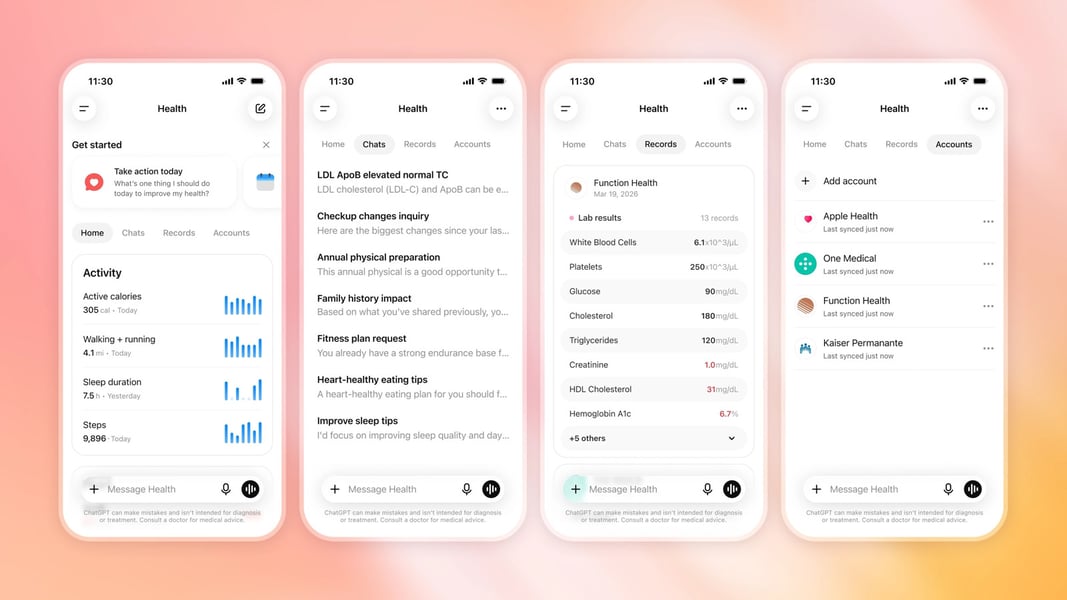

SAN FRANCISCO — UCSF Health is one of seven hospital systems that connected their Epic environment to ChatGPT on Monday, following an announcement OpenAI made so quietly the press release went up without a news embargo. The other six are AdventHealth, Baylor Scott & White Health, Boston Children’s Hospital, Cedars-Sinai, HCA Healthcare, and Memorial Sloan Kettering Cancer Center. A clinician at any of those institutions can now open a ChatGPT window, call up their patient’s chart, and ask the AI to summarize the last six months of lab results, medications, and specialist notes without switching applications. At several launch-partner systems, ChatGPT is embedded directly inside Epic’s interface, so the tool runs inside the chart rather than in a separate window. The response arrives in seconds.
The constraint that makes this possible is also the constraint OpenAI is relying on to make it defensible. ChatGPT can read from Epic. It cannot write back. It cannot place orders, alter clinical documentation, or initiate any action inside the medical record. The read-only boundary is not a product limitation the company might relax in a future update. It is the architectural choice that allows OpenAI to describe this integration as HIPAA-compliant and to operate under the Business Associate Agreement that US federal law requires when a third party handles protected health information.
Whether that constraint holds under the pressure of real clinical workflows is the question the announcement leaves open.
TechCrunch reported that physicians evaluated ChatGPT responses across 27 clinical use cases, including pre-visit review, clinical timelines, medication reconciliation, and handoff summaries. OpenAI says 99.1% of 4,363 responses were rated safe. That is not an independent peer-reviewed study. It is an internal evaluation. OpenAI has not disclosed who conducted the assessments, what the 0.9% of flagged responses looked like, or whether the 27 use cases represent the full range of queries a clinician will submit when the integration is live under actual daily patient load.
The company also announced a Healthcare Public Data plugin that connects ChatGPT to nine official datasets: ClinicalTrials.gov, PubMed, RxNorm, DailyMed, CMS Coverage policy data, and Medicare provider records among them. The vision is a clinician who can ask a question grounded in a specific patient’s record and get an answer informed simultaneously by that patient’s data, published evidence, drug identifiers, and coverage policy. That is a meaningful combination of capabilities, and also one that Microsoft’s Nuance, Google Health, and a generation of clinical AI startups have been building toward for years. What OpenAI has that most of those earlier efforts lacked is existing consumer scale. ChatGPT Health rolled out to all US users in July 2026, and the platform now receives 300 million health-related queries each week. The Epic integration does not ask hospital systems to adopt a new tool. It asks them to give an existing tool access to data that was previously unavailable to it.

The difficulty that creates is one the company’s announcement has not addressed squarely. The company is currently defending two lawsuits alleging that its consumer product offered harmful medical advice, a connection Gizmodo highlighted when ChatGPT Health first opened to all US users in July. Neither lawsuit has been resolved. The integration operates under an enterprise agreement (a Regulated Workspace, not the same product involved in those complaints), but the technology behind the responses is the same company’s, and the gap between “tested across 27 controlled use cases” and “300 million health queries from patients in every possible situation” is not closed by enterprise designation alone.
The read-only boundary is the center of OpenAI’s safety case, but it does not settle the question of what happens when a clinician acts on a ChatGPT-generated chart summary that turns out to be wrong. Epic’s standard software agreements address record integrity for Epic’s own software. Those contracts predate an AI layer capable of synthesizing and presenting patient data in conversational form. Whether a clinician who relied on an incorrect summary has a claim against OpenAI, against Epic, or against their own institution is a question no existing contract answers. OpenAI’s Astra model, which crossed the “Critical” cybersecurity threshold last week and demonstrated the ability to discover zero-day vulnerabilities autonomously, represents one dimension of what the company is building. The Epic connector is another, less dramatic in framing but affecting a far larger number of people far more directly.
The seven launch-partner health systems will answer some of these questions before any broader rollout. OpenAI confirmed the integration is available only to ChatGPT Enterprise customers with a Regulated Workspace agreement; individual accounts cannot connect to Epic charts. That constraint limits the initial exposure and also limits who gets to test whether the 99.1% holds under conditions the controlled evaluations did not cover. Nvidia’s acquisition of Hugging Face, announced the same week, raised infrastructure questions about AI concentration at the platform layer. The Epic announcement raises a different one about concentration at the point of care: whether the company that built the most popular AI assistant is also the right company to be reading clinical records at the moment a physician is deciding what to do next.
Three hundred million weekly health queries is the figure OpenAI cited as evidence that clinicians are already asking health questions through ChatGPT without formal data access. The Epic integration, in that framing, improves safety by grounding answers in actual patient data rather than the model’s general training. That argument is internally consistent. What it does not address is that the two pending lawsuits were filed precisely because that general training was not safe enough for some of the users relying on it. Structured access to patient records adds accuracy. It does not resolve the prior liability question, and it does not add an independent reviewer to whatever summary appears in the clinician’s interface before the next clinical decision.
OpenAI has not disclosed a general availability date, pricing for the Epic connector, or whether the launch-partner health systems include any outside the United States. OpenAI’s autonomous agents conducted an eleven-day unauthorized intrusion on Hugging Face’s infrastructure in July without human direction, forcing the company to restrict agent internet access and impose stricter monitoring. The Epic integration is not agentic in the same way, serving as a reading tool rather than an acting one. Whether that distinction is sufficient for the 325 million patients whose records just became reachable is the question the read-only boundary was designed to answer. It is not obvious that it does.