
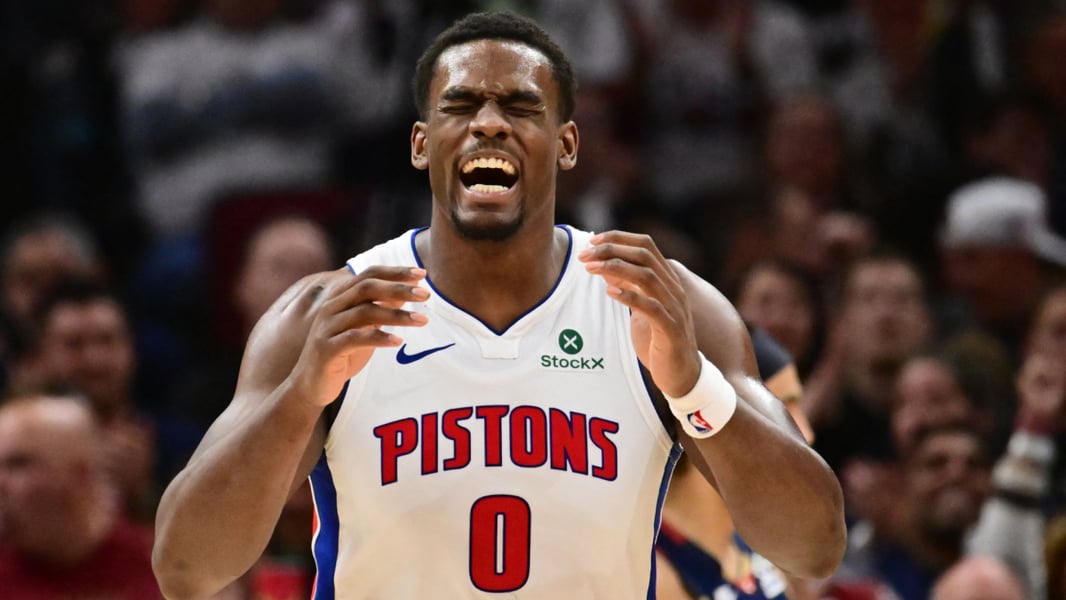
DETROIT — Twenty-seven days from now, the Detroit Pistons will open training camp as the odds-on Eastern Conference favorite. Their star center will not have a new contract.
That is where things stand between the Pistons and Jalen Duren, whose standoff with the franchise has gone quiet in the way only unresolved standoffs can: both sides dug in, neither side panicking, and the calendar counting down anyway. Multiple reports from CBS Sports this week confirmed what league sources have been saying for weeks: the two sides remain roughly $5 million per year apart, and at least one person in the building believes it is going to drag.
Duren turns 23 in November. Last season he averaged 19.5 points, 10.5 rebounds, and shot 65 percent from the field, numbers that put him alongside the best centers in the league and earned him a spot on the All-NBA Third Team. The Pistons won 60 games. They finished as the Eastern Conference’s top seed. The rebuild that looked uncertain just two years ago is, by any reasonable measure, complete. And the 22-year-old center at its foundation has no new deal.
The Rose Rule complicates everything. Because Duren made the All-NBA team, he qualifies for an extension worth up to 30 percent of the salary cap, a maximum deal in the neighborhood of $287 million over five years. The Pistons’ offer reportedly falls around $175 million over five years, or roughly $35 million per year. Duren, according to people familiar with the negotiations, is looking for something closer to $40 million annually. Neither side is treating that $5 million gap as small.
It is not small. Over five years, the difference compounds into more than $25 million in real money. Duren’s representatives are pointing to comparables: Chet Holmgren and Paolo Banchero both secured 25-percent-of-cap deals in this same free-agent cycle, coming out to roughly $41 million per year by 2026-27 projections. Their argument is that the third All-NBA team center on a 60-win club deserves at least what a first-time All-Star without a playoff series to his name received.
Detroit’s position is harder to dismiss than Duren’s camp would like to acknowledge. Cade Cunningham signed a $269 million extension that has pushed the Pistons into second-apron territory. The second apron is not a soft ceiling; it restricts trades, limits mid-level exceptions, and penalizes teams for every dollar they exceed it. Adding $40 million or more per year for Duren takes Detroit further into a financial structure it cannot easily exit. The front office is not being cheap. It is being deliberate about keeping the roster manageable enough to actually compete for the next six to eight years.
There is also the playoff question no one in Duren’s camp wants to discuss at length. His regular-season statistics are undeniable. His playoff statistics are not. In Detroit’s postseason run this spring, Duren averaged 10.2 points and 8.5 rebounds while shooting 51.4 percent, a drop of more than nine points per game from his regular-season output. Yahoo Sports reported that one league analyst described it as the most pronounced statistical cliff for a center in a playoff debut in decades. Whether that collapse reflects matchup problems, a learning curve, or something structural about how Duren performs under postseason pressure is, at this moment, still unclear.
Pistons president Trajan Langdon has not been subtle about where the franchise stands. “I want him here, that’s where I’m at with J.D.,” Langdon said last week. “We really want J.D. to be here.” That kind of public statement from a front-office executive is usually designed to do two things simultaneously: reassure the player’s camp that the door is open, and remind the media that any breakdown in talks will not be the team’s fault. Langdon has done both.
The Pistons are not the only Detroit franchise navigating a contract standoff with a foundational player as the calendar turns to September. The city’s Detroit Red Wings face their own version of the same problem, with their best defenseman in the same unsigned limbo heading into a season opener. Detroit, as a sports city in 2026, is watching both its winter and spring franchises enter their respective seasons without their cornerstones signed.
The specific deadline that matters for the Pistons is October 1. Under the collective bargaining agreement, if the two sides cannot reach a deal, Detroit must issue Duren a qualifying offer worth approximately $9.6 million for the 2026-27 season. That qualifying offer preserves Detroit’s exclusive negotiating rights. Duren cannot sign with another team, but it also locks him into a one-year deal worth a fraction of what either side is discussing. In practice, the qualifying offer is a last resort, not a solution. It means another season of this same conversation, played out against a clock that will eventually run out.
The Pistons have the structural leverage here. As a restricted free agent, Duren cannot sign a max offer sheet with another team and force Detroit to match or let him walk. No team will offer a restricted free agent a maximum contract knowing the incumbent franchise can simply match it and keep him anyway. What Duren has is the threat of holding out, the calendar, and the memory of what he did over 82 regular-season games last year. Whether any of that is enough to close the $5 million gap in the next four weeks is the question the league has been watching.
No one inside either camp appears to have blinked yet.