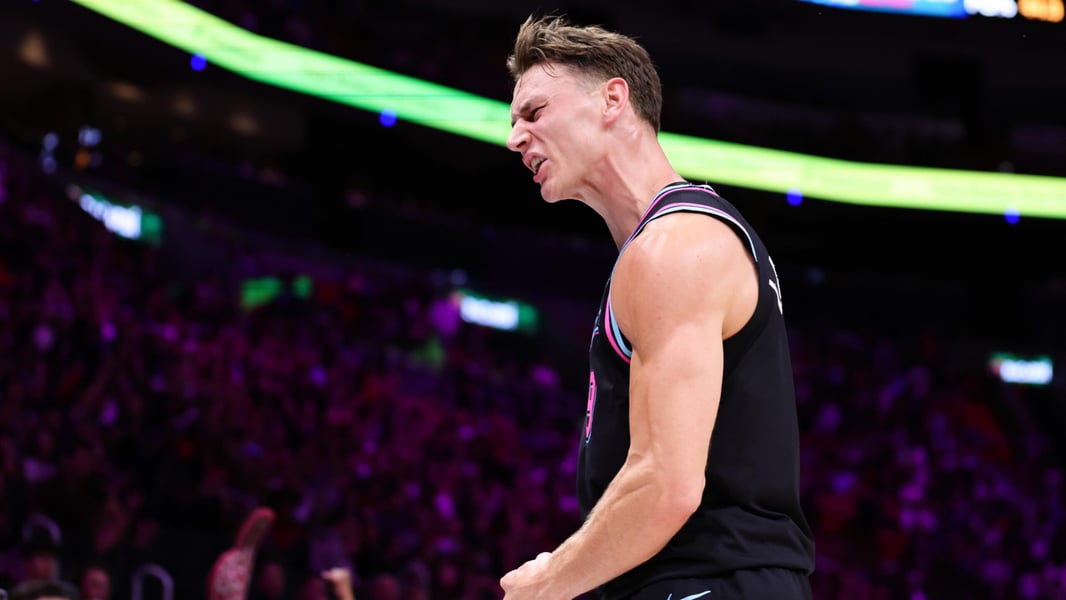

MIAMI — The transaction that brought Pelle Larsson to Miami cost the Heat a future second-round pick and some cash. Houston drafted him 44th, agreed terms, then sent him south in the same evening for assets that didn’t include a first, a rotation player, or any certainty about what they were moving. Larsson wasn’t the prize. He was the piece that made something else possible.
Two seasons later, he’s worth $60 million.
The Miami Heat and Larsson agreed Thursday to a four-year, $60 million contract extension, with a mutual option for the 2030-31 season, according to ESPN’s Shams Charania. Austin Brown and Steven Heumann of CAA Sports negotiated for Larsson; the extension begins in 2027-28 at $13.5 million per year and runs through his age-29 season. The Heat confirmed the deal through an official announcement on NBA.com.
It is, by most measures, a reasonable investment.
The 25-year-old Stockholm native averaged 11.4 points, 3.5 rebounds, and 3.4 assists in 70 appearances last season, including 54 starts. He shot 49.6 percent from the field and played 26.4 minutes per game—legitimate rotation-starter production in his second NBA season from a player who was never expected to be more than a training-camp body.
As a rookie, he averaged only 4.4 points per game.
That leap is what Miami is paying for: nearly seven additional points per game in one season, not through inflated minutes on a losing team, but within a developing Heat roster where roles had to be earned.
He improved as a ball-handler and secondary creator, with his 3.4 assists reflecting a growing role in Miami’s half-court offense. His true-shooting percentage reached 60.5 percent, supported by high efficiency at the rim and reliable free-throw shooting—79.7 percent—even as his three-point accuracy remained at 32.3 percent.
That 32.3% is the figure neither Miami nor his agents could negotiate around. On roughly six attempts per game from range, it sits below league average; it is the single largest risk attached to the $60 million. If his arc conversion improves toward 37 or 38 percent (his free-throw efficiency suggests it isn’t implausible), Larsson becomes a legitimate value at $15 million per year. If it stays fixed, Miami has bought a player opponents can hedge into one specific vulnerability every time down the floor.
The mutual option at the extension’s end acknowledges that uncertainty in explicit contractual language. Neither side knows yet which version of his three-point shooting persists. The option gives both a single point of recalibration after four years rather than locking either party into a fifth year on current evidence.
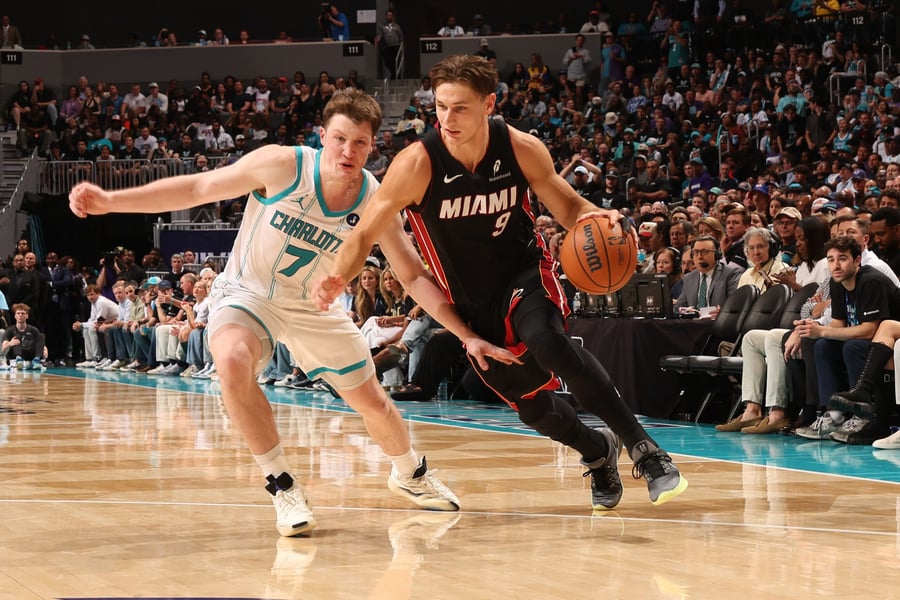
That is, effectively, the Heat’s bet: that versatility, ballhandling, and defensive range at 25 will compound in ways the year-two numbers only suggest. His jump from year one to year two was steep enough that a follow-on development curve is plausible. The next test, in year three, will come against opponents who now have two full seasons of film, defensive schemes that can account for his three-point tendencies, switching coverages that take away driving lanes, playbooks designed to make 32.3% the floor.
Whether it stays the floor, or becomes the ceiling, is the basketball question the $60 million cannot answer.
The draft pick that originally sent him to Miami has been spent. The future second passed from the Heat to Houston will eventually produce someone. Larsson, the transaction’s middle piece, signed for $60 million Thursday afternoon.