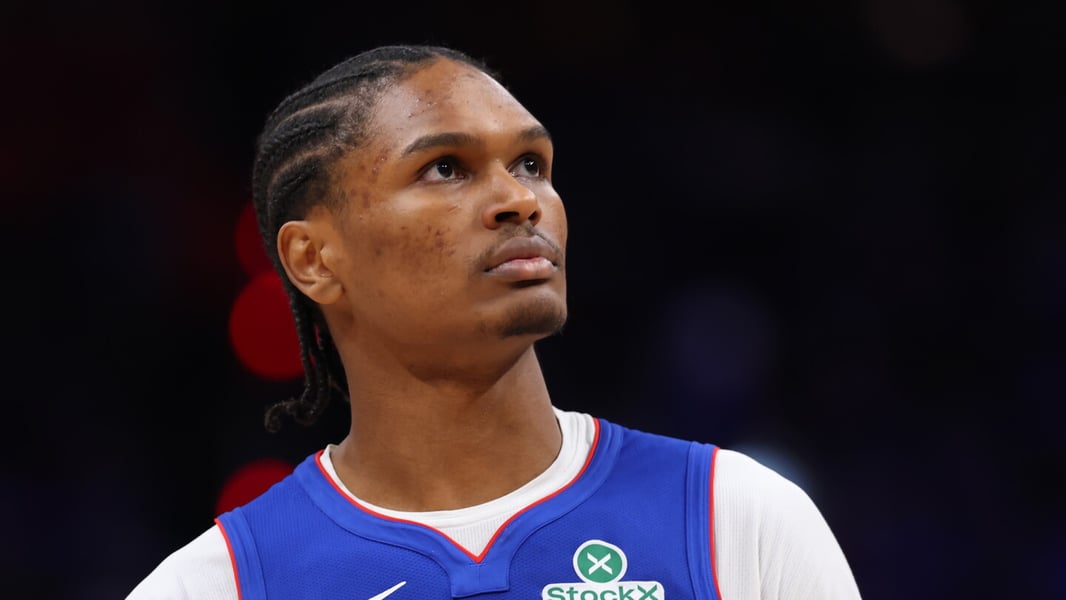

DETROIT — The Detroit Pistons gave Ausar Thompson a five-year, $155 million contract extension on Thursday. Two days later, he was not cleared for contact practice.
Those facts are not contradictory. Together, they offer the clearest picture of what Detroit is building—and what the organization is prepared to accept along the way.
Thompson, 22, is sitting out contact drills at training camp while the NBA and the National Basketball Players Association complete a medical-clearance process related to a blood clot he suffered during his rookie season. He says he feels great, but there is no timetable for clearance.
The Pistons signed him anyway.
In 72 games last season, the first full season he played since recovering from that blood clot, Thompson averaged 9.9 points, 5.7 rebounds, 3.1 assists and a league-leading 2.0 steals per game. The scoring line sits well below what max contracts usually require. The steals do not. He finished third in Defensive Player of the Year voting and earned a spot on the NBA’s All-Defensive First Team, the kind of honors that used to require a scorer’s name on top of them. Thompson changed that calculus. Detroit, at least, decided it had.
Two steals per game is not a statistical anomaly. It is a system. Thompson reads passing lanes the way skilled point guards read defensive rotations, converting his anticipation into transition offense before opposing coaches can call timeout. Teams spent the second half of last season consciously routing their ball-movement away from him, which is the highest compliment a perimeter defender can receive, and his steal total did not shrink even as they tried. His wingspan, his reaction time and his studied read of where the ball is going next are the things that $155 million is paying for.
That is a philosophical statement as much as a contractual one. A franchise that rebuilt itself around Cade Cunningham’s offense chose to pay the maximum for a player whose primary value is making the other team’s best perimeter scorer worse. Detroit is telling Thompson, and everyone watching, that defense is now currency in their construction, not complementary decoration.
The money itself: five years, $155 million, fully rookie-scale, set to begin after the 2026-27 season. ESPN’s Shams Charania broke the news Thursday morning, with the NBA’s official announcement confirming the terms.
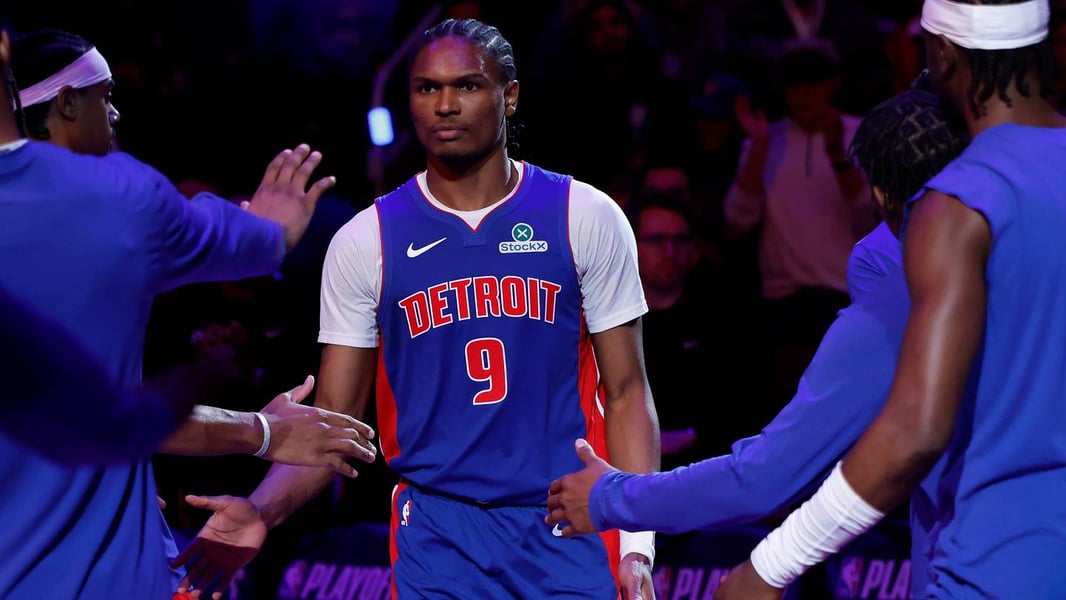
The complication is the training camp restriction. Thompson’s blood clot surfaced in his first NBA year and ended that season before it properly started. He recovered and played a full 72-game season without visible setback. Detroit’s medical staff and team officials are presumably satisfied with his health status to commit $155 million to him. The NBA and NBPA are working through a joint medical clearance protocol that applies to cases with blood clot history, a process that exists as a standard protection for players, not a signal of alarm. He has been cleared for conditioning, strength training and non-contact work. Full contact is on hold. There is no confirmed timeline.
Detroit’s front office knew this when it signed the extension. The Pistons committed $155 million to a player who cannot currently demonstrate the skill they are buying. They made that commitment based on 72 games last season, and they decided the medical uncertainty was an acceptable risk. Whether the extension includes any contractual health protections has not been disclosed.
The Pistons still have an unresolved situation with Jalen Duren, their center, who has been holding out over a gap that reportedly comes down to roughly $5 million annually. Those negotiations and Thompson’s extension live in separate budget categories; Duren’s holdout is about his own deal, not this one. But committing $155 million to one young player while another core piece remains unsigned does clarify which way a franchise is tilting.
The context for all of it is a season that ended differently than the previous three. Detroit erased a 3-1 deficit against Orlando in the first round, won that series in seven games, then pushed Cleveland to a seventh game. That is a franchise that has earned the right to believe its young pieces are real. Thompson was the defensive spine of that run. He is the reason opposing guards came out of playoff games visibly frustrated.
What nobody can tell you right now is when Thompson will be a full training camp participant, how long the clearance process takes, or what the practical effect is on a team preparing to open preseason play later this month. The medical process moves at its own pace, governed by a joint protocol neither the Pistons nor Thompson controls.
Detroit made a $155 million bet that the process will resolve in his favor. The franchise’s history with young players who earned their extensions suggests it will. His blood clot history suggests nothing that guarantees it.
That is the deal. That is the risk. The Pistons agreed to it anyway.