
MUMBAI — The IT sector’s relief rally on September 3 had clear beneficiaries: Tata Consultancy Services surged 4.40% to lead the Nifty 50, Tech Mahindra added 3.38%, and Infosys was not among them.
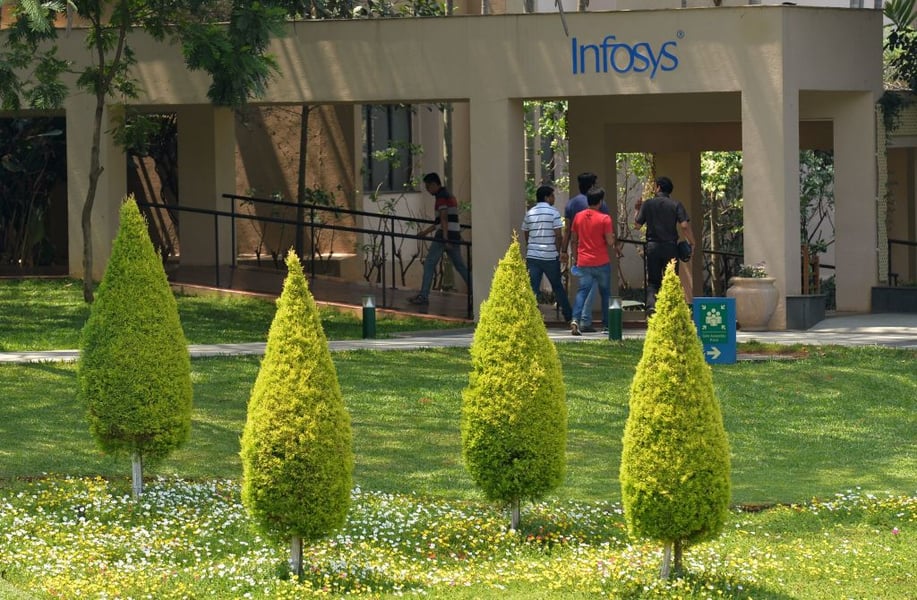
India’s second-largest software exporter closed at Rs 1,130.30 on the National Stock Exchange, down Rs 9.70, or 0.85%, from Wednesday’s close of Rs 1,140. The stock opened at a session high of Rs 1,144, turned lower within the first hour of trading, and touched an intraday low of Rs 1,123 before recovering partially into the close. Volume on the NSE reached 6.27 million shares. The Nifty IT index ended the session in positive territory on Thursday, making Infosys’s underperformance the sharpest internal question the IT sector raised on the day.
The context for that underperformance runs deeper than a single session. Infosys has been navigating a guidance revision that arrived just as the AI revenue narrative was beginning to tilt sentiment toward the sector. The company reported Q1 FY27 revenue of $5.08 billion for the quarter ended June 30, 2026, a 2.4% increase in constant currency terms year-on-year and a 1.0% sequential gain. Those numbers were solid for a company operating in a cautious technology spending environment, but they sat well below TCS’s 13.9% year-on-year revenue expansion in the same period. When the results came in, Infosys also trimmed its full-year FY27 revenue growth guidance to a constant currency range of 1.5% to 3.0%, a revision that placed a ceiling on near-term expectations the stock has traded against since July.
The operating and cash metrics underneath that guidance revision were less troubled. The company held its operating margin at 21.1% in Q1, within its stated 20%-22% target band, and generated free cash flow of $955 million, a figure that underscored the earnings quality that has historically supported Infosys’s valuation premium to the broader market. The guidance trim was about revenue visibility, not cost control.
Where the market’s attention has shifted most notably is AI. Infosys disclosed that AI-related revenues reached 8.2% of total Q1 FY27 revenue, up from negligible levels two years earlier, with the company citing double-digit quarter-on-quarter AI revenue growth over the past several consecutive periods. The Infosys Q1 FY27 investor release confirmed large deal wins of $3.6 billion in total contract value, with 61% of that representing net new business rather than contract renewals, a sign that Infosys is expanding its client base in an environment where retaining existing relationships alone is no longer sufficient to support sector-competitive growth.
The BFSI vertical, historically Infosys’s largest revenue contributor, has been the most visible source of demand friction. Banking and financial services clients in North America and Europe, Infosys’s two primary geographies, have kept discretionary technology spending compressed through much of 2025 and into 2026 as interest rate uncertainty persisted. The September 3 session produced a signal, at least, that the demand environment at the client level may be beginning to loosen. HDFC Bank gained 1.13% on Thursday, a move that reflected improving capital confidence at India’s largest private lender, an institution whose technology investment posture shapes IT vendor revenue in the quarters that follow.
At Rs 1,130.30, Infosys trades at approximately 19 times trailing twelve-month earnings, a premium to the broader Nifty 50 but below the company’s own five-year historical band, where the stock has commanded as much as 30 times earnings in peak demand cycles. Analyst price targets remain well above the current price, clustering in a range that implies significant upside if the FY27 guidance trajectory can re-accelerate from its current midpoint. The spread between current price and consensus targets reflects a market that accepts Infosys’s long-term AI thesis but will not price in the recovery until the revenue data demonstrates sustained acceleration rather than incremental quarterly gains.
Sensex closed fractionally changed on September 3, with the IT sector’s internally mixed performance contributing to the day’s cautious tone. TCS’s 4.40% advance accounted for most of the upward momentum that existed in the broader market; Infosys’s 0.85% retreat trimmed that same momentum at the margin. The divergence between the two largest Indian IT stocks on a day the sector was supposed to recover is the kind of signal that tends to sharpen positioning rather than resolve uncertainty.
What Thursday’s close did not settle is whether Infosys’s guidance range of 1.5%-3.0% represents a floor from which upward revisions emerge in Q2 FY27, or whether it more accurately describes the steady-state growth ceiling for a company that expanded at double-digit rates two years ago. The Q2 FY27 results in October will carry that answer, and with it the market’s next decision about where Rs 1,130.30 fits in a sector that has still not finished recalibrating.