
MUMBAI — Adani Ports and Special Economic Zone posted its sharpest single-session advance in three weeks on Thursday after disclosing that August cargo volume crossed 50 million metric tonnes, a record for any single month in the company’s history and a 19 percent jump from August 2025. The stock closed at Rs 1,706.5, up roughly 2 percent, on a day when the broader Nifty Infrastructure index traded in a narrow range and one of its other heavyweights, Larsen & Toubro, slipped marginally despite carrying the largest order book in the engineering conglomerate’s history.
The Adani Ports disclosure bypassed the oil price anxieties that dominated the session’s market conversation. The company earns port handling fees on cargo volume, not on the oil content of the cargo it moves, and it is structurally indifferent to whether Brent crude sits at $70 or $95. For portfolio allocators tracking India’s infrastructure buildout as a decade-long investment thesis, the August figure carried a specific confirmation: that India’s export-import engine is running at record throughput even as global trade absorbs pressure from tariff uncertainty and Iran-linked freight cost premiums.
The breakdown within the 50 MMT figure reinforced that reading. Dry cargo grew 25 percent year-on-year, driven by coal and fertiliser imports supporting India’s agricultural and power generation cycle. Container throughput rose 15 percent, reflecting the broad expansion of India’s manufacturing export base, particularly in electronics, pharmaceuticals, and textiles, that the government has been seeding through production-linked incentive schemes since 2021. The company’s August cargo disclosures show that for the April through August period, Adani Ports has handled 234.4 MMT of cargo, up 16 percent year-on-year, suggesting the full fiscal year is running well ahead of consensus volume estimates.
Larsen & Toubro’s day was quieter. India’s largest engineering and construction conglomerate closed at Rs 3,975, down Rs 6, or 0.15 percent, from Wednesday’s close. The marginal decline was less significant than what it obscured: the company entered the September quarter with an order book of Rs 5.12 lakh crore, a 27 percent year-on-year expansion, with international orders accounting for 52 percent of the total. Q1 FY27 profit came in at Rs 4,123 crore, a 14 percent gain. Order inflows for the quarter hit Rs 1.08 lakh crore, up 14 percent, which compares favourably with major global EPC operators.
Those are strong numbers by any measure. The reason L&T held flat rather than gaining is a margin question of the kind that becomes relevant when input costs are moving. At $95 Brent crude, construction material and logistics costs pressure project execution margins for an EPC company that prices contracts months before delivery. L&T has repeatedly maintained its full-year guidance, and its offshore wind and defence order pipeline is insulated from domestic construction cost pressures. But investors tracking the gap between order-book growth and margin trajectory are running the same calculation that defines the broader infrastructure sector: the volume story is intact; the cost story is not resolved.
UltraTech Cement, India’s largest cement producer by capacity and a constituent of the index, declined 1.21 percent on Thursday. Cement pricing has faced structural pressure through August, with regional oversupply in parts of South India and pricing discipline from smaller competitors who have brought new capacity online ahead of the festive season construction cycle. For UltraTech, the story is less about September 3 specifically and more about whether Q2 FY27 EBITDA per tonne can recover from the subdued Q1 reading. The answer depends on how quickly post-monsoon construction demand absorbs excess supply, a question that September’s volume data will begin to answer.

The Nifty Energy index saw NTPC and Power Grid post advances on the same day, supported by power ministry data showing August grid demand running 11.2 percent ahead of August 2025. Power utilities’ regulated revenue structure is crude-independent, and the session confirmed the sector’s insulation from the oil cost pressure hitting construction and cement names.
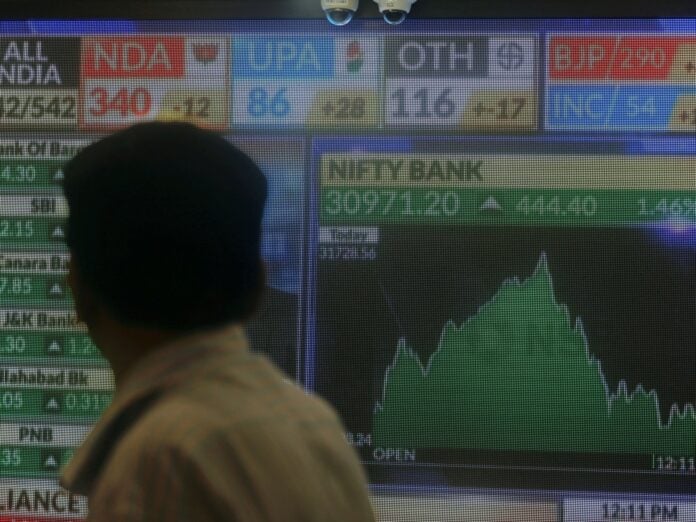
The Nifty Infrastructure index ended the session near 9,435, a level that neither broke the recent consolidation range nor suggested a directional move was forming. That arithmetic is partly the product of the index’s composition across 30 stocks spanning ports, telecom, power, construction, and cement, and partly the product of the offsetting moves within it. India’s benchmark Sensex fell 417 points on the same session, led by IT and FMCG heavyweights that have no operational exposure to the country’s infrastructure cycle.
The government’s capital expenditure disbursement pace is the near-term variable connecting all Nifty Infrastructure constituents. The Union Budget committed Rs 11.11 lakh crore in capital expenditure for FY27, a 10.1 percent increase from FY26. Disbursement through April-August has been running ahead of last year’s pace, but the full impact will flow through Q3 and Q4 rather than the current quarter. That gap between government spending commitment and company revenue realisation is what the market is pricing across the Nifty Infrastructure basket right now.
What cargo records at Adani Ports and order inflows at L&T suggest is that when that disbursement lands, there is an operating network ready to absorb it. The infrastructure thesis for India has not changed. September 3 confirmed it is intact. Whether it becomes visible in the index’s close price before Q3 numbers start arriving in October is the question the market has not answered.