
DUBAI — The Islamic Revolutionary Guard Corps announced Tuesday that it had seized an American unmanned underwater vehicle from the Strait of Hormuz, the narrow passage at the center of the US-Iranian standoff that has persisted since February. Within hours, a senior US official told Reuters that the drone had malfunctioned and was no longer operational before Iran recovered it, though Washington stopped short of confirming whether the vehicle Tehran claimed to have captured was the same one that had gone dark.
The distinction matters more than it might appear. If the IRGC recovered a functional American surveillance platform, even an aging one, the seizure carries intelligence and propaganda value that Tehran will not leave unused. If it retrieved a drifting, decommissioned vehicle the United States had already written off, the significance is considerably harder to assess.
According to the US official, who spoke on condition of anonymity, the drone was an old model and did not carry classified sonar or radar equipment. It had gone out of service more than a day before the IRGC made its announcement. Whether the captured drone and the malfunctioned vehicle were the same asset remained unresolved at the time of publication.
The IRGC framed the incident without ambiguity. The corps said it had seized the unmanned underwater vehicle while it was operating in the strait, presenting the recovery as evidence of Iranian surveillance capability in waters the United States has consistently patrolled as part of its regional posture, according to Iran International.
Tuesday’s incident comes against the backdrop of a conflict that has generated more disputed claims than verified confrontations. Since the United States and Israel launched strikes on targets inside Iran beginning in late February, the two sides have exchanged blows in a pattern that has defied every diplomatic attempt at stabilization, including a memorandum signed in mid-June that collapsed when both sides resumed fire in the weeks that followed.
Against that backdrop, the Strait of Hormuz has become an increasingly contested space. Roughly 20 percent of the world’s seaborne oil supply passes through the waterway each day. Any military incident there is read not merely as a bilateral event between Washington and Tehran, but as a signal to oil markets already tracking the conflict’s wider economic fallout, Gulf shipping operators, and governments whose energy security runs directly through that narrow channel.
The United States has maintained a significant naval presence in the region throughout the conflict, monitoring shipping lanes and sustaining a deterrent posture designed to prevent Iranian interference with commercial traffic. Unmanned underwater vehicles are a standard part of that surveillance infrastructure, tracking submarine activity and gathering intelligence on Iranian naval movements below the surface.
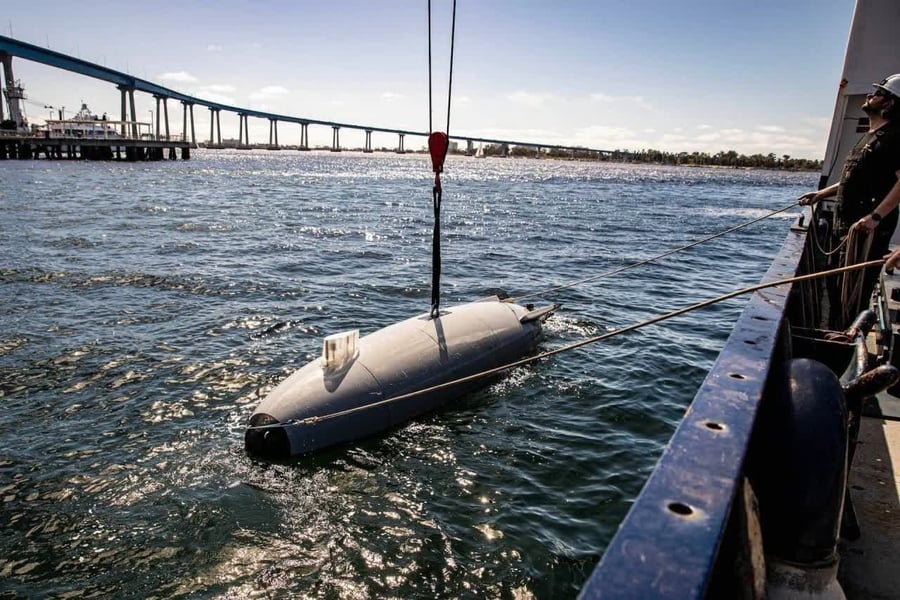
That is precisely why the IRGC’s claim carries resonance even if the hardware in question was aging and unclassified. A successful underwater seizure, if confirmed, demonstrates that Iran’s monitoring of the waterway extends beneath the surface, a capability with direct implications for US Navy planning and for any future escalation scenario in which the strait itself becomes a more active theater.
What remains genuinely unclear is the operational sequence. Did the drone malfunction, drift into Iranian-monitored space, and get recovered opportunistically? Or did Iranian forces detect and disable a functioning American asset? The US official’s framing points toward the former. The IRGC’s language implies the latter. Both accounts may describe the same event from different vantage points, depending on the precise timeline.
That ambiguity is unlikely to be resolved in the near term. Both governments have strong incentives to control how the incident is characterized: Washington to minimize the intelligence and symbolic value of the seizure, Tehran to maximize it. The absence of any formal statement from the Pentagon or the State Department as of Tuesday afternoon left the public account resting on a single anonymous official’s statement to one outlet, and the incident suspended between two irreconcilable framings.
The underwater drone episode came as the region absorbed multiple reported military incidents in the same waterway within 48 hours, including a separate claim by Iranian air defenses of downing a US MQ-1 drone above the strait, as TASS reported. Each claim adds to a count that neither side fully acknowledges and neither side can fully control, in a conflict that has outlasted every ceasefire attempt and shows no signs of settling into a stable equilibrium.