
PARIS — Three years after a group of researchers left Google DeepMind and Meta to build a European answer to OpenAI, Mistral AI closed a funding round Monday that no European technology company had reached before. The €3 billion Series D, led by Samsung Electronics, brings Mistral’s post-money valuation to more than €21 billion and is the largest equity deal in European startup history.
Samsung’s participation is the more structurally interesting number. The Seoul-based company made its name supplying memory chips and displays to the phones that now dominate the market — including Apple’s newly unveiled iPhone Ultra, whose Samsung-sourced OLED panels fold to the dimensions of a small tablet. Samsung’s Galaxy foldable lineup competes directly with the iPhone Ultra, and both companies are wagering that AI will determine which devices people reach for in the next five years. Samsung, lacking the internal model capability that Apple is still assembling through Siri, is acquiring it by equity.
The Series D was co-led by the EU-backed Scaleup Europe Fund, managed by EQT, and by existing investor PSG Equity. New investors include Advent, funds and accounts managed by BlackRock, and the Grand Duchy of Luxembourg. Returning backers ASML, NVIDIA, a16z, General Catalyst, Lightspeed, and Salesforce Ventures also participated, as TechCrunch reported.
That roster is unusual for a venture round. ASML — the Dutch firm whose extreme-ultraviolet lithography machines are the only equipment capable of producing the world’s most advanced chips — became Mistral’s largest individual shareholder at roughly eleven percent after committing €1.3 billion across prior rounds. An industrial supplier with no software heritage making that commitment to a model lab is not a conventional investment thesis. It reflects the view that AI adoption will drive semiconductor demand, and that a competitive European model ecosystem is worth funding as industrial policy, not just as a financial return.
Mistral’s product is not a single model. The company operates Le Chat, recently rebranded as Vibe, a unified agentic platform for long-horizon tasks including research, drafting, and code execution. Its open-weight model family — including Mistral Large 3 and the Magistral reasoning models — is released under the Apache 2.0 license, which permits commercial use and redistribution without a licensing agreement. That licensing choice is central to the company’s European positioning: governments and enterprises can deploy Mistral models on their own infrastructure without routing sensitive data to US-operated servers.
CEO Arthur Mensch has never described the company’s ambitions as purely commercial. In May, he told the French National Assembly that without urgent investment, Europe risks becoming a “vassal state” permanently reliant on US technology. Monday’s round gives that argument a capital structure to match the rhetoric.
The company reports more than 125 enterprise customers across 20 countries and projects it will surpass $1 billion in annual recurring revenue before year’s end. Both figures are self-reported and unaudited. Mistral has not specified whether the ARR projection reflects recognized revenue or contracted future bookings — a distinction that has mattered at other AI labs whose headline numbers have exceeded their actual billing.
Mistral’s prior Series C round, led by ASML in 2025, raised €1.7 billion at an €11.7 billion valuation. The new valuation of €21 billion represents a near-doubling in twelve months, a pace that mirrors investor multiples applied to OpenAI and xAI, both of which have raised at figures that embed assumptions about future model performance rather than present-year economics.
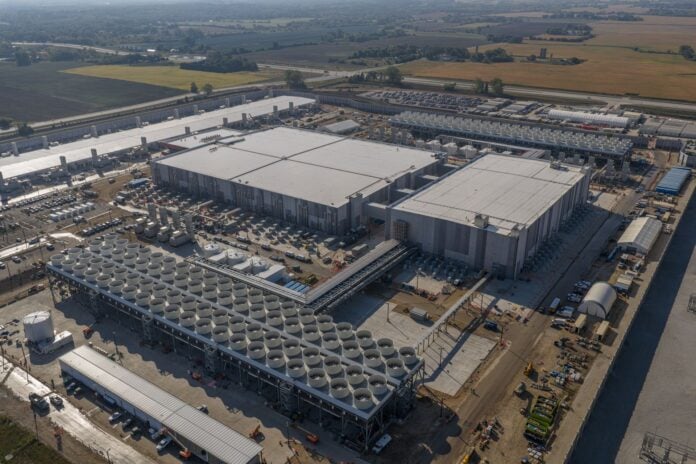
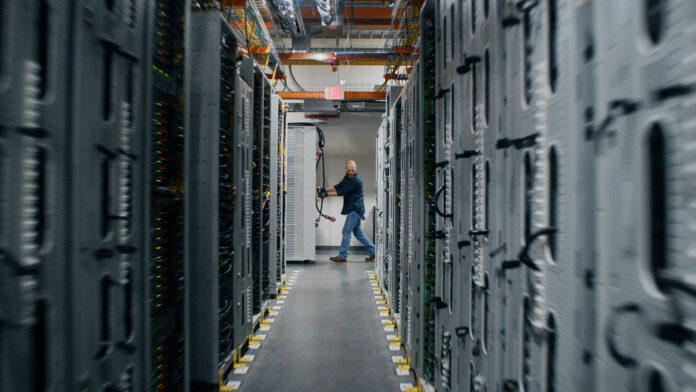
The gap that remains is compute. Microsoft committed $80 billion in AI infrastructure spending in the current calendar year alone. Amazon and Google have announced comparable figures. Mistral’s €4 billion European data center program is ambitious by any prior standard in European tech. In the context of what the American hyperscalers are building, it is a fraction of the total. Monday’s €3 billion will accelerate the pace. Whether it closes the gap depends on whether Mistral’s frontier models — currently benchmarked alongside GPT-5 and Claude 4 — can sustain that parity as training runs grow larger and costlier.
That question cannot be answered at a funding announcement. It will take until the next model ships to answer it.