
CUPERTINO – John Ternus had been Apple’s chief executive for eight days when he walked onto the stage at Steve Jobs Theater on Wednesday morning. The audience inside already knew what was coming. The supply chain had leaked most of it. What nobody knew was whether Ternus would be the kind of executive who inherits a pipeline or the kind who shapes one.
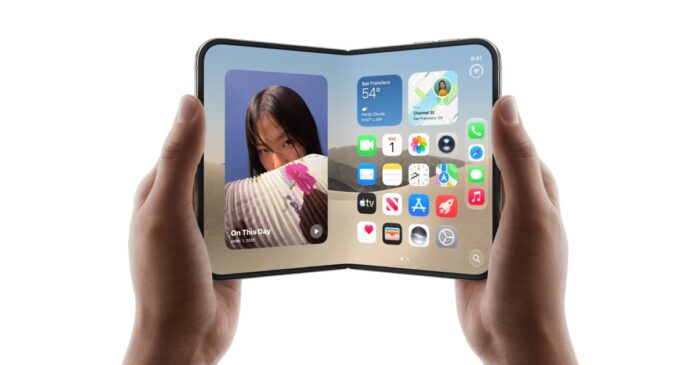
The answer arrived at 10 a.m. Pacific Time, when Apple officially unveiled the device its entire industry has spent five years anticipating: a foldable iPhone.
The device is called the iPhone Ultra. It is not cheap. At $2,199 for the base configuration and as much as $3,000 for the 1TB top-end, Apple is pricing the foldable category as though it has already proven its value, rather than pricing to recruit early adopters away from Samsung and Google. That posture may say more about Apple’s engineering confidence than anything Ternus said on stage.
The iPhone Ultra opens book-style, with a 5.5-inch OLED outer display and an inner panel that unfolds to 7.8 inches – roughly the surface area of a Magic Trackpad, which was apparently the internal design benchmark. Apple engineers spent years on the crease problem that has dogged rival foldables. The company says the hinge, built from a titanium-aluminum alloy, produces what it calls a practically invisible fold line. Pre-production unit reviews gave that claim some early credibility. Whether the claim survives six months in actual pockets is a question Apple cannot answer at an event.
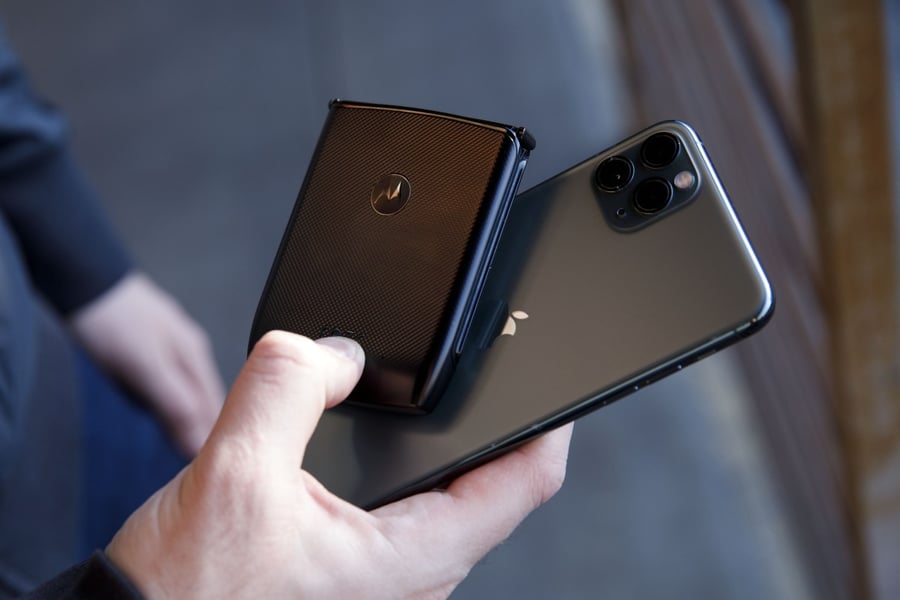
The camera system on the rear of the closed device carries a 48-megapixel main sensor and an ultra-wide lens. It is less elaborate than the iPhone 18 Pro Max’s setup – an unusual inversion for Apple, which has historically centered its most capable camera hardware on its flagship non-foldable line. The Ultra prioritizes the screen experience, and the camera hierarchy bends accordingly.
Both the iPhone Ultra and the iPhone 18 Pro lineup run on the A20 Pro, Apple’s first chip built on TSMC’s 2-nanometer node. The performance gains over the 3nm A19 Pro are real: Apple quoted up to 18 percent faster single-core CPU performance. But the more consequential engineering may be what the 2nm process does to power efficiency. The iPhone 18 Pro is rated for eight percent more battery life than its predecessor, a gain that comes almost entirely from the chip rather than the cell. The A20 Pro is also the first Apple chip to ship with the company’s C2 cellular modem, completing a transition away from Qualcomm that began in 2024, as TechCrunch noted during the event runup.
Apple Watch Series 12 and the Apple Watch Ultra 4 appeared alongside the iPhones, both updated to an S-class chip rather than a full architectural revision. The Ultra 4 gains a second altimeter and expands its sensor array for athletes who have exhausted the Ultra 3’s measurement ceiling. These are not breakthrough updates, and Apple did not frame them as such.
The AirPods lineup received the most structurally unusual update of the morning. AirPods Pro 4 ship with miniature infrared cameras embedded in each stem – invisible from the outside – that Apple says enable gesture recognition for hand-tracking interactions without requiring a paired phone or Watch. It is the kind of feature that either fundamentally shifts how people interact with audio devices or adds nothing to most users’ daily routines. Nobody will know which for several months after the devices ship.
The HomePad, Apple’s first touchscreen home display, rounds out the lineup. At 7 inches, it fills the gap between a HomePod mini and an iPad mini. Apple is positioning it primarily as a kitchen hub and security camera monitor. It runs tvOS with a persistent ambient display mode and is not designed to replace the HomePod mini, which received a refreshed chip and now processes Siri queries locally rather than routing them to Apple servers.
In interviews before today’s event, Ternus declined to characterize his approach to the CEO role relative to Tim Cook’s. He discussed the iPhone Ultra almost entirely in engineering terms: crease elimination, hinge tolerances, display continuity between the two panels. He did not mention the $2,199 starting price until asked directly.
Apple has not announced a simultaneous ship date for the iPhone Ultra alongside the 18 Pro. The Pro models are confirmed for this month. The Ultra carries a supply constraint Apple built into its public guidance: an initial production run of 10 million units, roughly one-third of a typical Pro model launch. If demand exceeds that allocation early, it will be read as market validation. If it does not, the price will be the first explanation anyone reaches for.
That is the one number John Ternus did not address on stage, and the one that will define the first months of his tenure more than any specification Apple announced today. Ternus inherits both an AI reckoning and a foldable launch simultaneously. Wednesday’s event resolved one half of that equation. The other will take until the first earnings call to answer.