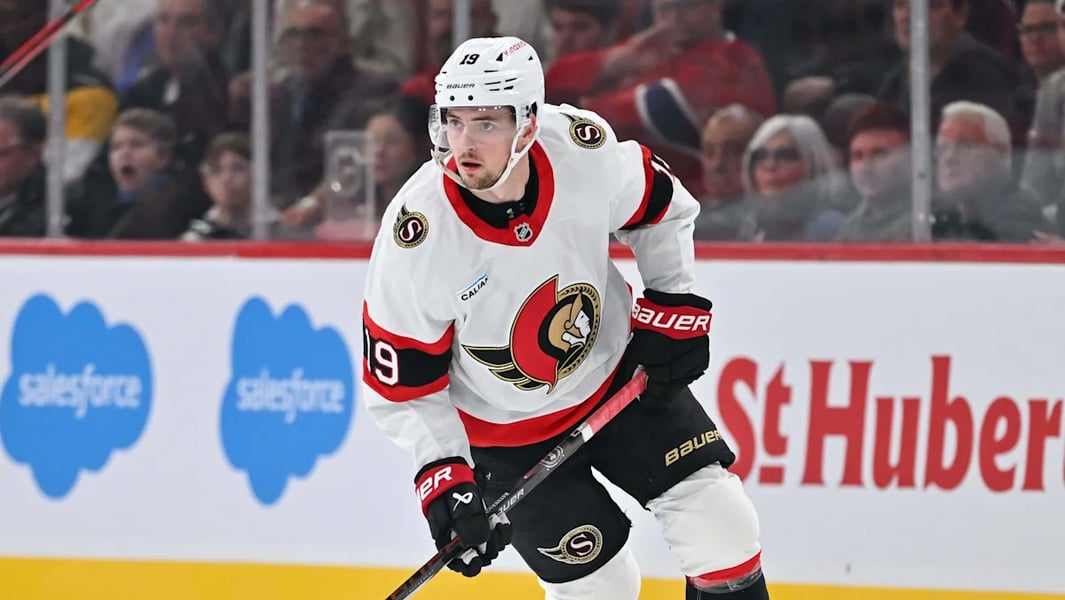

OTTAWA — Drake Batherson has played his entire NHL career wearing a single uniform. He joined the team as a fourth-round pick, remained through the rebuilding years, and was still with the franchise when it regained relevance. Earlier this month, he told reporters that Ottawa is “the only place I’ve ever known” and that it has always felt like home. Monday marks the day the Ottawa Senators must decide whether they feel the same way about him.
The CBA’s eight-year extension window closes on September 15. After that date, the maximum term a team can offer its own players drops from eight years to seven. For Batherson—26 years old, coming off the best season of his career, and entering the final year of a contract that pays him $4.975 million—the difference between eight and seven years is not an abstraction. At whatever number finalizes this deal, one additional year on the back end of a long-term contract represents significant earnings and organizational control, and Batherson’s camp has been clear that they want eight.
The Senators are not close to giving it to them. Multiple reports confirmed over the weekend that contract talks between GM Steve Staios and Batherson’s representation remain far apart, with forty-eight hours remaining before the deadline makes the conversation structurally different. Staios confirmed the talks are ongoing but offered no reassurance about their trajectory: “It takes two sides to come to a deal,” he told reporters, a statement that confirmed the impasse without explaining it.
The gap may not be surprising to anyone who has followed Batherson’s career closely. He signed his current deal in 2021 for six years at $4.975 million per season — an extension widely praised at the time as a steal for Ottawa and quietly accepted by Batherson’s camp under the assumption that the organization was building toward something. Five years later, Batherson has thirty-three goals and seventy-one points in seventy-nine games last season, career highs in both categories, and a contract that now looks like the most team-friendly deal among forwards of his production tier in the league. The market for a twenty-six-year-old right winger with those numbers is somewhere between ten and eleven million dollars per year. His current deal pays him less than five.
The Senators knew this reckoning was coming. The question is whether they are prepared to meet it at the number required to keep it from becoming a reckoning about something else — about how a franchise that asked a player to sign through the rebuild treats him when the rebuild succeeds.

What complicates the conversation further is what Batherson’s current contract produced in context. The six-year deal was not signed in a vacuum. It was signed at a moment when Batherson had to decide whether he believed in what Ottawa was building. He signed because he did. The Senators received five additional seasons of a player who outperformed his deal by a wider margin every year. The extension talks happening now are, in some sense, the accounting for that decision — a player asking whether his faith in the organization was well placed.
The competitive context makes the deadline sharper. Ottawa is not a rebuilding team anymore. They have built around Batherson and a core of players his age, and the front office’s posture over the last two seasons has been unambiguous: this is a team expecting to contend. A long-term extension for Batherson at market value is not a concession to a player’s leverage; it is the continuation of a roster strategy that has been working. Offering eight years instead of seven is the difference between locking in a thirty-three-goal scorer through his early thirties and giving both sides an implicit one-year renegotiation timeline.
Yahoo Sports reported this week that the two sides remain far apart, with other teams around the league actively monitoring the situation. Trade speculation has begun surfacing precisely because an organization in contention with an unsigned star winger and a deadline two days away is a familiar setup.
Carolina reached Monday’s deadline as Stanley Cup champions with an unsigned defenseman still on the roster, a different configuration of the same structural problem: the deadline does not adjust for circumstances.
What is not clear from the outside is where exactly the disagreement sits. Is it the annual value? The term? A combination of both? Staios said it takes two sides, which is accurate as a description and useful as an indicator that the Senators see themselves as having moved. Whether they have moved far enough — and whether their definition of “far enough” matches Batherson’s camp’s definition — is the question Monday answers.
Batherson has said publicly what he wants: a long-term deal in Ottawa. He is not positioning himself for a trade. He has been direct about wanting to stay with the organization that drafted him and the city where he has spent his entire career. That directness carries its own cost in negotiations. A player who has declared he wants to stay has reduced his own leverage.
What he may not have fully calculated is what it means to watch his preferred outcome become unavailable because his employer could not get to a number in time. The Senators have until midnight Monday. After that, they can still extend Batherson. But they cannot give him eight years. Whether the difference between seven and eight represents the actual gap in this negotiation, or whether the gap is something larger, the next forty-eight hours will tell — and one of those forty-eight hours has already passed.