NEW YORK — The point that ended Aryna Sabalenka’s dynasty at Flushing Meadows was not a power play. It was a chip.
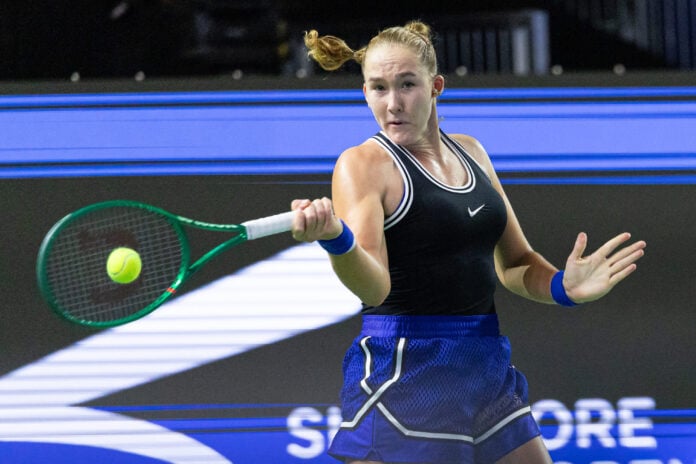
Elena Rybakina floated a backhand slice so short that Sabalenka had to sprint forward and scoop the ball upward, and Rybakina was already at the net, waiting. The volley that followed, punched crosscourt with clinical precision, broke the world No. 1’s serve for the second time in the third set and pushed Rybakina to 5-2 on a warm Saturday evening. Twenty minutes later, she was holding the US Open trophy for the first time, a 6-4, 5-7, 6-2 winner in a match that rewrote the most important scoreline in women’s tennis.
Sabalenka had won here in 2024. She had won here in 2025. She came to New York this year chasing something that had not been done in the Open Era: three consecutive US Open titles. On Saturday, Rybakina removed that possibility with the kind of controlled precision that has made her one of the sport’s most dangerous opponents on any surface.
“It’s just incredible,” Rybakina said on court afterward. “I still can’t believe it. I mean, no words.”
The win is her third Grand Slam title: Wimbledon in 2022, the Australian Open earlier this year, and now the US Open. That makes Rybakina the third player since 2000 to sweep the Australian and US Opens in the same calendar year. Angelique Kerber did it in 2016. Sabalenka herself did it in 2024. Now Rybakina, who turns 27 next month, has joined that group, according to CBS Sports.
The first set announced the match’s architecture. Rybakina’s serve was a weapon from the start; she finished with 12 aces on the day. She broke Sabalenka in the fifth game to go ahead 3-2, then closed out the set with two more holds. Sabalenka was in the match the entire time, generating pressure off the second serve and finding points in baseline rallies, but errors arrived at the wrong moments. The scoreline said 6-4; the weight of the set pointed Rybakina’s way from the start.

It lasted exactly as long as it needed to. Rybakina broke early, held, and the third set had a shape different from the one before. The chip backhand at 4-2 that produced the second break, the net volley punched into the open court, was the moment that matters now. Not because it was the final point, but because it was the one that made the final inevitable. When Rybakina reached 5-2 in a third set of a Grand Slam final, she had not lost a Grand Slam match from that position in her career.
What followed was procedural. Rybakina served out the match, hit a double-fault, then another, and then struck her 12th ace on the final point. The wobble and then the composure described her day. She was not perfect. She did not need to be.
The defeat leaves Sabalenka in a position no one in women’s tennis currently shares: two Grand Slams from the same tournament, two consecutive years. The streak ends at two. Whether she can return next year and build another is the question her season now hangs around, and there is no answer available in a loss.
This was the third Grand Slam final between these two players. Sabalenka won the 2023 Australian Open final when the gap between them was measurably wider. Rybakina won the 2026 Australian Open rematch. Now the US Open, and the head-to-head in Grand Slam finals stands at 2-1 to Rybakina.
The semifinal round earlier this week confirmed the bracket the draw promised. Rybakina dispatched Coco Gauff and Sabalenka overcame Jessica Pegula, the same four players who headlined the women’s semifinals that brought the top four seeds into the final four for the first time since 1975. Rybakina’s semifinal win over Gauff carried the authority of a player who had decided this tournament was hers before it started.
The pre-tournament draw had placed both players in halves that required them to beat the best women in the world to reach the final. They did. The question the draw could not answer was which of them would win the match at the end.
On Saturday night in New York, Rybakina answered it with a chip and a volley.
The WTA rankings update on Monday will confirm what the scoreboard made official: Elena Rybakina is the new world No. 1. She won the Australian Open earlier this year. She has won Wimbledon. She has now won the US Open.
“I’m super happy, so proud of all the work that’s been done,” she said.
Whether the WTA Finals in the autumn will extend this version of her season is the only thing the evening did not settle.