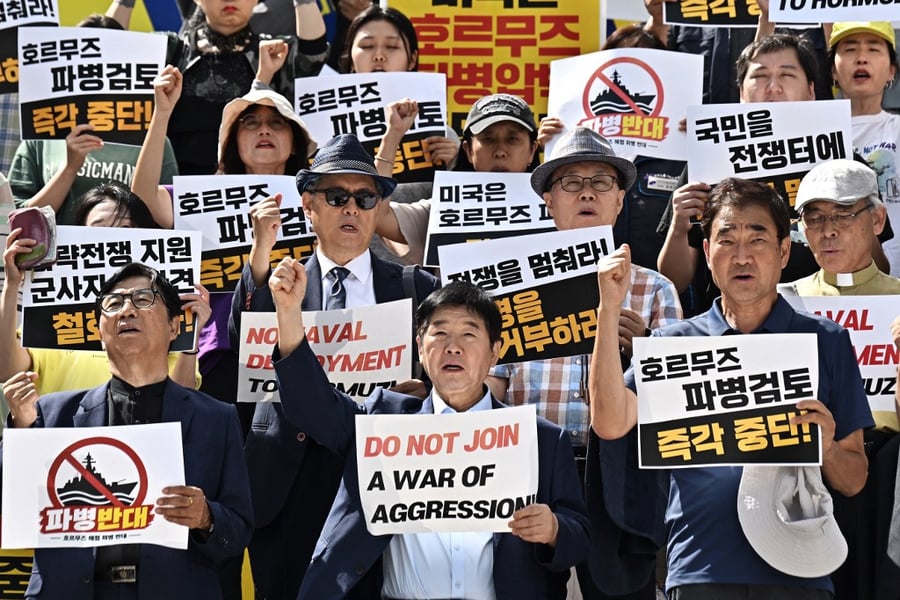

SEOUL — On a warm Tuesday morning outside the US Embassy, 601 civic groups held signs reading “Do Not Join a War of Aggression” and “No Military Deployment to Hormuz.” The September 9 rally was among South Korea’s largest anti-deployment mobilisations in years. Four days later, Seoul dispatched an assessment team to the United Arab Emirates.
The gap between those two facts defines South Korea’s position as the Iran conflict enters its most dangerous phase. President Lee Jae-myung is navigating three competing pressures:
- A Washington alliance that Seoul cannot afford to test.
- An energy supply chain that passes through the very chokepoint under attack.
- A domestic public that has made its opposition clear in the streets of the capital.
The assessment team’s departure for Abu Dhabi came the same day Ansar Allah seized Mayun Island inside the Bab el-Mandeb Strait, tightening the Houthi grip on two chokepoints that together carry the bulk of South Korea’s crude imports. Seoul draws 61 percent of its petroleum from the Strait of Hormuz and 54 percent of its naphtha. No South Korean government can be indifferent to what happens in those waters. The question is whether its military needs to be there.
When Lee met French President Emmanuel Macron in Paris on September 9, he offered an answer designed for both audiences. Any deployment decision, he said, would depend on “national interests and public consensus,” not outside pressure. Washington could read that as a yes in progress. Seoul’s opposition could read it as a no still on the table.
The options under review include a maritime patrol aircraft, a logistics support vessel, and a mine detection and clearance unit. None would place South Korean forces in a direct combat role, a distinction Seoul’s government has stressed in every public statement. But in a war zone, the line between support logistics and combat exposure narrows with every escalation.
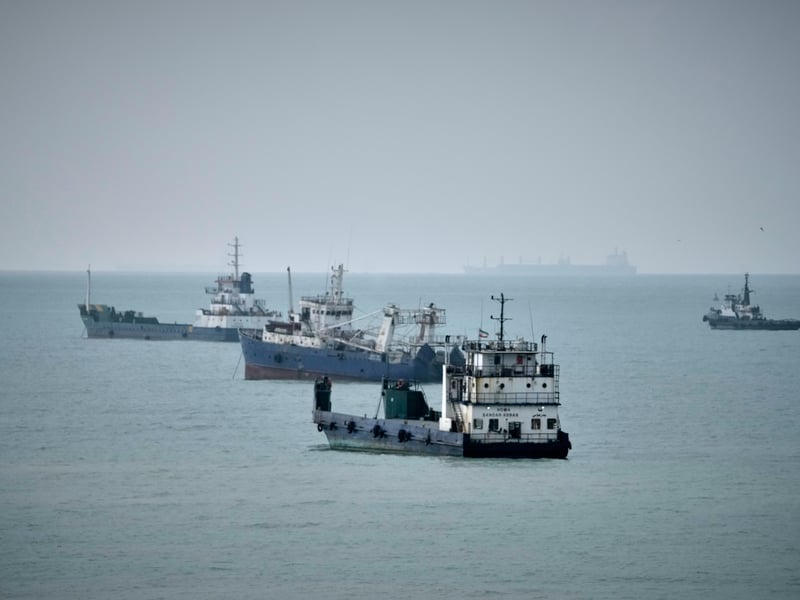
Iran’s framing reflects a consistent position: this conflict was not begun by Houthi missiles and Iranian naval operations. Tehran and its allies argue it was forced on them. Foreign militaries arriving to secure a chokepoint inside Iran’s sphere of influence are not neutral peacekeepers from that perspective; they are reinforcements for the adversary. Whether Seoul shares that reading or not, it is the framework under which any deployed South Korean unit would be operating, and it is the framework under which Iran has been projecting its position internationally all week.
The message is finding a receptive public. The 601 groups that demonstrated on September 9 are not a fringe coalition. They represent labor federations, religious organizations, and a broad cross-section of South Korean civil society. Their argument is straightforward: Seoul’s constitutional role does not extend to contributing forces to a war in which South Korea has no direct stake, regardless of what Washington asks. Protesters chanted that they could not “send our young people into a sea of death.”
South Korean law adds procedural weight to those political constraints. Any deployment requires a National Security Council decision, a Cabinet resolution, and National Assembly consent. Lee’s party does not hold a legislative majority, and the opposition has signaled no willingness to fast-track approval for a deployment with public support this narrow.
What changed on September 12 was the external calculation. The Houthi seizure of Mayun Island completed a strategic tightening at both chokepoints that analysts had feared but few had expected this quickly. Ansar Allah now holds a physical position inside Bab el-Mandeb, not merely the ability to strike ships passing through it. If that foothold extends toward Hormuz, the energy exposure Seoul has managed from a distance becomes immediate. The context for the tanker war already under way at Hormuz has worsened by the day.
The assessment team’s mission in Abu Dhabi will center on what role the US-led coalition needs Seoul to fill and what legal and operational framework would apply. According to Middle East Eye, the September 9 protest drew broad civil society participation that reflects how deeply the question has entered South Korean public life.
Washington’s patience has limits Seoul knows well. The Trump administration’s preference for transactional alliance management means South Korea’s willingness to contribute militarily will be measured against other standing requests: security guarantees, trade terms, the status of US Forces Korea. A flat refusal on Hormuz is not without cost.
What the government has not said, and what no official has confirmed on the record, is whether the assessment team is genuinely still gathering facts or has already begun drafting the operational annexes for a decision effectively made. The 601 groups outside the embassy have their own answer to that question. Nothing from Seoul this week has given them reason to believe they are wrong.