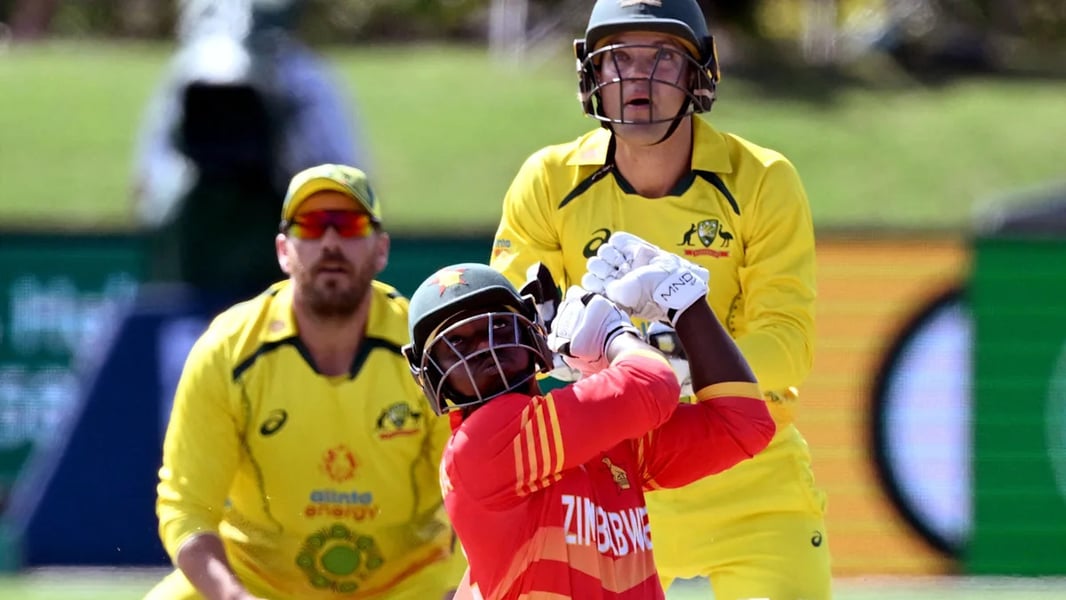

HARARE — Eight years is a long time between drinks, even in cricket. For Graeme Cremer, Zimbabwe’s 41-year-old leg-spinner, the wait ends Monday when Australia arrive in Harare for a three-match ODI series that carries more weight than the fixture list suggests.
He is not just back. Cremer holds Zimbabwe’s finest ODI bowling figures: 6 for 46 against Kenya in 2009, a record that has stood for seventeen years. The man who has come closest to matching it is Ryan Burl, his leg-spin partner and the junior generation’s standard-bearer. Burl’s 5 for 10 against Australia at Townsville in September 2022 — the afternoon Zimbabwe won on Australian soil for the first time in their history, by three wickets — is the second best. Both records belong to leg-spinners. Both men are now in the same squad. Australia are the opposition.
That symmetry will not write itself into a result, but it locates the central question the first ODI will answer: which version of Zimbabwe shows up in Harare — the side that ended a 31-year wait for a win over Australia at this ground in 2014, or the one that has cycled through injury, qualification nerves, and structural transition ever since?
The hosts arrive off a tight five-run win over Namibia in Windhoek earlier this month, a hard-fought result that revealed promise in the lower order without resolving doubts at the top. Australia’s first bilateral ODI visit to Zimbabwe in more than a decade is not a tour of sentiment for Mitchell Marsh’s squad — it is World Cup preparation, part of a broader push to lock in the combinations that will carry Australia into the 2027 ICC Cricket World Cup cycle with as few unknowns as possible.
Sikandar Raza takes the captaincy after Richard Ngarava withdrew with a lower-back injury. Raza has worn the armband before and carries the role naturally — a reassuring constant in a squad where Raza himself, Cremer, Craig Ervine, and Brendan Taylor are all 40 or older by the series’ close. That demographic reality will invite the obvious scepticism, but it also concentrates experience at a moment when Zimbabwe are trying to prove that they belong in the conversation for the next World Cup cycle rather than merely in the fixture.
Taylor’s return is the most pointed case. He has been away from ODI cricket for more than a year, a gap that in another era might signal the end of a career rather than a pause. His recall reflects Zimbabwe’s reliance on a generation that kept the programme alive through its years outside the top tier, but it also signals what the selectors see in this series as a genuine opportunity to build rather than maintain. Whether Taylor’s technique against international-quality pace, blunted by the layoff, holds up against Xavier Bartlett and Spencer Johnson will tell Zimbabwe something useful early.

Australia come to Harare with a squad that mixes established names with players in active competition for World Cup berths. Joel Davies, Oliver Peake, and Cooper Connolly are each working through the kind of bilateral exposure that turns potential into selection certainty. Marsh has made no secret that this tour is an evaluation as much as a fixture — the squad that lands in Harare is not necessarily the squad that boards the plane home.
Zimbabwe’s pace dimension rests with Blessing Muzarabani, who has matured into a consistent international operator capable of generating awkward bounce on Harare surfaces. If Muzarabani and Burl can replicate the coordination that worked so well at Townsville four years ago — pace pressure from one end and Burl’s wrist-spin creating the collapse Australia never recovered from — Zimbabwe have a blueprint they know works against this opposition.
Whether Cremer gets the chance to add his own chapter to that blueprint — or whether he watches from the dugout while the selectors manage his return carefully — nobody outside the dressing room knows yet. What is already certain is that Australia have arrived in Zimbabwe, for the first time in years, against a home side that has beaten them before. On this ground. In these conditions. With at least one man in the squad who knows exactly what that felt like.
What nobody knows yet is which version of Zimbabwe turns up to prove it again.