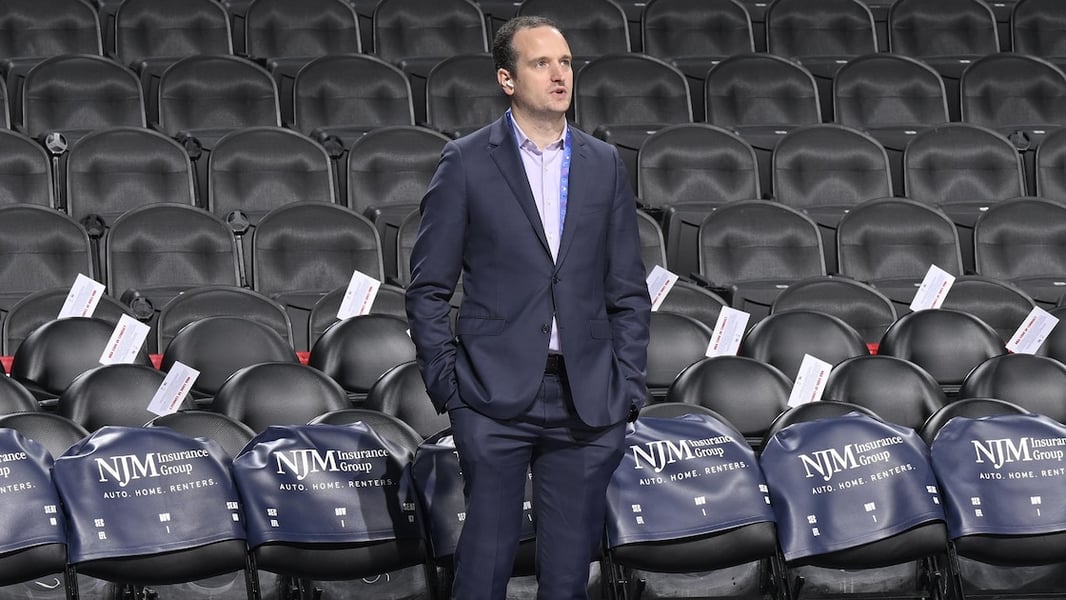

ATLANTA — The most unusual hire in the Atlanta Hawks’ front office this September was not the promotion. It was the former reporter sitting across from them.
Tim Bontemps spent 14 years on the media side of the NBA, first at the Washington Post and then eight seasons at ESPN, covering the league’s most consequential decisions from press row. On September 8, the Hawks made it official: Bontemps crossed to the other side, joining as a strategic advisor in a front office now formally under the command of president of basketball operations Onsi Saleh.
The announcement arrived bundled with two other moves that have quietly reshaped Atlanta’s power structure since Saleh’s own promotion from general manager in May. Peter Dinwiddie was elevated to executive vice president of basketball operations, officially the No. 2 executive behind Saleh after more than a year as senior vice president of strategy and analytics. Maxwell Kupchak, in his fourth season with the organization and previously the team’s coordinator of cap strategy and player personnel, moved up to director of the same function.
Three titles. Three promotions. One coherent blueprint.
The sequencing matters. Saleh’s elevation in May came after one of the sharpest midseason turnarounds in recent league memory. He traded Trae Young to Washington in January for CJ McCollum and Corey Kispert, then watched his team go 27-15 the rest of the way, highlighted by an 11-game winning streak, before falling to the New York Knicks in a hard-fought first-round playoff series. That deal ended an era and accelerated a rebuild that, from the outside, looked messier than it turned out to be. Saleh was runner-up for 2026 Executive of the Year.
As Eastern Conference rivals were making their own preparations, the Golden State Warriors and LA Clippers touched down in Hawaii for training camp while James Harden finalized a three-year deal in Cleveland. The Hawks, meanwhile, were quietly assembling the people who will make their next decisions.
Kupchak’s promotion is quieter but meaningful. In a salary cap environment where every dollar and every waiver claim carries downstream consequences, cap management is no longer a support function, it is a competitive weapon. The Hawks navigated the Trae Young trade in part because they understood their flexibility precisely, knowing what contracts they could move and what exceptions they could activate. Kupchak moving from coordinator to director is a recognition that cap architecture will be central to whatever they build next.
And then there is Bontemps. The hire was first reported in late June, when it landed as something of a footnote during a busy free agency window. His official announcement in September, folded into a broader front office release, does not quite capture how unusual the move is. As Bleacher Report noted, ESPN colleagues Tim MacMahon and Brian Windhorst broke the news of his departure from the network. Reporters-turned-executives are rare in any sport; in the NBA, where every conversation is a negotiation and every relationship is currency built across years of access, the transition from press row to front office is rarer still.
Bontemps is 41. He has covered the league since 2012 and built a career on understanding who was calling whom and why. Now he is on the receiving end of those calls.
What he brings to Atlanta is harder to quantify than a trade package or a salary slot. Sourcing, the trust accumulated through years of conversations with agents, players, coaches, and executives in hotel lobbies and late-night text chains, is the most valuable currency in league offices. Teams have increasingly recognized that the best basketball analysts are not always the ones with front-office pedigrees. The Oklahoma City Thunder rebuilt on unconventional thinking. Golden State’s dynasty was sustained in part by executives who thought in narratives about players, not just numbers. That Atlanta is making a similar bet signals where Saleh believes the next competitive edge lives.
Whether it produces another playoff run, or something more, is a question for April. The Hawks cannot yet tell us whether this front office coalition will hold together under the pressure of a full season. Dinwiddie has been a strong No. 2 at multiple stops but has never operated as the principal decision-maker; his new title does not change that, but it does raise the stakes around the question. Bontemps has never worked inside a team. Kupchak carries his father Mitch’s surname, two decades building championship rosters in Los Angeles, but Maxwell has earned his own standing in Atlanta quietly, across four seasons few outside the organization noticed.
What September 8’s announcement confirmed is that Saleh is not building a front office of agreement-seekers. He added an analytics architect with Pacers and 76ers experience, a writer who spent his career scrutinizing front-office decisions, and a cap specialist whose family understands organizational culture at the championship level. That is a deliberate combination of skills, and a fairly direct statement about what kind of front office the Hawks intend to run.
For a franchise still figuring out what comes after Trae Young, that is no small thing.