
DETROIT — The ball came down in Bryce Lance’s hands and then it didn’t. In that instant, Kellen Moore’s arithmetic became a loss.
That was the play that ended the game—not Jahmyr Gibbs’ 156 rushing yards and career-high three touchdowns, not Tyler Shough’s extraordinary 410-yard response to a 21-point deficit, and not Ryan Wright’s missed 62-yard field goal that forced a sold-out Ford Field to watch overtime.
The Detroit Lions beat the New Orleans Saints 31–30 on Saturday night because a pass fell incomplete in the corner of the end zone, while a head coach who trusted his probability model watched the decision produce its harshest possible outcome.
Moore had the numbers. Win-probability models generally favor an aggressive overtime decision when a team scores to pull within one: convert and win rather than kick and extend the game. Moore had built his coaching identity around such choices for two seasons. He also had a quarterback who had just driven 75 yards in under two minutes against a tiring defense that needed only one stop.
What he did not have was a completed pass.
That gap is the thing New Orleans takes home. What Shough produced on this afternoon, for three of the four quarters he was allowed to be good, looked like something worth building around. The Saints’ second-year starter completed 35 of 56 for 410 yards and three touchdowns, becoming the first New Orleans quarterback to exceed 400 passing yards in a season opener since Drew Brees in 2011, per Sports Illustrated. He threw two interceptions and lost a fumble. He also erased 21 points in under two quarters on the road.
The interceptions and the fumble came early, and they accelerated the damage.
The Saints disagreed with the verdict.
Shough’s second half was the kind of performance that earns a franchise’s patience. Chris Olave ran a route that put 47 yards between the catch and the line of scrimmage and reframed what New Orleans could do through the air when it was moving cleanly. Devaughn Vele caught a touchdown. Kendre Miller took it in from eight yards and gave the Saints something the first half had taken from them: belief. With 1:07 remaining in regulation, Shough found Juwan Johnson in the end zone against Carlton Davis, threading the ball into coverage on a throw that made the 24-24 tie feel less like a lucky bounce than a planned outcome.
Wright’s field goal from 62 yards in regulation had no real chance. Overtime.
Gibbs carried through the extra period the way he had carried through the first half. When Moore gave him the ball from the one-yard line, it was Detroit 31, Saints 24. The Lions’ defense needed one stop.
Getting it was not simple. Shough moved the Saints quickly and connected with tight end Jordan Love, New Orleans’s Jordan Love and not Green Bay’s, for the score that made it 31-30. Moore called timeout, gathered his offense, and chose his number.
Ifeatu Melifonwu covered Lance in the corner of the end zone. The pass arrived. Lance came down without it. Whether contact played a role is the kind of question that replay views invite and officials do not revisit under current rules.
Moore did not walk through his probability model after the game. That is typically what happens when the math produces a one-point loss. The two-point call was defensible. It may have been correct. What it will be remembered as is a result, not a calculation.
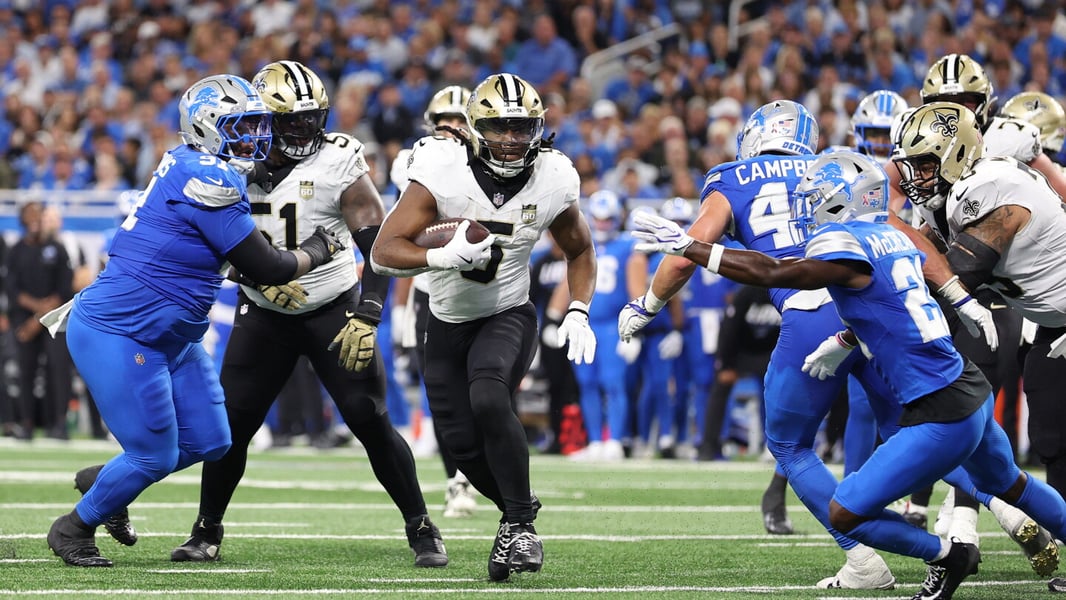
Gibbs finishes the opener with 29 carries, 156 yards, and three touchdowns: a career high in scores and a workload that tests most backs. The Saints’ front four was not a soft draw. Gibbs got through it repeatedly, and the Lions’ offensive line gave him the room to make those carries count. CBS Sports’ game recap provides the full statistical breakdown of what Detroit’s ground game produced on Saturday.
Goff threw for 206 yards without a turnover. He found St. Brown when the matchup called for it and managed the game when managing it was enough. For the broader picture of what NFL running backs did this opening weekend, Derrick Henry’s three-touchdown demolition of the Colts offers a companion read on what a healthy backfield does to a game’s arithmetic. Caleb Williams and the Bears produced their own kind of Week 1 statement across the NFC, but in Detroit the message was simpler: Gibbs runs, Goff manages, the Lions win.
What the Saints produced was something messier and more interesting than a one-point loss implies. A quarterback who threw for 410 yards in his first real start after a 2025 injury, against a defense that held when it needed to. A head coach whose aggressive call was probably right and cost his team a game. An offense that turned a 21-0 deficit into 30 points in under two quarters, and then watched the two-point attempt land incomplete in the corner.
One week in. The NFC North is 1-0. The questions it has are not the ones it expected.