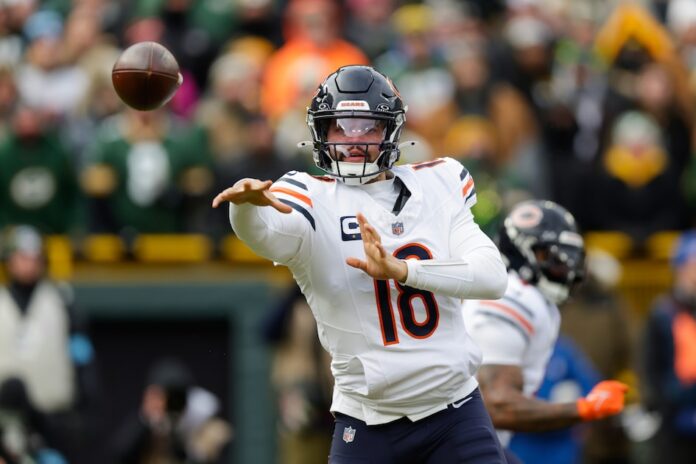

CHARLOTTE — The Bears needed three seconds and twenty-nine yards to settle the question, and Caleb Williams answered it himself.
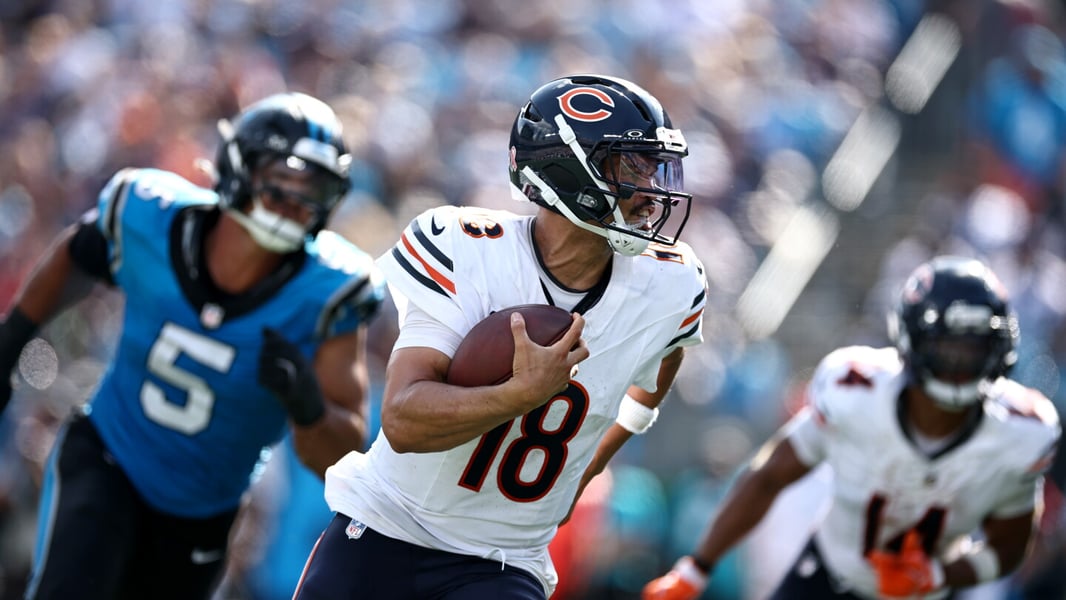
With Chicago leading Carolina 38–17 in the third quarter and the Bank of America Stadium crowd already absorbing everything that had gone wrong, Caleb Williams turned a broken pocket into a decisive statement.
He sprinted through a gap in the Panthers’ defense and accelerated untouched for the final 15 yards into the end zone. It was the defining moment of a game that offered several, but also the clearest illustration of what Ben Johnson’s offense has become in its second season: a system that prevents defenses from winning simply by taking away one dimension, because it does not rely on only one.
By the time the final whistle blew Sunday, the Bears had scored 59 points. The combined total of 96, as CBS Sports reported, was the most in NFL season-opener history, eclipsing the 88 Tampa Bay and New Orleans produced in 2018. The score itself, 59-37, sits as a Scorigami, the 1,096th unique score combination in regular-season NFL history, a tally that had never before appeared in a box score.
Chicago’s 59 points were the franchise’s most since 1980 and broke the team’s own opener record of 45, set against the Packers at Wrigley Field in 1948. Forty-six years of restraint ended in one September afternoon in Charlotte. And in a Week 1 that saw Derrick Henry join Marcus Allen on the all-time rushing list and the Texans set a franchise sack record in Buffalo, the Bears’ afternoon in Charlotte still found its own category.
Williams completed 21 of 29 passes for 269 yards with two touchdowns, then added 65 rushing yards and two more scores on the ground, including that 29-yard burst in the third quarter. It was the first time in Bears franchise history that a quarterback posted 200 passing yards, two passing touchdowns, 50 rushing yards, and two rushing touchdowns in a single game. The number reads cleanly, but what it represents is harder to quantify: a quarterback who spent an entire offseason absorbing Johnson’s demands and arrived at Week 1 looking like this system’s natural inhabitant rather than a student still finding the edges of it.
Johnson addressed the design of the offense directly after the game. “The run game is not the jab,” he said. “It’s the haymaker. But the play-action pass is also the haymaker.” Defenses that commit to stopping Chicago’s ground game will find the passing game already waiting. Defenses that split their attention will find both.
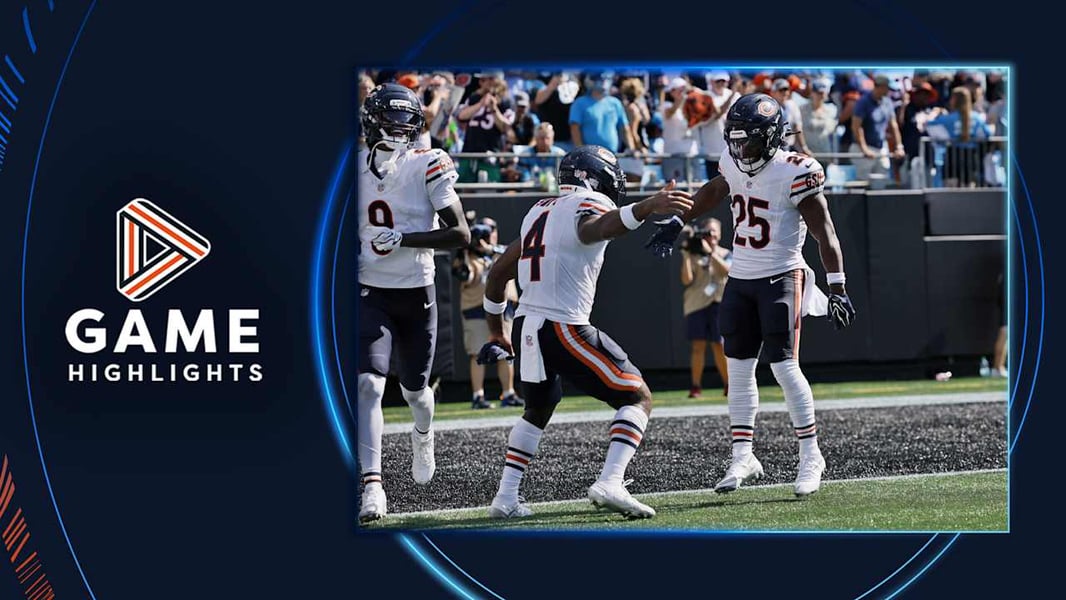
Carolina offered resistance. Bryce Young completed 23 of 37 passes for 361 yards and three touchdowns, and wide receiver Jalen Coker caught two of them on sharp routes that identified some real coverage concerns in the Chicago secondary. But the Panthers committed three turnovers: a Jimmy Horn muffed punt that Chicago converted into points, a Tetairoa McMillan fumble, and a Young interception. Each one handed the Bears additional momentum in a game they had owned from the second quarter forward. Young’s individual numbers would read as a competent afternoon in a different context. In this one, they were a losing effort from a quarterback absorbing a system that was already operating at a different altitude.
Across the rest of Week 1, the league sorted through its own identity questions. The Panthers enter 2026 building around a second-year starter while asking him to compete simultaneously, and Sunday widened the gap between both demands rather than narrowing it.
For Williams, the afternoon ended not with celebration but with a corrective frame. “That’s who we want to be this week,” he said in the locker room, already oriented toward the film that would arrive Monday morning. “We got to go clean up. We want to be truthers. Obviously, this is going to be our kind of worst game.”
That a quarterback who scored four touchdowns could call the performance a floor rather than a ceiling is either the highest competitive standard in the league or the natural idiom of the Johnson system. The honest question has not been answered: Carolina’s secondary was shorthanded, and the Panthers’ 2025 defense ranked among the most porous in football. Another opponent, healthy and with a week of film, will say more about what this offense can actually sustain than 96 combined points on a September afternoon in Charlotte.
The record books absorbed what Sunday sent them. Week 2 will be harder to read.