
Here’s a tightened version while keeping the context, facts, chronology, and all wording of the quote-free reporting intact:
THE HAGUE — The screens in Pristina went up in the squares, and thousands of Kosovars gathered to watch a court in The Hague convict the man who had been their president.
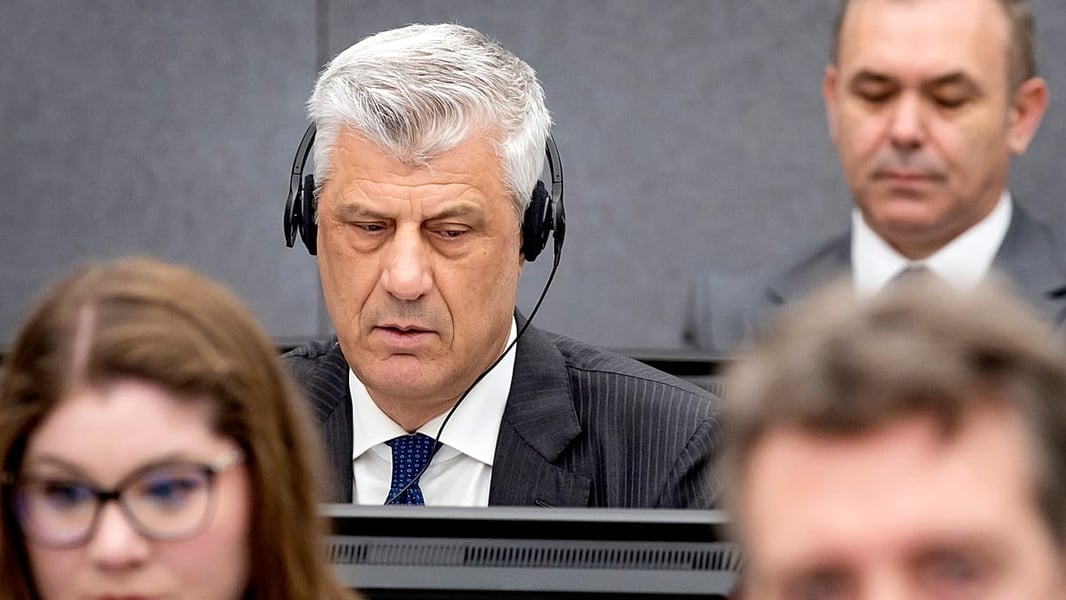
What they saw when the verdict came down Tuesday was not what most expected. The Kosovo Specialist Chambers sentenced Hashim Thaci, 58, to 25 years in prison after finding him guilty of war crimes committed not against Serbian forces or their allies, but against political opponents, perceived collaborators, and civilians within the Kosovo Liberation Army’s own reach.
The verdict fractures, perhaps permanently, the founding story Kosovo has told about its 1998-1999 war of independence. The KLA, long lionized as freedom fighters who broke Serbian rule at enormous cost, was found by the court to have used murder, torture, cruel treatment, and arbitrary detention as tools not only against the enemy but against Albanians who stood in the faction’s way.
The court found Thaci guilty of murdering 96 people, torturing 303 detainees, committing cruel treatment against roughly 50 people, and arbitrarily detaining 385. Three co-defendants were also sentenced: former Kosovo parliament speaker Jakup Krasniqi received 25 years; former assembly speaker Kadri Veseli was sentenced to 18 years, reduced for time already served; former parliamentarian Rexhep Selimi received 13 years, also accounting for time in custody.
The Kosovo Specialist Chambers, an EU-backed tribunal based in The Hague established specifically to address allegations against KLA leadership, acquitted all four defendants on six charges of crimes against humanity. Those counts required prosecutors to prove the crimes were part of a widespread or systematic attack on a civilian population. On those elements, the court found the evidence fell short.
That partial acquittal gave Pristina a narrow legal foothold. Kosovo’s Foreign Minister Donik Konjufca did not use it. “This is a terrible judgment for Kosovo, for our people and for our liberation war,” Konjufca said, according to Anadolu Agency. In the capital, protesters gathered outside the government building. The convictions were read not as a legal finding but as an assault on Kosovo’s legitimacy and its struggle for recognition.
The parallel drawn in Kosovo’s squares Tuesday was to the International Criminal Tribunal for the former Yugoslavia, where convictions of Serbian commanders, including the life sentence handed to Ratko Mladic for the Srebrenica genocide, came after decades of proceedings that left scars across the region that have not closed. Kosovo’s leaders had argued consistently that the KSC proceedings were misguided, that the KLA fought a legitimate war of liberation, and that the tribunal’s focus on Albanian commanders gave revisionist accounts of the conflict a foothold they did not deserve.
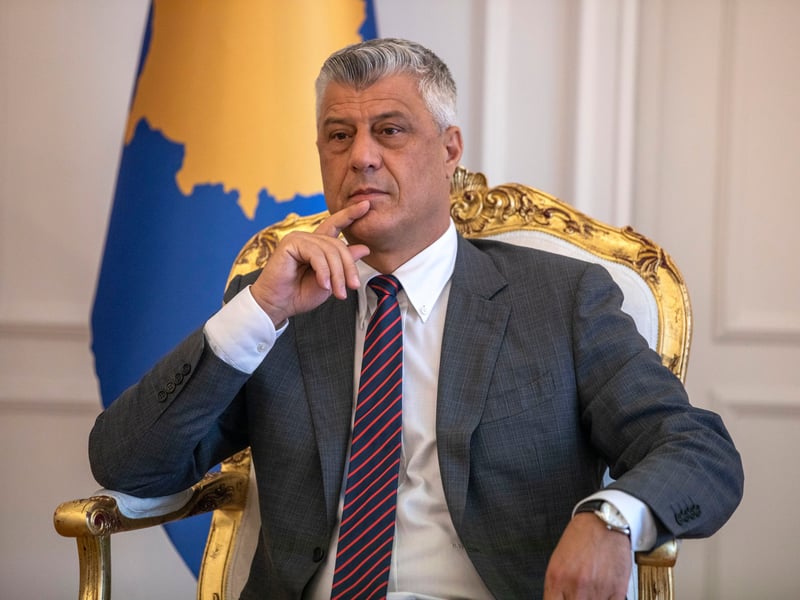
Thaci, who served as Kosovo’s president from 2016 to 2020, surrendered to the court that year after being charged. His absence from Kosovo’s political life over the past six years did not diminish his symbolic weight. He remained the commander whose war produced independence, and Tuesday’s verdict made that history considerably more complicated.
Kosovo’s political leadership under Prime Minister Albin Kurti, who built his career partly in opposition to Thaci’s Democratic Party of Kosovo, faces difficult politics. Condemning Thaci means acknowledging the verdict’s authority; defending him risks endorsing crimes the court spent three years documenting in forensic detail.
Both prosecution and defense have the right to appeal. Neither side announced a decision immediately after the verdict. For the Kosovo Specialist Chambers, founded amid significant resistance from the Kosovo government and staffed by international judges, the ruling represents an institutional test: whether a tribunal deeply unpopular in the country it concerns can nonetheless impose accountability.
What remains unresolved is the effect on Kosovo’s long-stalled path toward European Union membership and its fraught negotiations with Serbia over normalization. Brussels has conditioned progress on both tracks on judicial cooperation and rule of law, and the verdict’s reception in Pristina, where a wartime conviction was greeted with protests rather than reflection, will be noted in capitals that hold Kosovo’s future in their hands.
The crowds dispersed before nightfall. The screens came down. Thaci will appeal, or he will not. In either case, Tuesday’s judgment will be harder to reverse than the sentence.