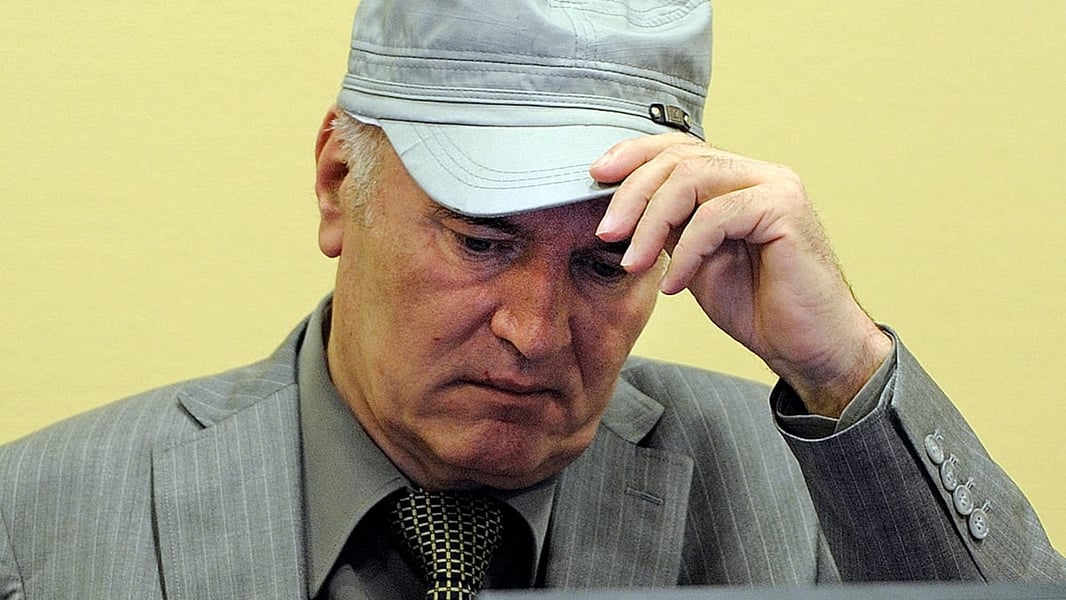

THE HAGUE — The women who buried their sons in Potočari will not mourn him. For three decades they watched the proceedings in The Hague with a mixture of hope and fury, hoping that something in the man who ordered the slaughter might bend toward acknowledgment. It never did. Ratko Mladic, who commanded the Bosnian Serb forces that killed more than 8,000 Bosniak Muslim men and boys at Srebrenica in July 1995 and directed a 44-month siege that turned Sarajevo into a killing ground, died Thursday in the prison hospital of the United Nations detention facility in The Hague. He was 84.
The tribunal’s registry confirmed his death on Thursday, according to Euronews. No official cause of death was provided. Mladic had suffered several strokes in recent years, his health declining as he served the life sentence handed down by the International Criminal Tribunal for the former Yugoslavia in 2017, a conviction his lawyers challenged on appeal and lost. He died without ever publicly expressing remorse for the crimes a court determined he directed.
The name Srebrenica has become synonymous with the worst mass atrocity on European soil since the Second World War. In July 1995, Mladic’s Army of Republika Srpska overran the United Nations-declared safe area in eastern Bosnia, separating men and boys from women and girls at gunpoint. Over the following days, the men and boys were executed in fields, factories, and ravines. Their bodies were buried in mass graves, then exhumed and moved to secondary sites to complicate identification. The forensic recovery effort led by the International Commission on Missing Persons has continued for thirty years. Some families are still waiting.
Mladic commanded not just a military operation but a project of erasure. His forces, according to the tribunal’s findings, intended to destroy the Bosniak Muslim community of Srebrenica as such, meeting the legal definition of genocide under the 1948 Genocide Convention. Recordings of Mladic captured in the days before the massacre show him walking through the enclave and telling the camera that the time had come for “revenge against Turks in these regions,” his term for Bosniak Muslims. In other communications, he instructed officers to direct fire toward civilian neighbourhoods. The tribunal found that he exercised effective control over the soldiers who carried out the killings and did nothing to stop them.
The siege of Sarajevo was a separate chapter of the same war. From 1992 to 1995, the Bosnian Serb army encircled the Bosnian capital and subjected its civilians to daily artillery fire and sniper attacks from the surrounding hills. The siege lasted 1,425 days, longer than the Battle of Stalingrad. More than 11,000 people died, the majority of them civilians. Mladic’s forces controlled the supply routes, restricting food, water, electricity, and medicine. Sniper positions were established with lines of fire into markets, schools, and tram routes. The tribunal found him responsible for overseeing this sustained campaign of terror against the civilian population of Sarajevo.
He evaded justice for fifteen years. When the Dayton Agreement ended the conflict in 1995 and the tribunal began issuing indictments, Mladic disappeared. He lived in Serbia for much of that period, reportedly with the protection of elements within the Serbian military and security apparatus, an arrangement Serbia has never fully accounted for. He was arrested in a Serbian village in May 2011, living under a false name and in declining health, and extradited to The Hague within days.
His trial lasted years. Mladic often disrupted proceedings, taunting relatives of victims in the gallery and making throat-slitting gestures at witnesses. He was removed from the courtroom on multiple occasions. His defence lawyers argued he had been acting within the laws of war and bore no command responsibility for what individual soldiers did. The judges rejected that argument in its entirety.
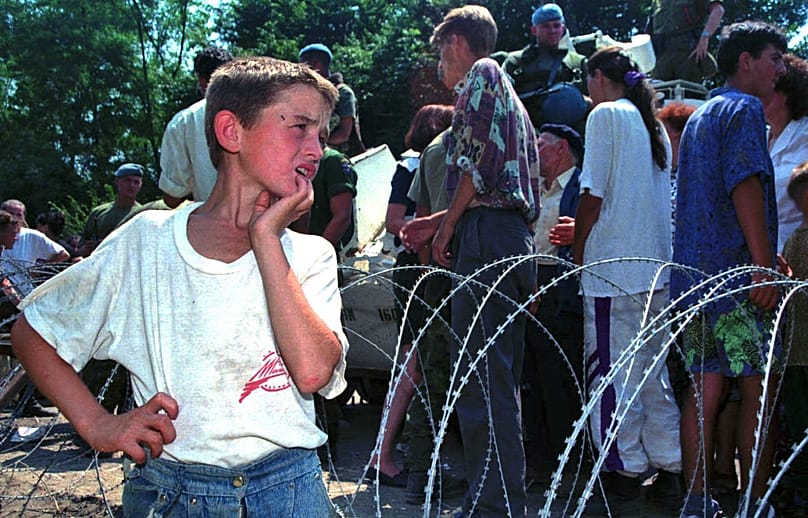
The reaction in Bosnia and Serbia to his death divided along the lines of the war. In Sarajevo and at the Srebrenica memorial in Potočari, grief was tempered by the recognition that Mladic had died without ever answering to the survivors who deserved to face him. Munira Subašić, who chairs the Mothers of Srebrenica association and lost her son and husband in the massacre, said his death did not return what had been taken. In nationalist circles in Serbia, Mladic has long been celebrated as a defender of the Serb people, a framing the tribunal explicitly rejected and one that continues to complicate regional reconciliation at a moment when war crimes accountability across European conflicts remains fiercely contested.
The International Criminal Tribunal for the former Yugoslavia, established by the United Nations Security Council in 1993, closed formal proceedings in 2017 and transferred remaining functions to a residual mechanism. Mladic was among its most prominent defendants. His conviction, alongside the earlier conviction of Radovan Karadžić, is considered one of the tribunal’s defining achievements. Neither man ever acknowledged guilt. The tribunal’s work established a precedent for holding military commanders personally responsible for mass atrocities, a precedent invoked in subsequent conflicts even as NATO’s overstretched air defences in Europe are redirected toward more immediate crises.
What Mladic’s death does not resolve is the question the families at Potočari have never stopped asking: how much of what he set in motion remains unaddressed. Dozens of men who participated in the Srebrenica executions have been convicted in regional courts, but the full network of command, complicity, and concealment has never been completely mapped. His death removes the possibility, never likely, that he might one day have spoken about what he knew. For the women of Potočari, that silence is now permanent.