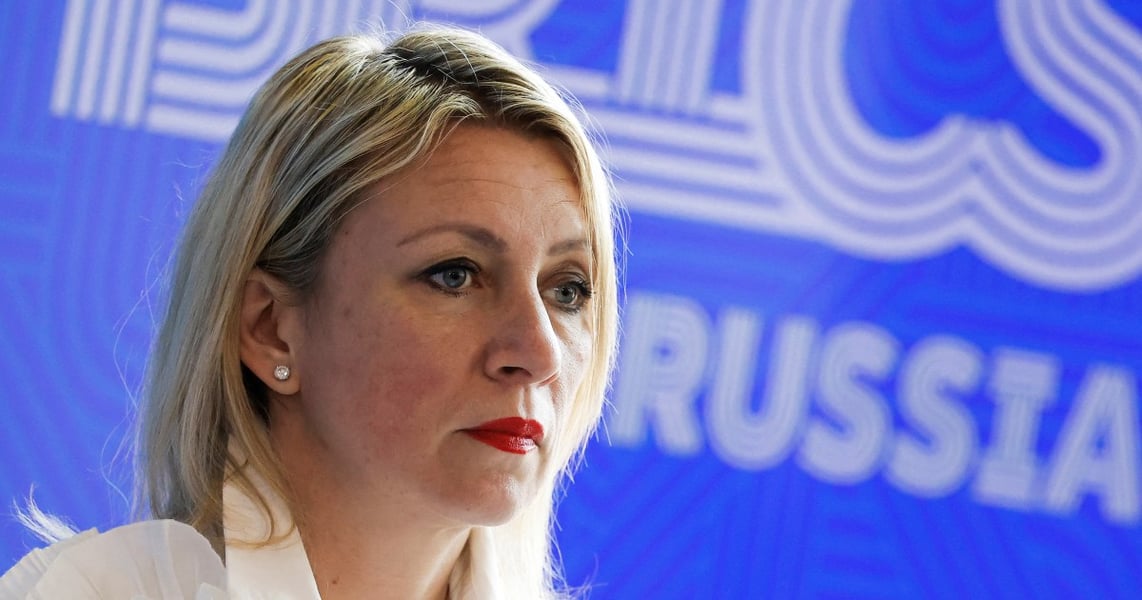

LONDON — For the first time since the start of Russia’s military operation in Ukraine, Moscow placed British military installations — including those beyond Ukrainian borders — explicitly into the category of potential strike targets on Thursday. The warning, issued by Russian Foreign Ministry spokeswoman Maria Zakharova, arrived less than a week after London announced it would help Ukraine manufacture Storm Shadow cruise missiles domestically, a move the Kremlin has characterised as a fundamental shift in Western involvement.
“Any British military installations and equipment in Ukraine and beyond its borders could be targeted,” Zakharova said in a formal statement circulated by the ministry, in language that carried none of the usual hedging attached to such declarations. She described Britain as “one step away from becoming legally complicit in terrorism” and called on the British government to “once again carefully analyse the situation and immediately abandon the hostile, aggressive line.”
The immediate pretext was a specific allegation: Russia accused Ukraine of deploying British-supplied Storm Shadow cruise missiles against a shopping centre in Donetsk, the city Russia administers as its own territory following a referendum that most of the international community does not recognise. Ukraine neither confirmed nor denied the specific strike. Britain, consistent with its standing position, denied any involvement in target selection and maintains that operational decisions rest with Kyiv.
But the deeper cause of Thursday’s statement runs further than any individual strike. London’s announcement that it would help Ukraine build Storm Shadow missiles domestically — an industrial arrangement enabling Ukraine to develop its own long-range precision strike capacity, rather than merely receive a weapon delivery — gave Moscow a structurally more significant grievance. The Kremlin has long drawn a distinction between supplying munitions and embedding strike-manufacturing capability inside a combatant’s territory. Russia publicly treated that line as a threshold. Thursday’s statement is the formal signal that it considers the threshold crossed.
Ukrainian Foreign Minister Andrii Sybiha confirmed the wider military context Thursday morning. “Overnight, Russia carried out a massive strike against Ukraine,” he said, “targeting ports, grain storage, energy, industry and other infrastructure with ballistic and hypersonic missiles and combat drones.” Ukraine’s air defences intercepted seven ballistic missiles and approximately ninety percent of the incoming drone wave, according to the Ukrainian Air Force — a defensive record that reflects significant capability improvement, though one that still leaves substantial ordnance reaching its targets. The overnight exchange is part of the broader Russia-Ukraine war escalation documented in recent reporting from Kyiv and Odessa.
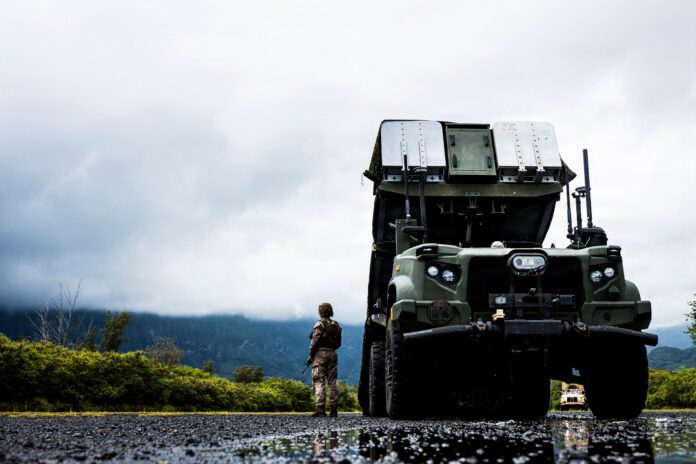
The Storm Shadow is a British-French designed cruise missile with a range of roughly 250 kilometres, capable of penetrating hardened targets at low observable altitudes. Ukraine’s deployment of the system beginning in 2023 gave Kyiv a reach into Russian-controlled territory that transformed the long-range strike picture. Russia’s objections to its use have escalated with each reported employment. Thursday’s statement differs from prior warnings in one critical geographic respect: for the first time, the targeting language has shifted beyond Ukrainian territory to British soil.

That shift carries legal and strategic implications that European governments and NATO planners will not treat as ordinary rhetoric. The alliance’s Article 5 collective defence clause formally obliges all members to treat an attack on one as an attack on all. Russia is fully aware of that mechanism. The deliberate inclusion of “beyond its borders” in Zakharova’s statement — rather than language limited to British assets inside Ukraine — is calibrated to test whether NATO governments respond to a targeting threat that formally triggers collective defence language, before any ordnance leaves a launcher.
Britain’s government issued no formal public response by the time this article was filed. London has tended to respond to escalatory language from Moscow through action — additional weapons transfers, new commitments, expanded sanctions — rather than through counter-rhetoric. Whether that practice remains tenable when Britain is named explicitly as a potential target, rather than implicitly as a supplier, is a calculation that the government has not yet addressed publicly.
The warning arrives against a specific resource backdrop. As documented in recent reporting, NATO’s Patriot missile stockpile in Europe has fallen to levels US officials describe as “beyond critical,” drawn down by Ukraine transfers and the Iran war. British defence spending is increasing but stretched across multiple active commitments. Russia has consistently calculated that the gap between Western declaratory policy and available military inventory constrains the credibility of NATO’s own escalatory posture.
Moscow’s pressure campaign against Western contributors to Ukraine is broadening on multiple fronts simultaneously. Earlier this week, the Russian government labelled France’s tanker seizures piracy in what analysts have characterised as a parallel effort to test European cohesion — applying pressure against individual Western governments rather than concentrating it on Washington alone.
What Thursday’s statement leaves unanswered is the central question: at what point does Moscow’s escalatory language become operational reality? Throughout the Russia-Ukraine conflict, Russia has consistently raised the rhetorical temperature at intervals without crossing certain physical thresholds. Whether that pattern holds as Ukraine develops domestic long-range strike manufacturing capacity — and as Russian-controlled territory continues to receive attacks from increasingly capable systems — is what British officials and European governments are now calculating. The answer is not yet available.