MOSCOW — The word Moscow keeps reaching for is the one word that guarantees it loses.
Artem Studennikov, who runs the First European Department at the Russian Foreign Ministry, told RIA Novosti this week that France’s repeated boarding and diversion of tankers carrying Russian crude amounts to piracy and robbery at sea. It is the same formulation the Kremlin spokesman Dmitry Peskov used in June, when he said French actions “border on international piracy,” and the same one the Russian embassy in Paris used after the most recent seizure. The phrase is vivid. It is also, under the treaty Russia signed and ratified, unavailable.
That distinction is not lawyerly bookkeeping. Somewhere inside this dispute Moscow has a genuine legal grievance, one that European maritime lawyers concede is the hardest question in the whole shadow-fleet enforcement campaign. Every time a senior official reaches for “piracy” instead of naming that grievance, the grievance gets harder to hear.
Start with what France has actually done. Since September 2025 the Marine Nationale has boarded and diverted five tankers suspected of belonging to the fleet of ageing, opaquely owned vessels that moves Russian crude past the Group of Seven price cap. The first was the Boracay, stopped off Brittany in October. Two more, the Ethera and the Deyna, were taken in March. The Tagor was boarded roughly 400 nautical miles west of Brittany on June 1 with British and allied tactical support, after sailing from Murmansk. The Deliver, flying a Cameroonian flag and carrying cargo loaded at Primorsk, was boarded off Sicily in late June.
In every case the stated trigger has been the same, and it is worth being precise about it, because Paris has been careful in a way the coverage often is not. France has not claimed a right to stop ships because their cargo is Russian. The Brest prosecutor’s office opened its criminal investigations over failure to justify the vessel’s nationality, absence of a valid flag, and refusal to comply. The Chinese master of the Boracay, Chen Zhangjie, 39, drew a year in prison and a fine of 150,000 euros from a criminal court in Brest for refusing to obey orders. Not for carrying oil.
What happens next is the part Moscow has the strongest case about, and the part it talks about least. The vessel is escorted to a French port. Investigators go through the paperwork. A penalty is negotiated. The ship sails. Euronews reported in February that one suspected shadow-fleet tanker was released after a multimillion-euro payment, and The Moscow Times noted in June that previously seized ships had all gone free once their owners paid. The campaign is not a confiscation programme. It is a toll booth with helicopters.
The provision France leans on is Article 110, the right of visit, which permits a warship to board a foreign vessel on the high seas where there is reasonable ground to suspect it is without nationality or is flying a false flag. On the facts Paris has published, that is a strong footing. Flag fraud is the shadow fleet’s operating method, and the boarding parties have repeatedly reported exactly that.
But Article 110 authorises a visit. It authorises checking documents and, if suspicion survives the documents, a further examination on board. It does not, on its face, authorise taking the ship somewhere. Russian diplomats have made this narrower point in other settings, and it is the one that would actually be difficult for France to answer: the gap between inspecting a vessel where it floats and escorting it several hundred miles to Marseille or Brest to sit under a prosecutor’s jurisdiction while a fine is worked out. That is the argument. It is not piracy.
The scale of what is being policed keeps growing. The European Union’s 21st sanctions package, adopted in July, added 41 more hulls and brought the bloc’s designated list to roughly 673 vessels. Two years earlier the list ran to 25. Moscow’s counter, made most explicitly by its embassy in Paris, is that these are unilateral measures never approved by the UN Security Council and therefore create no obligation for anyone. That argument is considerably better than the piracy one, and it is the argument much of the world outside Europe and North America has quietly accepted, which is why Russian crude keeps arriving in India in volume despite three years of designations.
The enforcement model itself is not unique to the Atlantic. American forces have been running a comparable operation in the Gulf, where CENTCOM has turned back dozens of vessels bound for Iranian ports without boarding most of them, relying on the threat rather than the act. The French version is more physical and, for that reason, more legally exposed.
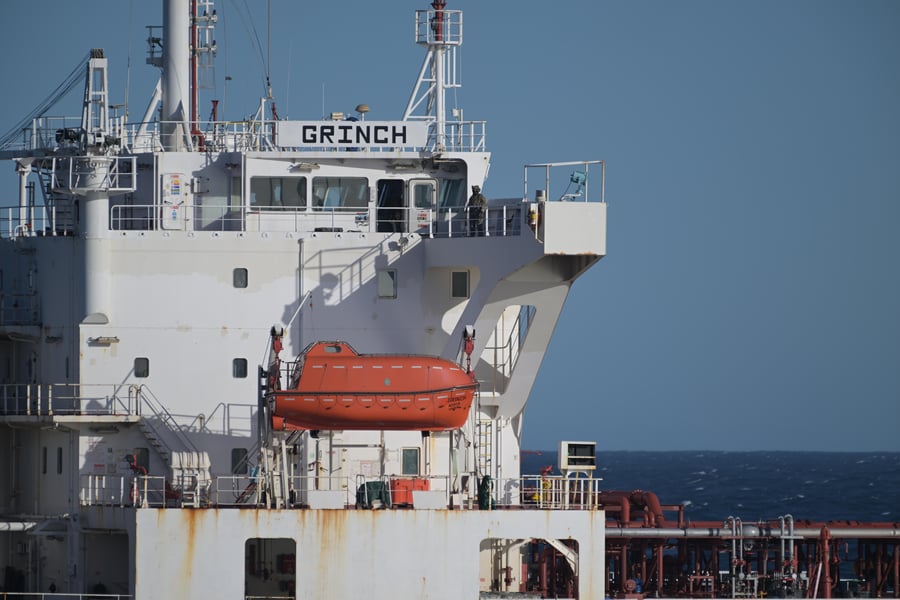
There is a gap in the public record that nobody has closed. In January, French naval forces diverted a tanker called the Grinch to Marseille after it sailed from Murmansk under a Comoros flag, an operation Al Jazeera reported at the time. The Grinch does not appear in the tally of four that Paris and European outlets were using in June. Whether it was renamed, reflagged, counted under a different category, or simply left out has not been explained, and the French navy has not been asked to explain it. It is a small thing. It also means the number everyone is quoting may be wrong.
The larger silence is louder. No flag state whose registry France has effectively declared fraudulent has brought a claim. Russia has not filed at the International Tribunal for the Law of the Sea or the International Court of Justice, either of which would force the question onto a record. Moscow has instead spent nine months escalating warnings about European military targets and issuing statements like Studennikov’s, which read well in Russian and do nothing in The Hague. A state that believed it had the better legal case would probably have gone and made it by now.