MANAMA — The number that CENTCOM publishes every few days is going up by about one a day. On Monday it stood at 71 commercial vessels redirected since the United States reimposed its naval blockade of Iranian ports. The two numbers alongside it have not moved in more than a week, and that is the more revealing part of the tally.
As of August 24, US Central Command said on X, its forces had redirected 71 commercial vessels, disabled three and boarded two to ensure compliance. More than 40 vessels supporting humanitarian aid have been allowed through.
Run the same statement back through August and the pattern is clean. On August 14 the count was 62 redirected, three disabled, two boarded. By August 20 it was 67 and three. On August 21, 68, three and two. On August 23, 70, three and two. Nine more ships turned around in ten days, and in that same period not one additional vessel was disabled and not one additional vessel was boarded.
What that describes is not an escalating campaign. It is a blockade that has stopped needing to use force, because masters are complying before it comes to that. A redirection costs the US Navy a radio call. Disabling a ship costs missiles, a legal justification and a diplomatic incident, and Washington has not paid that price since the beginning of the month.
The last time it did is documented. On August 11 a US Navy MH-60 Seahawk fired two Hellfire missiles into the Panama-flagged containership Vela Nova in the Gulf of Oman, destroying its engine and steering gear, in the first vessel disabled under the reimposed blockade. All the crew survived. Two weeks on, the disabled column still reads three, which means the Vela Nova and two others account for the entire kinetic record of the operation.
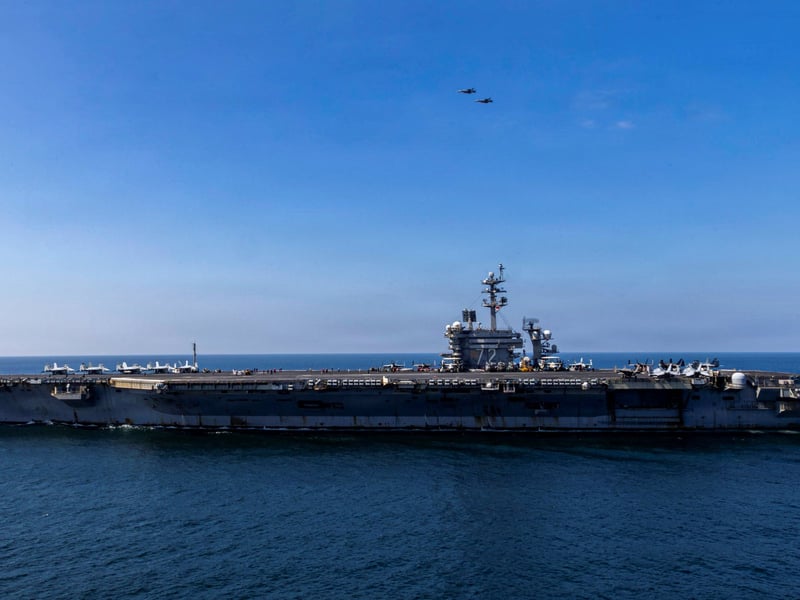
That also makes the figure hard to audit. CENTCOM is the only source for it. There is no independent tally of how many of the 71 were bound for Iranian ports, how many were carrying sanctioned cargo, or how many simply altered course when hailed and would have done so anyway. Nor has CENTCOM said what proportion of traffic in the area the 71 represents, which is the number that would show whether the blockade is comprehensive or merely conspicuous.
The humanitarian line has the same problem. More than 40 aid-supporting vessels allowed to pass sounds like a control, and it may be one. Without a figure for how many sought passage, or how long any waited, it establishes only that the number permitted is not zero.
How the blockade came back is a sequence of tit-for-tat that has been running since midsummer. On July 8, President Donald Trump declared the ceasefire reached with Iran in June no longer in effect, and American strikes resumed. CENTCOM said it was responding to Iranian action against commercial vessels transiting the Strait of Hormuz. Tehran struck US bases across the region and accused Washington of breaking the agreement first. On July 12 Iran announced it was closing the strait until American interference in the region ended. The following day Trump said the United States would become the strait’s guardian, and reinstated the blockade of Iranian ports.
Iran has since set out terms for reopening. Its security council published seven conditions, among them American war reparations, the lifting of sanctions and a full military withdrawal, none of which Washington has shown any sign of considering. The 60-day memorandum that was supposed to produce a settlement expired on August 17 with the two sides further apart than when they started.
So the blockade is doing what it was set up to do, in the narrow sense, and it has become the default condition rather than a measure with an endpoint. Nobody in Washington has said what would cause it to be lifted, and Tehran’s stated conditions for reopening the strait are not ones any American administration would meet.
The economic reading of that is already visible in the oil price, which has spent the summer well above where it began the year. The strategic reading is harder. A blockade sustained by compliance is cheap to run and easy to prolong, which is exactly what makes it a poor instrument for forcing a decision. It generates pressure without generating a deadline, and Iran has shown no sign of treating open-ended pressure as a reason to concede.
What CENTCOM has not published is the thing that would answer the question. It reports what it has done to ships. It has not reported what has stopped reaching Iran as a result, in barrels or tonnes or dollars, and until it does, 71 is a measure of activity rather than of effect.